Gyeongsangnam-do has announced the amount of damage and restoration costs resulting from the extreme heavy rain in July, pledging to carry out swift recovery efforts and take measures to prevent recurrence.
On the 19th, Gyeongsangnam-do held a briefing at the provincial government press center and stated, "According to the results of the central government’s joint investigation, the damage caused by the torrential rains in the province from July 16 to 20 has been confirmed at 517.7 billion won, with restoration costs totaling 1.1947 trillion won."
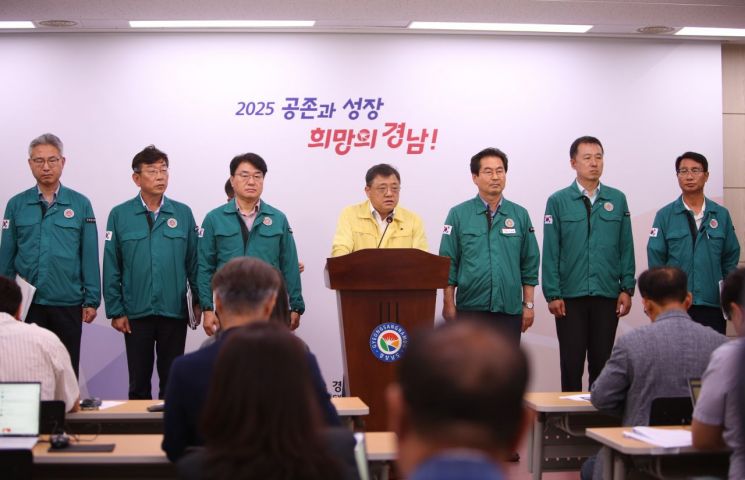 Park Myungkyun, Deputy Governor of Gyeongnam Province, is announcing the restoration costs and recovery plans for the heavy rain damage. Photo by Lee Seryung
During this period, heavy rainfall was concentrated in the western inland areas, with Sancheong County recording 632mm, Haman County 583.5mm, Hapcheon County 532.2mm, Changnyeong County 374mm, and Hadong County 369.5mm. In particular, Dansung-myeon in Sancheong County experienced downpours exceeding 101mm per hour.
Landslides, river flooding, and inundation caused by the heavy rain led to 14 deaths, 1 missing person, and 4 serious injuries in Sancheong County alone.
There were 2,602 cases of damage to public facilities and 16,086 cases of private property damage recorded.
By region, Sancheong accounted for the largest share, with damages totaling 327.1 billion won, or 63.2% of the province’s total. Hapcheon followed with 108.4 billion won, making up 20.9% of the total.
This year’s natural disaster restoration costs in Gyeongsangnam-do are the largest in 22 years since Typhoon Rusa in 2022 (1.9 trillion won) and Typhoon Maemi in 2003 (3.2 trillion won). The province has secured 977.1 billion won of the total restoration budget.
Gyeongsangnam-do plans to allocate 1.095 trillion won for the restoration of public facilities and 99.7 billion won for the restoration of private facilities.
The province will pursue a mid- to long-term recovery plan that combines "functional restoration," which focuses on restoring original functions, and "improvement restoration," which enhances disaster prevention capabilities to prevent future disasters of similar scale. Functional restoration will be completed before next year’s rainy season, and major improvement restoration works will also be finished within the same timeframe as much as possible.
The public facility restoration plan includes comprehensive district-level restoration and improvement projects, such as reinforcing river embankments, expanding drainage pump stations, and developing a relocation complex in Sangneung Village, Sancheong, with 513 billion won allocated across 21 districts.
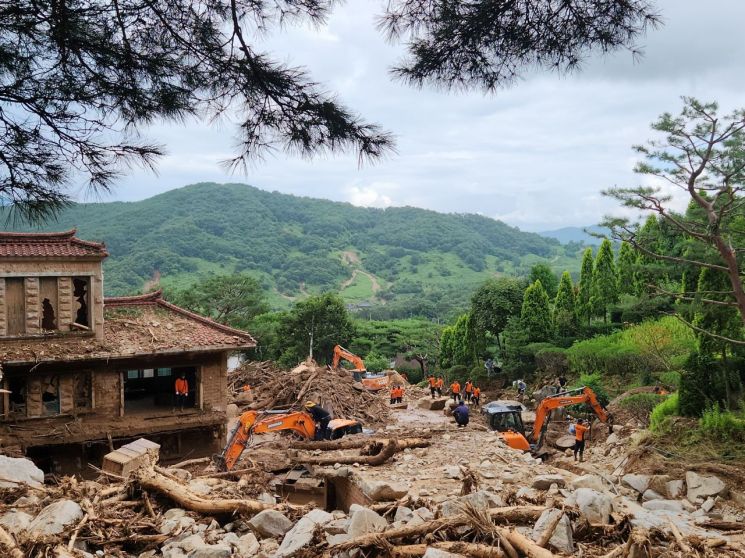 Search operations for missing persons are underway in a village in Sancheong County devastated by heavy rain. Provided by Gyeongnam Province
First, the province will invest a total of 427.3 billion won in 16 local rivers, including Yangcheon and Hogaecheon, to implement improvement restoration projects that will enhance disaster prevention functions through structural reinforcements such as river widening and embankment strengthening.
Additionally, since the land in Sangneung Village, Saengbiryang-myeon, Sancheong County, became uninhabitable due to ground subsidence caused by the extreme rainfall, the province plans to build a 15,000-square-meter residential complex at a total cost of 30.5 billion won to relocate 13 households (16 residents).
For the original Sangneung Village site, the province will remove earth and sand, demolish houses, create sedimentation basins, maintain drainage channels, and install slope protection to prevent secondary damage, as well as restore public facilities such as roads and small rivers.
An additional 95.9 billion won will be invested to restore landslide-affected areas, including the construction of erosion control dams.
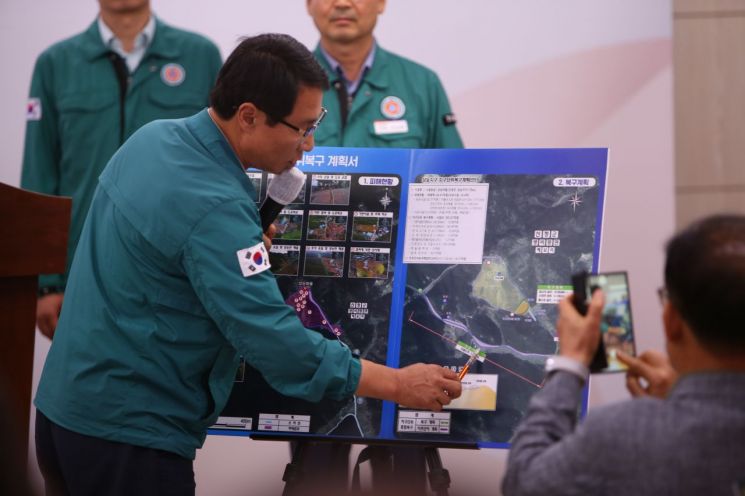 A Gyeongnam Province official is explaining the relocation complex development plan for Sangneung Village in Saengbiryang-myeon, Sancheong-gun. Photo by Lee Seryeong
For households whose homes were completely destroyed by the torrential rains, the province will provide an additional 60 million won on top of the existing government support of 22 to 39 million won.
For households with partially destroyed homes, an additional 30 million won will be provided, bringing the total support to 41 to 50 million won.
For policyholders of disaster insurance, an additional 32 million won will be provided based on estimated insurance payouts, and for households with flooded homes, the province will add 3.5 million won to the existing wallpaper and flooring support, as well as an additional 3.5 million won for compensation of damaged appliances and household goods.
For crop and forest damage, the province will adjust unit prices for major affected items and increase the support rate to 100%, double the previous rate, for agricultural, livestock, forestry, and fisheries facilities from 35% to 45%, and for agricultural machinery, up to 50% for all types.
For small business owners affected by the heavy rain, the province will add 5 million won, including 2 million won from the disaster relief fund, to the existing support, for a total of 10 million won.
Park Myungkyun, Deputy Governor, who made the announcement, stated, "We will accelerate the restoration projects to prepare for typhoons and the rainy season this year and next year," adding, "We will do everything possible so that residents affected by the heavy rain can quickly regain stability and return to their daily lives."
He also added, "Our province, together with related agencies such as the fire department and police, is doing its utmost to search every part of the region for missing persons. Although there are some limitations due to the prolonged search, we will proceed in consultation with the bereaved families."
© The Asia Business Daily(www.asiae.co.kr). All rights reserved.
![Clutching a Stolen Dior Bag, Saying "I Hate Being Poor but Real"... The Grotesque Con of a "Human Knockoff" [Slate]](https://cwcontent.asiae.co.kr/asiaresize/183/2026021902243444107_1771435474.jpg)


















