Digital Literacy Survey Reveals
8.2% of Korean Adults Struggle with Basic Digital Device Operations
'Turning on a navigation app to find directions, booking train tickets or movie tickets through an app, transferring money, ordering food at a kiosk, checking information via KakaoTalk...'
These are representative activities in daily life that involve operating digital devices.
The Ministry of Education conducted a survey to assess the digital literacy level of adults in South Korea, targeting 10,000 adults aged 18 and older nationwide in areas such as 'basic digital usage, digital information utilization, digital communication, and digital-based problem solving.' The results showed that one in four adults struggles to use digital devices or technologies in everyday life.
According to the results of the '1st Adult Digital Literacy Survey' announced by the Ministry of Education on August 19, adults classified as 'Level 1,' who have difficulty with basic digital device operations in daily life, accounted for 8.2% of the total (approximately 3.5 million people).
Adults classified as 'Level 2,' who have basic understanding and can operate devices but are insufficient in applying them to daily life, made up 17.7% (about 7.58 million people). In total, about 25.9% of adults are not proficient in utilizing digital devices or technologies.
This digital literacy gap was pronounced depending on region, educational background, income, and age.
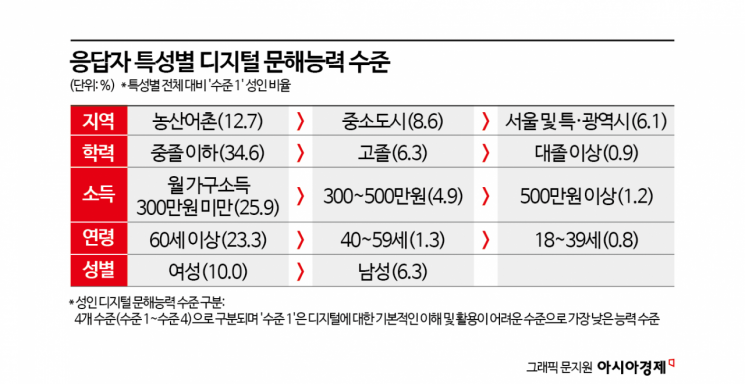
The proportion of 'Level 1' individuals was higher among women than men, increased with age, was higher in rural and fishing villages than in cities, and was relatively higher among those with lower education or income levels.
In particular, among adults aged 60 and older, 2 out of 10 (23.3%) fell into this category. Among those with a middle school education or less, 3 out of 10 (34.6%) were in this group, and for those with a monthly household income below 3 million won, 3 out of 10 (25.9%) lacked basic digital understanding and experience, making daily life challenging.
In contrast, among the younger population aged 18 to 39, only 0.8% were classified as 'Level 1' in digital literacy.
Among respondents, 29.9% said that 'digital literacy education programs for adults are necessary.' Of these, 62.1% expressed willingness to participate if such programs were available, indicating a strong desire to improve digital literacy. The most common reason for wanting to participate in digital literacy education was 'to adapt quickly to the changing world and boost self-confidence' (77.6%), followed by 'to resolve inconveniences in daily life' (70.9%), and 'to prepare for starting something new (changing jobs, starting a business, finding employment)' (17.8%).
Based on the survey findings that the proportion of 'Level 1' adults is higher with increasing age, in rural areas compared to cities, and among those with lower education or income, the Ministry of Education plans to further strengthen support for artificial intelligence (AI) and digital lifelong education for adults.
First, through the mobile digital literacy education program 'Hangeul Haetsal Bus,' the ministry will support adults with limited access to literacy education so they can easily learn how to use digital devices and technologies near their place of residence.
In addition, by collaborating with private companies and public institutions, the ministry plans to secure learning venues such as banks and stores, and enhance digital problem-solving skills in daily life through field practice and hands-on experiences.
Furthermore, the ministry will work to reduce disparities in participation in AI and digital lifelong education caused by social and economic conditions by providing lifelong education vouchers for low-income adults and seniors (aged 65 and older), as well as digital lifelong education vouchers (AID Career Jump Pass) for adults aged 30 and older.
Choi Eunok, Vice Minister of Education, stated, "Through this first Adult Digital Literacy Survey, we were able to closely examine the scale and characteristics of adults who have difficulties using digital devices and technologies," adding, "The Ministry of Education will actively support adults who are not familiar with digital devices and technologies so that they are not left behind and can continue their daily lives, even in a rapidly changing digital environment."
© The Asia Business Daily(www.asiae.co.kr). All rights reserved.
![Clutching a Stolen Dior Bag, Saying "I Hate Being Poor but Real"... The Grotesque Con of a "Human Knockoff" [Slate]](https://cwcontent.asiae.co.kr/asiaresize/183/2026021902243444107_1771435474.jpg)
















