On August 19, the Nihon Keizai Shimbun (Nikkei) reported that a U.S. Department of Defense official positively assessed South Korea's efforts to increase its defense budget, while expressing a negative view toward Japan.
The official stated, "With the new government, South Korea is expected to make progress on the defense budget issue," adding that Japan is the only country showing a passive stance.
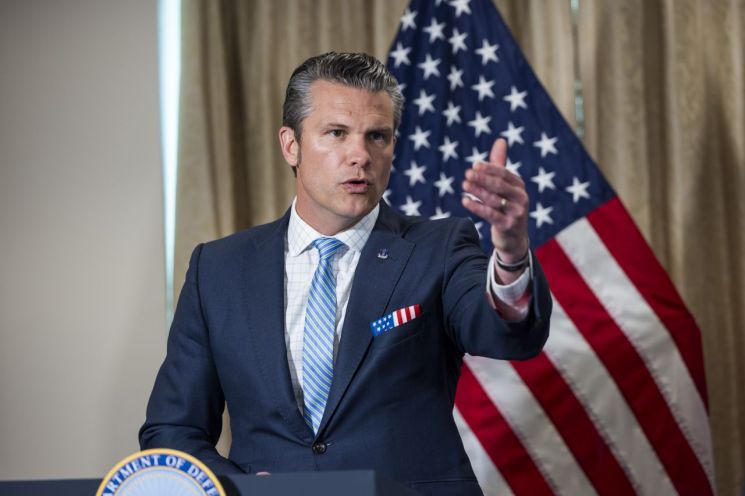
Regarding Japan, the official pointed out, "They have repeatedly expressed deep concern that the security environment has deteriorated dramatically," and added, "Nevertheless, it is very strange that they claim there are constitutional constraints limiting Japan to only rear-area support for the United States."
While Nikkei did not provide further details on these remarks, it reported that the United States views allies such as South Korea, Australia, Germany, and Canada as generally aligning with the Trump administration's approach.
Japan aims to raise its defense budget to 2% of its gross domestic product (GDP) by the 2027 fiscal year (April 2027 to March 2028). However, the U.S. Department of Defense official commented, "Although Japan's defense budget has improved compared to the past, it is clearly insufficient given the current security environment."
For fiscal year 2025, Japan's defense-related budget stands at about 1.8% of GDP (9.9 trillion yen), but the United States has reportedly called for this to be increased to 3.5%.
Since the launch of the second Donald Trump administration, the U.S. Department of Defense has been negotiating with defense authorities in Europe and Asia, demanding increased defense spending from allied countries. Previously, NATO member states such as Germany and Canada agreed to allocate 5% of their GDP to defense spending (3.5%) and indirect costs (1.5%).
The United States is also urging its allies in the Indo-Pacific region to strengthen their defense capabilities to counter China. In a spokesperson's statement issued last June, the U.S. called on Asian allies to increase their defense budgets in line with NATO's new targets.
The German government under Friedrich Merz has enacted constitutional amendments to ease debt limits, allowing for a significant increase in defense spending. Referring to Germany, the U.S. Department of Defense official emphasized, "If you take security seriously, you must be able to adapt accordingly, and you must do so." This is interpreted as meaning that it is not reasonable for the Japanese government to refuse to increase its defense budget on constitutional grounds.
He stated, "Expecting Japan to fulfill its role for national defense and collective self-defense is not a one-time demand." He added, "This is also the result of listening to the Japanese government's position," and emphasized, "We need to approach this situation rationally."
Meanwhile, according to the Asahi Shimbun, Japan's Ministry of Defense is in the final stages of considering a record-high budget of 8.8 trillion yen for the 2026 fiscal year.
© The Asia Business Daily(www.asiae.co.kr). All rights reserved.

















