Sampling and Analysis Time Reduced from 3.5 Days to Same-Day
Joint Investigation with Private Experts to Restore Public Trust
The Ministry of Environment is set to overhaul the water quality management system of the Nakdong River. By switching to a method that collects samples directly near water intake points and analyzes them on the same day, the ministry aims to improve both the speed and accuracy of its response to green algae blooms. A comprehensive plan, including measures to block livestock manure, is also scheduled to be established within the year.
On the 19th, Minister of Environment Kim Sungwhan announced these improvements to the green algae inspection method and the management of microcystin, a toxic substance produced by green algae, at the Government Sejong Complex. Minister Kim stated, "We will adjust the sampling locations for the algae alert system currently operated at four points on the Nakdong River (Haepyeong, Gangjeong-Goryeong, Chilseo, and Mulgeummaeri) from 2 to 4 kilometers upstream of the intake points to within 50 meters of the raw water intake." This measure addresses, for the first time in 13 years, the controversy over "water quality information not matching field conditions" that arose from the gap between intake points and sampling sites since the completion of the Four Major Rivers Project in 2012.
Until now, it took an average of 3.5 days from sample collection to analysis and alert issuance, so samples were collected in advance from upstream. Going forward, however, on-site mobile analysis vehicles and the Nakdong River Water Environment Center of the National Institute of Environmental Research will be used to immediately measure cyanobacteria cell counts and other indicators, making it possible to issue alerts on the same day.
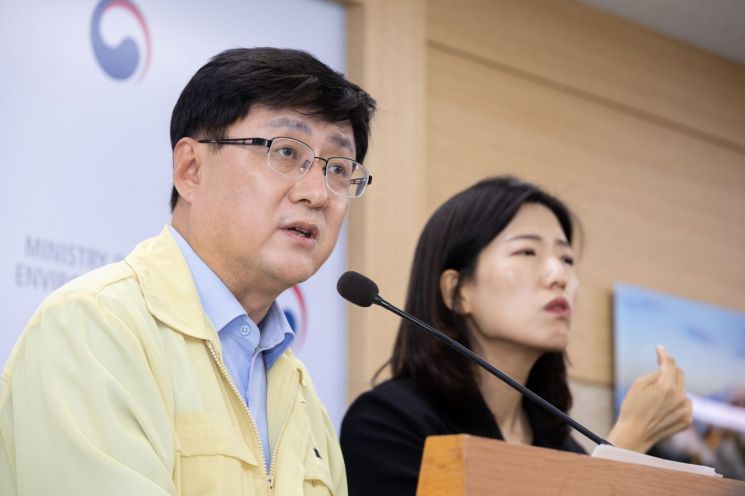 Kim Sungwhan, Minister of Environment, is holding a press briefing on the method of green algae water quality inspection and the reorganization of information disclosure at the Ministry of Environment press room in the Government Sejong Complex on the 19th.
The algae alert system, introduced in 1998, operates at 28 water sources and 8 recreational water activity zones. Currently, for water sources, an "Attention" alert is issued if there are 1,000 or more harmful cyanobacteria cells per 1 ml sample, a "Caution" alert at 10,000 or more cells, and a "Bloom" alert at 1 million or more cells. For recreational water activity zones, the "Attention" and "Caution" alerts are issued at 20,000 and 100,000 cells or more, respectively. The Ministry of Environment plans to add a standard reflecting the concentration of algal toxins (microcystin) through a legal amendment within the year.
To address public health concerns related to green algae, the ministry will also expand its monitoring scope to include drinking water, agricultural products, and airborne algal toxins. In cooperation with the Ministry of Agriculture, Food and Rural Affairs and the Ministry of Food and Drug Safety, the safety of agricultural products cultivated in areas with high concentrations of green algae will be investigated, and research on the inhalation toxicity of airborne algal toxins will begin in the second half of the year. To address the ongoing controversy with environmental groups over the detection of airborne algal toxins, the ministry will resume joint investigations to ensure credibility.
The Ministry of Environment will also implement pollution source control measures such as expanding facilities to reduce non-point source pollution from livestock farms and agricultural land, increasing biogas facilities for livestock manure, and strengthening discharge standards for public sewage treatment plants. In addition, a separate plan for the ecological restoration of the Four Major Rivers, including the Nakdong River, will be developed and implemented in stages.
Minister Kim stated, "To resolve public distrust, we will transparently disclose the investigation process from the sample collection stage and conduct joint investigations with private experts." He added, "In particular, we will establish a comprehensive plan centered on the Nakdong River, which supplies drinking water to 13 million people, and lay the foundation for a fundamental solution within the term of the Lee Jaemyung administration."
© The Asia Business Daily(www.asiae.co.kr). All rights reserved.

















