Electric Vehicle Sales Surpass 26,000 Units, Reaching 18.5% of Domestic Market
Eco-Friendly Vehicles Account for 55% of Domestic Sales, Establishing a Majority Share
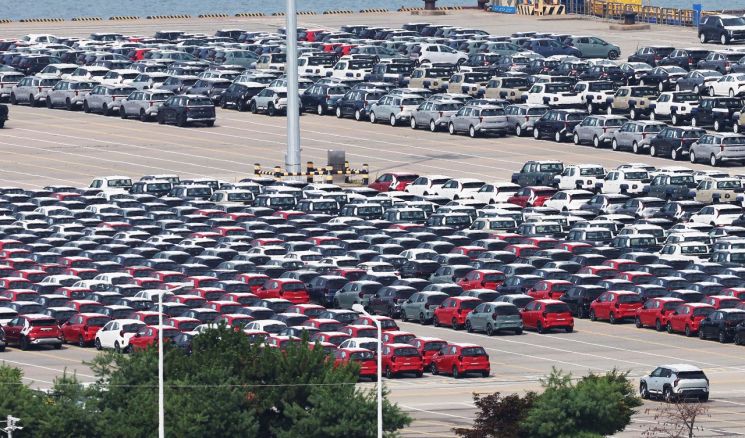
In July of this year, South Korea's automotive industry saw increases in exports, domestic sales, and production compared to the same month last year, marking a smooth start to the second half of the year. In particular, domestic sales of electric vehicles reached an all-time high, accelerating the transition to eco-friendly vehicles.
According to the Ministry of Trade, Industry and Energy on the 19th, last month automobile exports reached 212,000 units, up 5.8% from a year earlier, while domestic sales rose 4.6% to 138,000 units. Production increased by 8.7% to 316,000 units. Export value also climbed 8.8% year-on-year to $5.83 billion.
Domestic sales of electric vehicles surged 69.4% year-on-year to 25,568 units. Their share of total domestic sales also hit a record high at 18.5%. Total sales of eco-friendly vehicles reached 77,000 units, accounting for 55.3% of all domestic sales, surpassing the halfway mark for the second time after first doing so in May. Hydrogen vehicles also saw a 161.3% increase year-on-year, with 1,045 units sold, driven by the launch of the new Nexo.
In July, automobile exports to the US market fell by 4.6%, while exports to the European Union (EU, up 32.7%), other European countries (up 78.7%), and Asia (up 34.6%) increased significantly. Notably, exports of eco-friendly vehicles and used cars surged in Germany (up 67.9%), Sweden (up 215.0%), and Turkiye (up 471.7%). However, exports to the Middle East dropped by 13.8% due to the ongoing Israel-Iran conflict.
Exports of eco-friendly vehicles rose 17.0% to 68,000 units, with hybrid and plug-in hybrid vehicles continuing their strong performance. Electric vehicle exports increased for the second consecutive month to 20,000 units, but the export value declined by 4.1% due to a higher proportion of entry-level models.
Looking at production by company, Hyundai Motor produced 138,000 units and Kia produced 126,000 units. Thanks to a base effect from last year's wage negotiations, GM Korea recorded a 59.9% year-on-year increase to 31,000 units. Renault Korea also showed signs of recovery, producing more than 10,000 units-more than double the previous year's figure.
The government assessed that the conclusion of South Korea-US automobile and parts tariff negotiations at the end of July has significantly reduced uncertainties surrounding exports to the US. An official from the Ministry of Trade, Industry and Energy stated, "We will continue to provide multifaceted support, including financing, technology development, and pioneering new markets, so that the domestic automotive industry can quickly adapt to the changing trade environment and secure growth momentum."
© The Asia Business Daily(www.asiae.co.kr). All rights reserved.

















