Overcoming Performance Limits of PbS Quantum Dot Solar Cells
with Cost-Effective SnO2 Surface Passivation
Achieving World-Class Power Conversion Efficiency and Stability
On August 19, it was announced that a joint research team led by Professor Ko Minjae of Hanyang University and Dr. Yoo Hyunggeun of the Korea Institute of Science and Technology (KIST) has overcome performance limitations by applying a surface treatment technology to cost-effective tin dioxide (SnO₂) materials, achieving a world-class power conversion efficiency (PCE) for lead sulfide (PbS) quantum dot solar cells.
 From the left) Professor Go Minjae of Hanyang University, Dr. Yoo Hyunggeun of KIST, Dr. Kim Wooyeon of Hanyang University, Dr. Lim Chanwoo of KIST. Hanyang University
Quantum dots are semiconductor crystals just a few nanometers (nm) in size, whose optoelectronic properties can be freely tuned according to particle size. In particular, PbS quantum dots can absorb and emit light in the infrared region, making them applicable to a variety of next-generation optoelectronic devices such as solar cells, infrared cameras, and night vision goggles.
In this context, the performance of the electron transport layer, which efficiently collects and transfers electrons generated by light, is a key factor. While tin dioxide has attracted attention as an electron transport layer material due to its high transparency and electrical conductivity, its performance in quantum dot devices has been lower than that of zinc oxide (ZnO), limiting its use.
The research team identified that the cause was "interfacial degradation reactions," such as the detachment of quantum dot surface ligands and lead oxidation, resulting from proton emission on the SnO₂ surface.
Furthermore, they introduced a "surface passivation" technique by treating the SnO₂ surface with molecules containing both carboxyl (-COOH) and thiol (-SH) groups simultaneously.
As a result, harmful reactions were suppressed and charge extraction efficiency was improved, enabling the solar cell to achieve a power conversion efficiency of 12.7%, significantly surpassing conventional ZnO-based devices (10.4%). In addition, the device maintained 90% of its initial efficiency for over 100 days even without encapsulation, demonstrating outstanding stability.
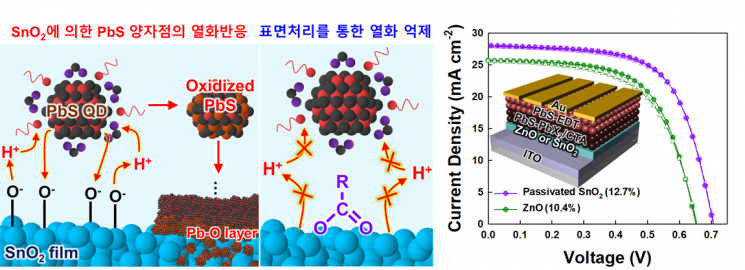 Degradation process of PbS quantum dots (first image on the left) and the passivated surface (second image on the left), performance improvement graph of the applied device. Hanyang University
Professor Ko explained, "This research is significant in that it opens the way for utilizing cost-effective tin dioxide in high-performance quantum dot devices."
This study was supported by the National Research Foundation of Korea and was published as a cover article in the internationally renowned journal in the field of energy and chemistry, 'ACS Energy Letters,' on August 8.
© The Asia Business Daily(www.asiae.co.kr). All rights reserved.


















