Wage Gap and Talent Outflow Are the Main Causes of R&D Personnel Shortages for Local Companies
Busan Chamber of Commerce and Industry:
"Policy Support Needed to Secure Top Talent and Bridge Wage Disparities"
Why are local companies unable to secure research and development personnel? As expected, survey results pointed to wage levels and talent outflow as the main reasons.
Amidst the rapidly changing global business environment-characterized by digital transformation, the spread of eco-friendly practices, and the strengthening of protectionism-enhancing research and development competitiveness is essential for the survival of local companies. However, it has been found that wage gaps and talent outflow are causing significant difficulties in securing R&D personnel.
The Busan Chamber of Commerce and Industry (Chairman Yang Jaesaeng) announced on August 19 the results of a survey on the "Mismatch Status of R&D Personnel in Busan's Manufacturing Companies," which targeted 200 local manufacturing companies with R&D capabilities and 200 science and engineering students from universities in the Busan area.
According to the survey, 53.5% of local companies responded that the current supply of R&D personnel is "adequate." However, they projected that a shortage of R&D personnel could arise if demand increases due to expanded government R&D budgets and improvements in the business climate of key industries.
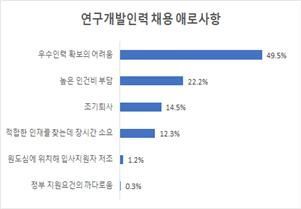
The greatest difficulty in recruiting R&D personnel was the challenge of securing top talent (49.5%). This is mainly attributed to the outflow of personnel to the Seoul metropolitan area, where expected wage levels and working conditions are better. This was followed by the burden of high labor costs (22.2%) and early resignations (14.5%).
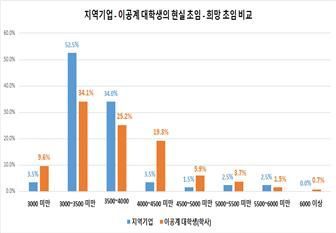
A comparison between the actual starting salaries offered by local companies and the desired starting salaries of science and engineering students showed a disparity: 90% of local companies pay less than 40 million won as the starting salary for R&D personnel, while 31% of local science and engineering students hope for a starting salary of 40 million won or more.
Additionally, while local companies value industry experience such as hands-on work, relevant majors, and completed training, local science and engineering students place greater emphasis on working conditions, such as salary and work-life balance (adherence to working hours), highlighting a significant perception gap in the hiring process.
Although the government is implementing support measures to alleviate the imbalance in the supply and demand of R&D personnel, the effectiveness of industry-academia cooperation and recruitment-linked support measures is somewhat lacking. Furthermore, policies for nurturing R&D personnel tailored to local SMEs and universities are insufficient.
To resolve the mismatch in R&D personnel, local companies have called on the government to: ▲ supply more top R&D talent, ▲ strengthen support for R&D labor costs, ▲ expand support for industry-academia cooperation projects, and ▲ reinforce measures to prevent the outflow of local talent.
A representative from the Busan Chamber of Commerce and Industry’s research team stated, "To strengthen the R&D capabilities of local small and medium-sized enterprises, policy support to secure outstanding talent is essential." The representative emphasized, "In particular, it is necessary to provide labor cost support to narrow the gap between actual and expected wages-which is the biggest obstacle in R&D recruitment for local companies-and to expand industry-academia cooperation linked with recruitment, in order to create an environment where talent can settle in the region."
© The Asia Business Daily(www.asiae.co.kr). All rights reserved.



















