President Lee Heads into Summit with Trump Tonight
"I Will Do My Utmost to Safeguard National Interests"
"Future-Oriented Strategy for U.S. Forces Korea Is Necessary"
President Lee Jaemyung, who is currently visiting the United States following his trip to Japan, stated on the 24th (local time) ahead of the South Korea-U.S. summit with U.S. President Donald Trump, "It is true that there have been requests from the U.S. side regarding the flexibilization of the U.S. Forces Korea, among other things, but for us, it is a difficult issue to agree to easily." He added, "However, discussions on the future-oriented strategization of the U.S. Forces Korea are also necessary from our side." President Lee continued, "The meaning of certain terms asserted by both sides is slightly different, and adjusting these differences is part of the negotiation process. Contrary to what some might think, the atmosphere is not particularly hostile."
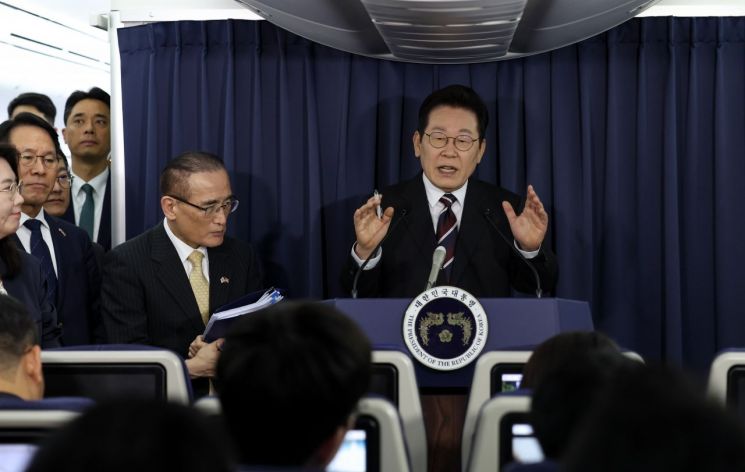
President Lee held an impromptu press briefing onboard his private jet en route from Haneda Airport in Japan to Washington D.C., sharing his views on key issues. Regarding the progress of the tariff negotiations, which is a major point of contention, President Lee said, "Ultimately, we will reach a realistic and reasonable conclusion." He added, "The process is very challenging. However, knowing that it will be difficult allows us to prepare in advance, so I will do my best."
President Lee remarked, "As countries are increasingly prioritizing their own interests in diplomacy, it seems that we need to make several times more effort than before to protect our national interests." He continued, "It is difficult to ensure that our national interests are not compromised in situations where it is impossible to meet all the demands of the other side." President Lee emphasized, "My job is to protect the national interests of the Republic of Korea and to create a better situation, and I believe that is what will happen. I will do my utmost."
On the afternoon of the same day, President Lee entered the United States via Andrews Air Force Base near Washington D.C., beginning his three-day summit schedule. He plans to stay at a hotel near the White House instead of the official guest house, Blair House, which is currently under renovation.
Prior to the summit, working-level officials from the South Korean government have been holding ongoing consultations in preparation for the South Korea-U.S. summit. Minister of Foreign Affairs Cho Hyun, Minister of Trade, Industry and Energy Kim Jeonggwan, and Trade Negotiations Head Yeo Hankoo, among others, arrived in Washington D.C. ahead of President Lee and are coordinating the final agenda on trade and security issues between the two countries. Unusually, during the summit, the three top aides from the presidential office-Chief of Staff Kang Hoonshik, Policy Chief Kim Yongbeom, and National Security Chief Wi Sunglak-will all be present to assist President Lee.
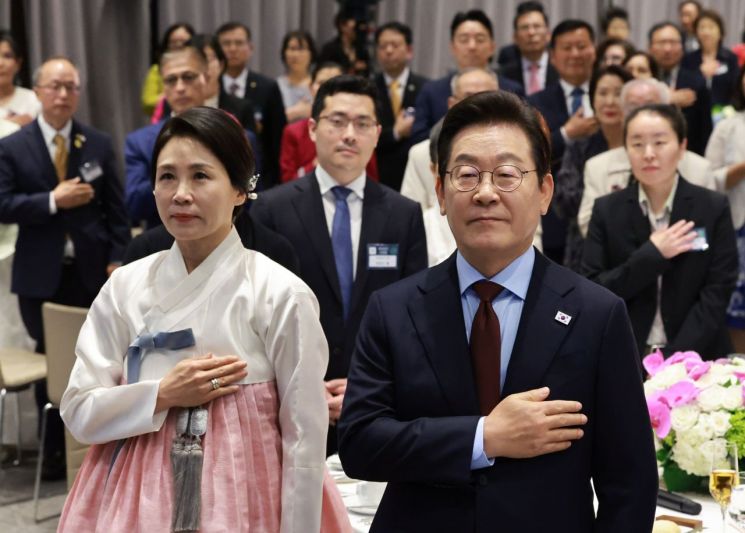
President Lee predicted that the outcome of this South Korea-U.S. summit would ultimately be a realistic and reasonable conclusion. He questioned, "Isn't President Trump the most successful individual in the United States? If he had acted as carelessly as some people claim, how could he have succeeded?" President Lee also referenced one of President Trump's books.
Regarding the perception among some in the U.S. political sphere that President Lee is "pro-China," he responded, "If it benefits the national interest, we maintain close relations; if it does not, we keep our distance." He added, "There is no such thing as pro-China or anti-China in diplomacy. The Republic of Korea is not a country that can survive by engaging in diplomacy with only a select few nations," dismissing the characterization.
President Lee also stated that, if possible, issues related to North Korea policy could be brought to the table for discussion. He said, "Whether it is the North Korean nuclear issue or any matter concerning North Korea, anything related to peace and stability on the Korean Peninsula is the most important security issue for the Republic of Korea." He continued, "Regardless of who brings it up first, I believe we should try to open a path for dialogue on North Korea policy." He also reiterated that the "complete denuclearization" of North Korea, as included in the joint press statement following the South Korea-Japan summit, is ultimately the path that must be taken.
On the other hand, if the issue of non-tariff barriers in the agricultural and livestock sectors-which was not conclusively resolved in last month's mutual tariff negotiations-comes up for discussion, President Lee plans to firmly reiterate his opposition. He stated, "The mutual tariff announcement was made directly by the U.S. President, and the contents were determined through mutual approval by the Presidents of Korea and the United States. We cannot simply agree to change it unilaterally." He emphasized, "It is not desirable to easily overturn or change an agreement."
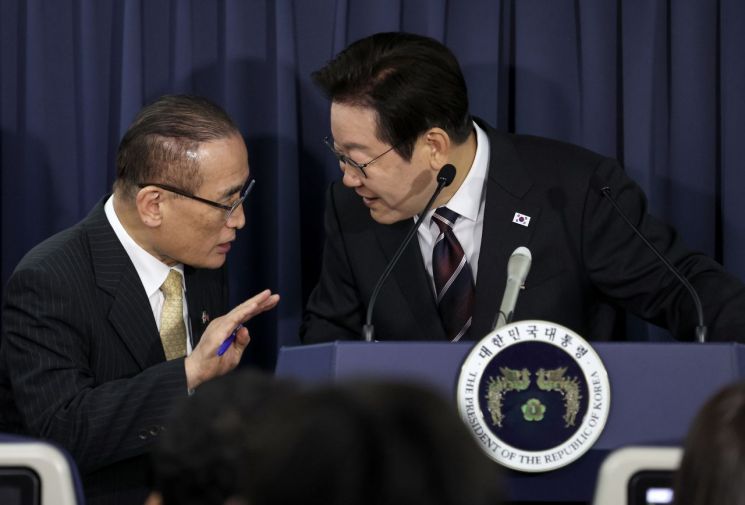
President Lee explained, "Japanese Prime Minister Ishiba Shigeru provided a great deal of friendly advice regarding the U.S. tariff negotiations," adding, "He specifically promised to cooperate in detail on what to be cautious about and what advantages there might be for Korea in negotiating with the United States. As a result, the small-group meeting lasted longer than expected."
Meanwhile, ahead of the South Korea-U.S. summit, both the ruling and opposition parties urged that discussions be held to ensure that the opening of the agricultural and livestock markets does not disadvantage Korean agriculture. On the 25th, a ruling party lawmaker on the National Assembly's Agriculture, Food, Rural Affairs, Oceans and Fisheries Committee told Asia Economy, "I suspect there will be requests to ease non-tariff barriers related to quarantine in the agricultural sector," adding, "It would be impossible to take measures that bypass quarantine procedures specifically for the United States. I trust the President will handle this well."
Opposition lawmakers also insisted that the talks should be focused on the national interest and that concerns about the opening of the agricultural and livestock markets should be dispelled. An opposition lawmaker on the same committee told Asia Economy, "Previous administrations have always given up agriculture first while prioritizing other industries. We are closely monitoring to ensure the principles maintained in the first round of negotiations are upheld." He continued, "There is a high possibility that quarantine-related issues will come up, but since this is a matter of public health beyond agriculture, it cannot be conceded as a negotiation card. It is something that must be protected."
Song Eonseok, Emergency Committee Chairman and Floor Leader, stated at a press briefing the previous day, "Chief Wi said, 'It is true that there are requests from the United States for further opening of the agricultural market,' which is very concerning." He added, "After President Trump's social media post, the People Power Party raised concerns about this issue, but the government has repeatedly told us not to worry without providing a clear explanation."
Chairman Song emphasized, "The public demands that the promise of no further opening of the agricultural and livestock markets be kept, without wavering in the face of U.S. demands." He appealed, "As the President of the Republic of Korea, President Lee must protect our national interest and dignity at the South Korea-U.S. summit."
© The Asia Business Daily(www.asiae.co.kr). All rights reserved.



















