Relative Evaluation Maintained: Students Choose Subjects Based on Grades, Not Aptitude
Overburdened Teachers Lead to Decline in Lesson Quality
Exposed to Grade Inflation and Falsified Records
"Abolish at Least the Minimum Achievement Level
Following the introduction of AI digital textbooks, calls are growing for a complete overhaul of the newly implemented "high school credit system" this year. On August 18, three major teacher organizations-the Korean Federation of Teachers’ Associations, the Korean Teachers and Education Workers Union, and the Korean Teachers’ Union-as well as Kim Youngho, Chair of the National Assembly’s Education Committee, Baek Seungah of the Democratic Party, Kang Kyungsook of the Innovation Party, and Jeong Seongguk of the People Power Party, held a forum at the National Assembly Members’ Office Building in Yeouido to discuss directions for improving the high school credit system. Critics argue that, under the current system, the original intent-to allow students to select courses and design their learning paths based on their career interests and aptitudes-has been lost, resulting in a decline in educational quality. They emphasize the need for reforms tailored to realities on the ground.
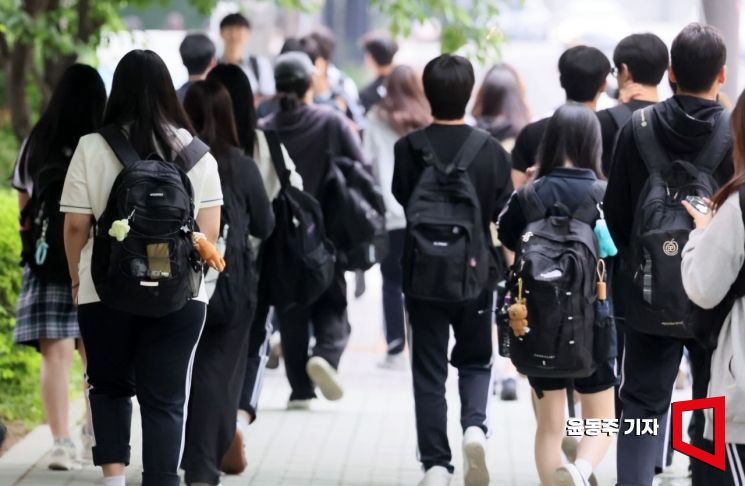
Originally Introduced as Absolute Grading, Now Distorted by Shift to Relative Grading
The high school credit system allows students to graduate upon completing 192 credits over three years. Discussions began at the end of the Park Geun-hye administration in 2016, and the Moon Jae-in administration pursued its implementation with the goal of launching in 2022. At that time, the system was designed to be introduced alongside "absolute grading." While common subjects would retain the existing rank-based grading (relative grading), elective subjects chosen under the credit system were to be evaluated with an achievement-based system (absolute grading).
However, as the implementation was delayed and the system was fully rolled out in the first semester of this year, the grading for elective subjects was also changed to relative grading. With the change from a nine-level to a five-level internal grading system, all subjects are now evaluated with both absolute grades (A-E) and relative grades (1-5). The credit system, originally designed around absolute grading, was introduced and implemented under a relative grading structure, causing confusion in schools. A high school teacher in Daegu noted, "When choosing subjects, students prioritize those where they can earn higher grades over those that match their interests or aptitudes." This is because it is harder to receive higher internal grades in subjects with fewer students.
Under the five-level internal grading system, only the top 10% of students can receive a grade of 1. The next 34% receive grade 2, the next 66% grade 3, up to 90% grade 4, and below 90% grade 5. If a grade has fewer than 100 students, fewer than 10 can receive a grade of 1. With the credit system, class sizes for each subject are even smaller, and in courses with 1-9 students, no one can receive a grade of 1. This means that, regardless of ability, it may be impossible to achieve the highest grade. As a result, there are concerns that the credit system, designed to expand students’ career and aptitude opportunities, may not be implemented as intended. One official involved in designing the system said, "With absolute grading, students can take the courses they truly want regardless of scores, but the shift to relative grading has distorted the system."
One Teacher Handles Four Subjects: "No In-Depth Lessons Possible"... "Choesungbo" System Should Be Abolished
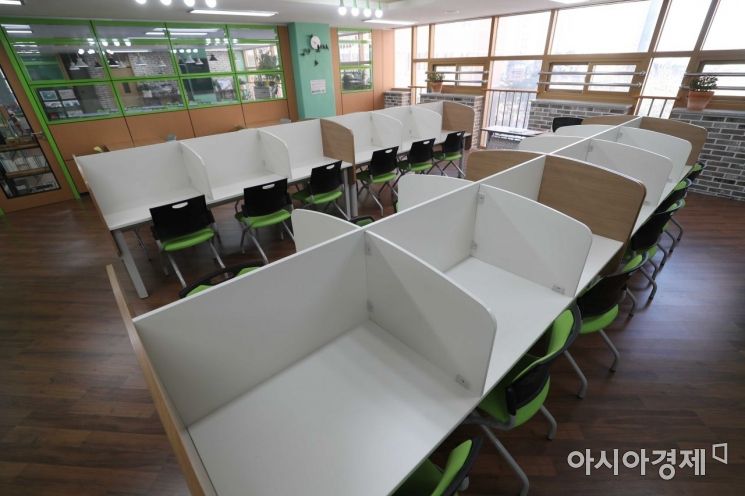 Photo material related to the implementation of the high school credit system at Galmae High School / Photo by Moon Honam munonam@
Teachers point out that having to handle more subjects under the credit system is lowering the quality of instruction. According to a survey conducted last month by the three teacher organizations among 4,162 teachers, 78.5% reported being responsible for two or more subjects. The proportion handling four or more subjects was 5.0%. As a result, 86.4% of respondents said, "It is difficult to prepare in-depth lessons for each subject, leading to a decline in lesson quality."
Preparing student records is also cited as an issue. Kim Jooyoung, a senior researcher at the Korean Federation of Teachers’ Associations, explained, "Because the credit system operates on a semester basis determined by credits rather than grade level, the amount of student record-keeping inevitably increases." He added, "It is impossible to write everything individually, so some teachers use AI programs." He further pointed out, "Education activities are being reduced to mere record-keeping."
The most contentious issues are the "non-completion system" and the "minimum achievement level guarantee guidance (Choesungbo)" system. Under the credit system, students must attend at least two-thirds of classes and achieve at least 40% academic achievement to earn credits. If they do not reach the minimum achievement level, they must receive supplementary instruction to make up for learning gaps. However, critics argue that this has led to a focus solely on "completing courses," resulting in unintended side effects.
Kim Heejeong, head of the high school credit system task force at the Teachers’ Union, said, "The non-completion and Choesungbo systems, introduced under the pretext of responsible education, have devolved into 'grade giveaways' and 'false record-keeping' to prevent students from being held back." She added, "Students who do not meet the standards often lose self-esteem during supplementary instruction and sometimes choose to drop out." She concluded, "To properly operate the credit system, at a minimum, the non-completion and Choesungbo systems should be abolished."
Students: "Early Career Pressure" and "Classroom Confusion"
Students cited pressure to make career decisions early, ongoing academic stress from relative grading, and the breakdown of classroom communities due to moving between classes as major issues. An Kiback, a student at Gaeseong High School who attended the National Assembly forum on August 18, said, "Many students have not yet had enough time to consider their career paths or aptitudes, but the credit system forces them to make these decisions when choosing courses." He added, "Since the system was implemented, the composition of classrooms and classmates changes with each class, so there are fewer opportunities to talk with friends from the same homeroom." He lamented, "School feels less like a place to learn together and more like a place to compete alone."
Students also pointed out the negative effects of maintaining relative grading. Gwak Donghyun, a student at Kaya High School, said, "If a subject is advantageous for internal grades, many students are virtually forced to choose it, regardless of their career interests." He added, "When moving between classes for each period, sometimes classmates are so tired they fall asleep, and others don’t even bother to wake them." He concluded, "The credit system is not being implemented as intended in schools at all," and requested, "Please address the root cause of the competitive structure."
An official from the Ministry of Education who attended the forum said, "We are actively reviewing the demands of teacher organizations, and going forward, we will listen to the opinions of teachers, students, and parents to develop practical improvement measures for the field."
© The Asia Business Daily(www.asiae.co.kr). All rights reserved.


















