Commercialization of Starlink and Eutelsat OneWeb Services
Entry into the Korean Market via KT SAT and SK Telink
LEO Satellite Value Expected to Grow in the 6G Era
Unlike traditional ground-based networks that rely on base stations, a communication network utilizing low Earth orbit (LEO) satellites orbiting at altitudes below approximately 2,000 km may begin service in South Korea as early as next month.
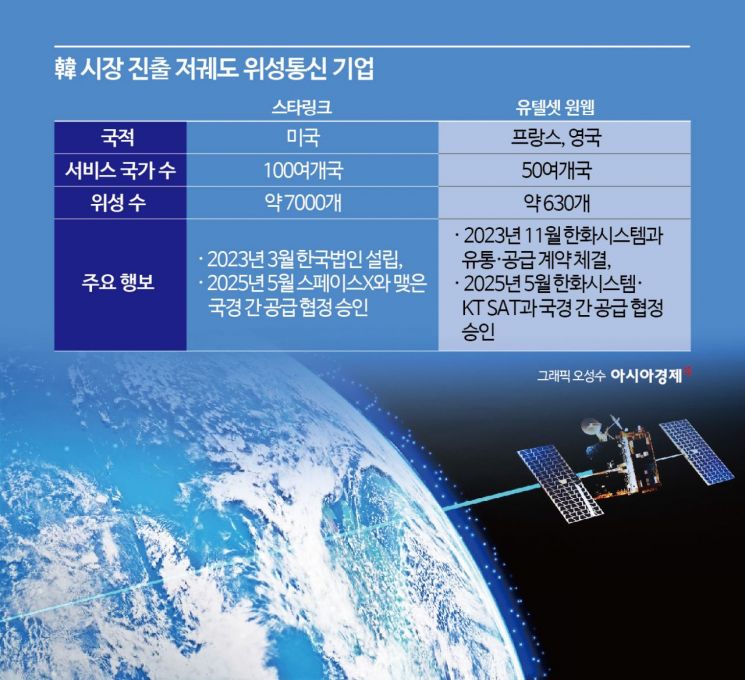
Leading LEO satellite communication companies, such as the US-based Starlink and Europe’s Eutelsat OneWeb, are on the verge of commercializing their services after completing government approval procedures.
According to the Ministry of Science and ICT on August 19, the “LEO Satellite Communication Earth Station Wireless Equipment” (model name UTA-252) from SpaceX, led by Elon Musk, recently passed its conformity assessment.
Currently, only one type of antenna terminal has been certified, but the remaining equipment is also expected to be approved sequentially in the near future. Once the conformity assessment is completed, each company can autonomously decide when to launch its service.
An official from SK Telink, the official reseller of Starlink Korea, stated, “We expect to begin operations shortly after all equipment certifications are completed, following a brief lead time,” adding, “We will also launch customer engagement and marketing activities accordingly.”
Meanwhile, according to KT SAT, Eutelsat OneWeb-a joint venture between France and the UK-has also recently completed equipment certification and is working on integrating its domestic network point of presence (PoP) with ground infrastructure.
A KT SAT representative said, “OneWeb is currently installing PoP equipment, and we expect the installation to be completed within August, so the service could start around September.”
However, the representative added, “There is unlikely to be significant B2C (business-to-consumer) demand for LEO satellite communication among the general public. Instead, LEO satellite services will be prioritized in areas such as aviation and maritime sectors, where access to ground networks is challenging.”

Meanwhile, Japan introduced the Starlink service in October 2022 to establish a mobile communication service that enables ultra-fast, low-power internet access from anywhere, regardless of geographic constraints.
In South Korea, where ground networks are already densely established, the immediate impact on the telecommunications market may be minimal. However, as the era of cutting-edge 6th-generation (6G) communications arrives, the potential of LEO satellites will become limitless. This is because LEO satellite communication enables the implementation of innovative technologies that require precise control, such as artificial intelligence (AI), extended reality (XR), urban air mobility (UAM), and autonomous vehicles.
According to Morgan Stanley, the global space industry is projected to grow to $1 trillion (about 1,314 trillion KRW) by 2040, with satellite communications accounting for more than half at $540.5 billion.
As various private services combining satellite data and AI technology are developed, along with solutions to address global challenges such as climate change, the added value is expected to increase even further.
© The Asia Business Daily(www.asiae.co.kr). All rights reserved.


















