Modi to Visit China After 7 Years, Signaling Thaw in Relations
Uncertainty Looms Over October Quad Summit
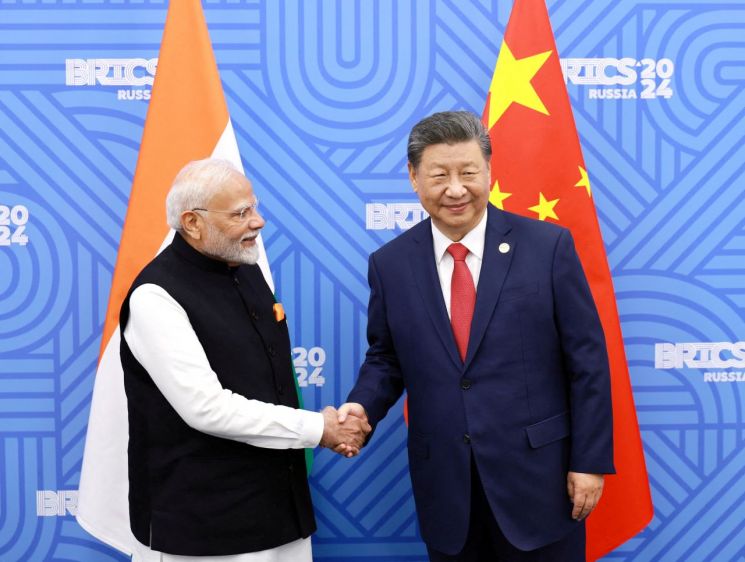 In October last year, Chinese President Xi Jinping (right) and Indian Prime Minister Narendra Modi (left) met and shook hands at the BRICS summit held in Kazan, Russia. Photo by Reuters Yonhap News
As Indian Prime Minister Narendra Modi finalizes his first visit to China in seven years, the planned visit of the U.S. trade delegation to India has been canceled. This marks a complete reversal in India’s foreign policy, which had been closely aligned with the United States and focused on countering China since the border dispute with China in 2020. With uncertainty surrounding the upcoming Quad summit-a security consultative body comprising the United States, Japan, Australia, and India-scheduled for October, there is growing attention on whether this could weaken the U.S.-led containment network against China.
Modi to Visit China for the First Time in 7 Years... U.S. Trade Delegation Visit Canceled
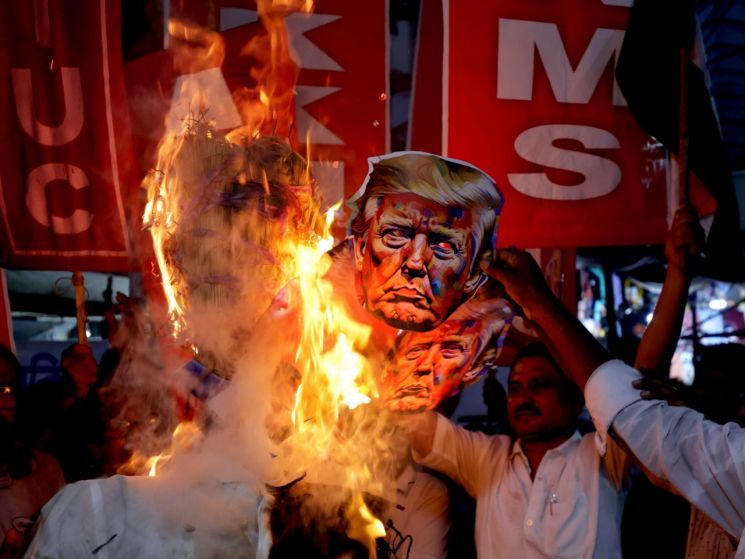 On the 13th, citizens in Kolkata, India, burned masks depicting the face of U.S. President Donald Trump during an anti-American protest. Photo by EPA Yonhap News
On the 18th, Wang Yi, Director of the Office of the Central Foreign Affairs Commission of the Chinese Communist Party and Minister of Foreign Affairs, visited India for the first time in three years. During high-level talks with the Indian government aimed at resolving border issues, Wang Yi also prepared for a summit between Prime Minister Modi and Chinese President Xi Jinping during Modi’s upcoming visit to China at the end of this month.
Prime Minister Modi is scheduled to attend the Shanghai Cooperation Organization (SCO) summit in Tianjin, China, on the 31st. This will be Modi’s first direct visit to China in seven years, and the visit and summit are expected to significantly improve bilateral relations. This marks the first substantial move toward reconciliation between China and India since the bloody clash between their militaries in the Ladakh region of Kashmir in June 2020, which occurred more than five years ago.
In contrast, the visit of the U.S. trade delegation to India, which was scheduled for August 25 to 29, has been canceled following the Indian government’s decision to halt negotiations. The two countries have been at odds throughout the year over tariff negotiations and agricultural market access. Relations deteriorated sharply after the United States unilaterally imposed a 25% reciprocal tariff on India earlier this month. With tariff negotiations suspended, the U.S. government plans to impose an additional 25% tariff on Indian goods starting on the 27th.
October Quad Summit in Doubt... U.S. Containment Network Against China Weakening
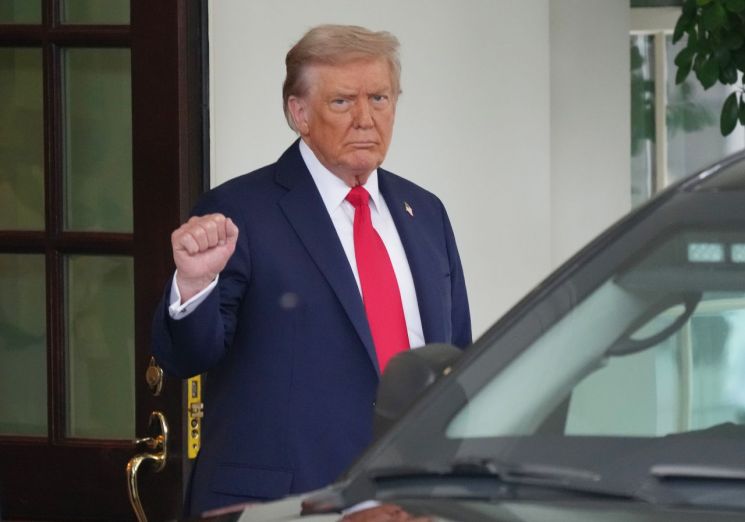
As the Indian government draws closer to China and drifts apart from the United States, the prospects for the Quad summit scheduled for October have also become uncertain. The Quad, formed in 2017 as a military consultative body to counter China in the Asia-Pacific region, comprises the United States, India, Japan, and Australia. This year’s Quad summit was planned for late October in Mumbai, India, but many now predict the summit may not take place at all if the tariff war between the United States and India continues.
The South China Morning Post (SCMP) noted, “The strategic viability of the Quad military alliance is now being tested,” and pointed out, “Current U.S.-India relations are at their worst since the 1998 nuclear tests, which led to a major confrontation between the two countries.” The Trump administration’s tariff dispute triggered diplomatic friction with India, and recent efforts to strengthen ties with Pakistan have further aggravated India.
President Trump made an unusual move in June by inviting Pakistan’s Chief of Army Staff Asim Munir to the White House for a private meeting. At the end of last month, he officially announced plans for joint development of large oil reserves in Pakistan and even stated his intention to visit Pakistan in September. The Indian government, which had reached a ceasefire with Pakistan after a border dispute in May this year, has strongly protested President Trump’s pro-Pakistan actions.
The Indian Ministry of Defense has reportedly halted its planned purchase of U.S. F-35 fighter jets and is now considering acquiring Russian-made Su-57s. Citing sources, Bloomberg reported, “The Indian Ministry of Defense is shifting its focus to the Su-57, which comes with a comprehensive technology transfer promise, unlike the F-35, which does not allow domestic production or technology transfer.” Previously, the Indian government had announced plans to purchase more than 110 F-35 fighter jets to strengthen its air force following the border dispute with China in 2020.
Limits of 'Tactical Embrace' Between China and India... Ukraine Ceasefire as the Biggest Variable
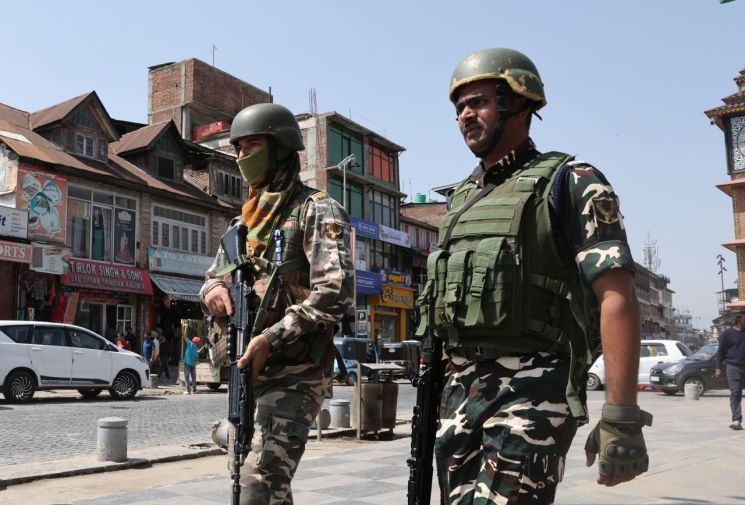
Some analysts believe that the rapprochement between India and China will not last long. The border dispute that triggered the conflict between the two countries is not easily resolved, and the long-standing nature of the dispute has resulted in low levels of mutual trust.
Parva Amer, a lead researcher at the Asia Society Policy Institute, told CNN, “From India’s perspective, strengthening cooperation with China at this moment is less about sharing a common vision and more about a tactical embrace to increase its bargaining power with the United States,” adding, “India and China have continued to clash over border disputes and regional hegemony, and the resulting distrust runs very deep.”
Given that the core of the U.S.-India tariff dispute lies in restricting imports of Russian oil, some analysts suggest that progress in ceasefire negotiations in the Ukraine war could significantly ease tariff pressures. Vivek Mishra, Deputy Director of the Strategic Studies Program at the Observer Research Foundation (ORF), an Indian think tank, told SCMP, “The U.S. tariff pressure on India was largely a tool to restrict imports of Russian oil and thereby pressure Russia,” and explained, “If the U.S.-Russia summit related to the Ukraine war leads to a ceasefire, the secondary U.S. tariff threat against India could disappear.”
© The Asia Business Daily(www.asiae.co.kr). All rights reserved.
![User Who Sold Erroneously Deposited Bitcoins to Repay Debt and Fund Entertainment... What Did the Supreme Court Decide in 2021? [Legal Issue Check]](https://cwcontent.asiae.co.kr/asiaresize/183/2026020910431234020_1770601391.png)

















