Name Changed to "Geojedo Sujeongsanseong Fortress"
Designated as a Historic Site
Symbolizes Independent Construction by Residents and
Represents the Evolution of Korean Fortress Techniques
The mountain fortress that was constructed the latest in Korea is set to be designated as a National Heritage Site.
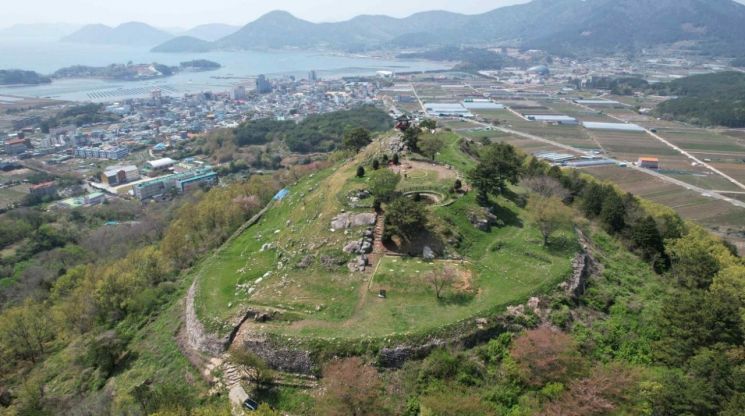
The National Heritage Administration announced on August 19 that it would change the name of 'Oksanseong,' currently designated as a Gyeongsangnam-do Monument, to 'Geojedo Sujeongsanseong Fortress' (巨濟 水晶山城), as recorded in historical documents such as Tongjeyeong Gyelog and Geoje Guneupji, and would preliminarily designate it as a Historic Site. The agency plans to collect opinions from various sectors for a month and then decide on the designation after a review by the Cultural Heritage Committee.
Geojedo Sujeongsanseong Fortress is a stone fortress built in the temoe style (where the fortress wall surrounds the mountain summit), located on Sujeongsan Mountain at an elevation of 143 meters. The total perimeter of the fortress walls reaches 450 meters. From the summit, visitors can view the Geoje Plain, the southwestern coastline, and the scenery of Hallyeohaesang National Park.
The construction period is confirmed to be the 10th year of King Gojong's reign (1873), as indicated by the stele inside the fortress, 'Sujeongsanseong Chukseonggi' (水晶山城築城記). Since the Annals of the Joseon Dynasty do not record any fortress construction after the 1871 reconstruction of Gimhae Bunsanseong Fortress, this fortress is considered the latest-built among mountain fortresses in Korea. It is also regarded as rare and symbolic because it was constructed independently by Geoje Magistrate Song Heeseung and the people of Geoje, without government support, to defend against foreign invasions.
This fortress also demonstrates the evolution of fortress construction techniques. Through eleven rounds of excavation and survey, it was confirmed that the original walls built during the Silla period of the Three Kingdoms era were repaired and expanded during the Goryeo and Joseon periods.
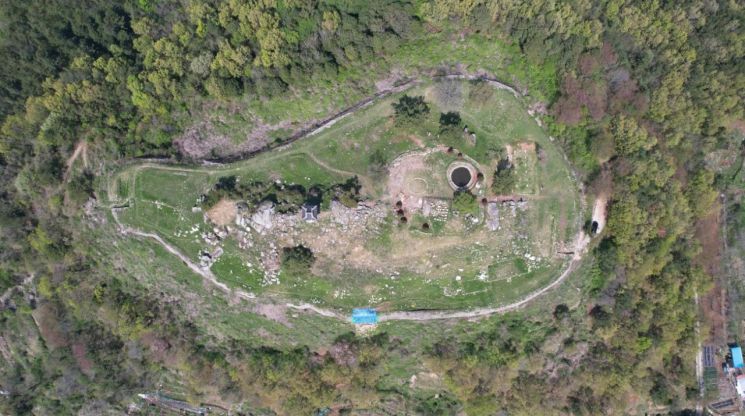
The initial construction period is estimated to be from the late 6th century to the early 7th century, based on the presence of slender rectangular dressed stones in the original wall, horizontally aligned masonry (where the horizontal joints of each stone layer are straight), fortress gates and base structures, and tiered circular water storage facilities. A National Heritage Administration official explained, "This provides important evidence for understanding when and how Silla established its defensive system as it expanded into the southern coastal region."
The building sites and east and west gate sites discovered within the fortress are also key materials for understanding the structure and construction methods of late Joseon period fortresses. In particular, Building Site No. 1, which lacks an ondol (underfloor heating) system and uses decorative roof tiles, is presumed to have served a special purpose, such as a warehouse or official residence. A National Heritage Administration official stated, "Despite the absence of limestone deposits in the Yeongnam region, a large amount of lime, which was a high-quality material at the time, was used, indicating that this was likely an important building."
© The Asia Business Daily(www.asiae.co.kr). All rights reserved.
![Clutching a Stolen Dior Bag, Saying "I Hate Being Poor but Real"... The Grotesque Con of a "Human Knockoff" [Slate]](https://cwcontent.asiae.co.kr/asiaresize/183/2026021902243444107_1771435474.jpg)

















