50% High Tariffs on Key Components Like Electrical Steel
Price-Cutting Pressure Unavoidable Even If Costs Are Passed to Customers
Major Companies Respond by Expanding Localization Strategies
The U.S. government has imposed a steep 50% tariff on steel and aluminum derivative products, including transformers, putting the power industry on high alert. Although the industry has enjoyed an unprecedented boom due to the expansion of artificial intelligence (AI) data centers and the replacement of aging power grids in the United States, concerns are mounting that domestic production and export volumes will inevitably be hit going forward. Transformer manufacturers are expected to accelerate their localization strategies to minimize the impact of these tariffs.
According to the power industry on August 18, the 50% U.S. tariff on steel and aluminum derivative products, which took effect on this day, includes essential materials and components for transformer manufacturing, such as electrical steel. For derivative products, the tariff is applied additionally depending on the proportion or value of steel and aluminum used in the components, so the final tariff rate is expected to vary by product. However, "oriented electrical steel," which is included in this measure, accounts for 30-40% of a transformer's cost and is a key item with limited local production in the U.S., leading to analysis that the industry will face a heavier burden due to the tariffs.
The U.S. Department of Commerce has added oil-immersed transformers with a capacity exceeding 10,000 kVA (kilovolt-amperes) and related components to the list of products subject to high tariffs. According to the Korea International Trade Association, U.S. imports from Korea of these items amounted to $600 million (about 831 billion KRW) last year. Assuming that electrical steel, which makes up a higher proportion in extra-high voltage transformers, accounts for 30% of the price, the tariff burden would be at least around 120 billion KRW. This is raising concerns about increased pressure to lower prices.
Although the specific method for calculating the tariff has not been finalized, the industry believes the impact will be greater for companies with a higher export ratio. Last year, HD Hyundai Electric recorded consolidated sales of 3.3223 trillion KRW, with North American sales estimated at about 1 trillion KRW. Considering that 60% of products are produced in Korea and exported, this amounts to approximately 630 billion KRW.
LS Electric, which does not have a local transformer plant and exports all of its domestically produced units, recorded about 800 billion KRW in exports, while Hyosung Heavy Industries exported about 380 billion KRW worth of products from its Changwon plant to North America. Although these figures may change depending on this year's orders, sales fluctuations, and negotiations with clients over tariff burdens, the sales volumes mentioned are all within the scope of the tariff's impact.
Han Areum, a senior researcher at the Korea International Trade Association, said, "Since a large volume of transformers is exported to the U.S., the impact will be significant. While the material and component content must be examined for each product, the high proportion of steel means the burden will inevitably be heavy."
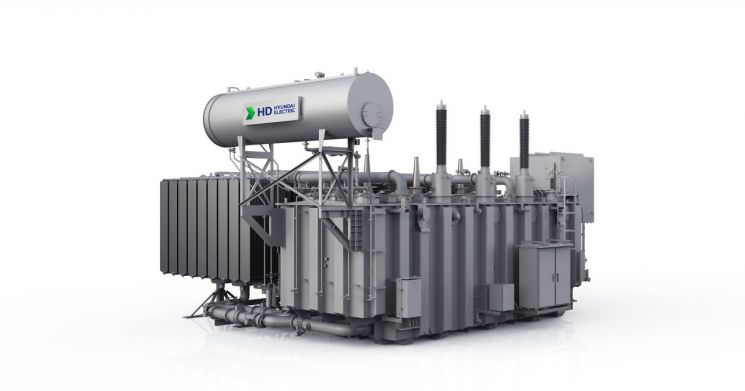
The North American transformer market is expected to more than double from about 17 trillion KRW last year to around 35 trillion KRW by 2034. With the expansion of data centers and the demand for power grid replacement occurring simultaneously, a "supplier's market" has emerged, where supply cannot keep up with demand. Nevertheless, industry sentiment remains cautious. A senior official at a transformer manufacturing company said, "It's difficult to assess the impact until specific guidelines are released, but we will do our best in negotiations to pass on the costs to our clients."
However, it appears that price-cutting pressure will be unavoidable when competing with global companies such as Siemens, which have already completed localization. HD Hyundai Electric, LS Electric, and Hyosung Heavy Industries are reportedly exploring countermeasures following the tariff announcement. The consensus is that localization will become increasingly important in responding to the market and offsetting tariffs.
HD Hyundai Electric is currently operating its Ulsan and Alabama plants at full capacity and plans to complete an expansion of its U.S. plant, into which it is investing 185 billion KRW, by the end of next year. The expanded plant is scheduled to begin operations in 2027. The company is also monitoring the local investment trends of global competitors to determine whether to pursue further expansion.
Hyosung Heavy Industries has been expanding its Tennessee plant in the U.S. since June last year. The company has invested $49 million (about 7 billion KRW) to increase its annual production capacity of extra-high voltage transformers from fewer than 100 units to around 160 units. A Hyosung Heavy Industries representative explained, "Most North American orders have already been shifted to local production. For products bound for the U.S., we plan to further increase the proportion of local manufacturing and to source materials locally as well, in order to minimize the impact of the tariffs."
LS Electric, which does not have a local transformer plant, is effectively exporting all of its products from Korea. Rather than building a new transformer plant, the company is expected to maintain its localization strategy focused on its main product lines, such as switchgear and low-voltage power equipment. The company plans to respond strategically by targeting the switchgear market, which is expected to grow more than transformer demand in the future.
An official from the power equipment industry said, "If high tariffs are imposed, profitability will inevitably deteriorate in proportion to the export ratio. Tough negotiations with clients over pricing are expected to continue."
© The Asia Business Daily(www.asiae.co.kr). All rights reserved.

















