Economic Impact: 1.5 Hours Saved Per Week,
Productivity Gains Estimated at 1.0 Percent
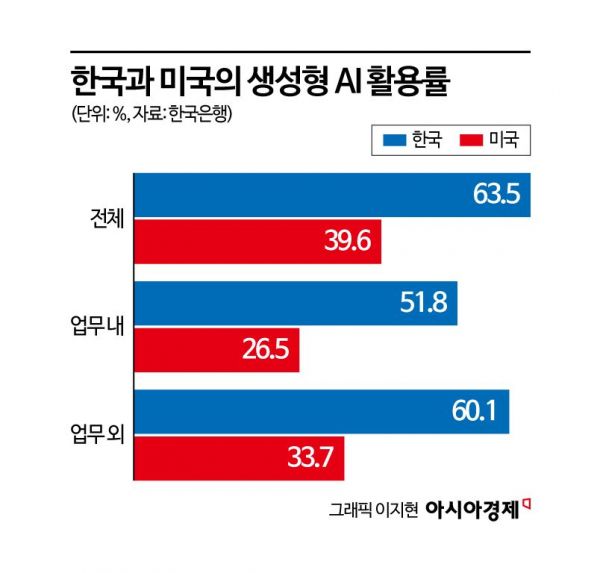
More than half of Korean workers have used generative artificial intelligence (AI) tools such as ChatGPT for work. This rate of AI utilization in the workplace is about twice as high as that of the United States. As a result, average working hours were reduced by 3.8%. Based on a 40-hour workweek, this equates to a reduction of 1 hour and 30 minutes. The upper limit of the potential productivity improvement effect from this is estimated at 1.0%, similar to the United States (1.1%).
The Bank of Korea announced these findings on the 18th through its BOK Issue Note, "The Rapid Spread of AI and Productivity Effects: Based on Household Surveys" (Seo Donghyun, Oh Samil, Kim Minjeong).
5.2 out of 10 have 'used it for work'... Higher usage among men, young adults, highly educated, and high-income earners
The proportion of Korean workers who have used generative AI at least once reached 63.5%. Regular users accounted for 22.2%, while experimental users made up 41.3%. Even when limited to work purposes, the rate was 51.8%, exceeding half. The proportion of workers who use it regularly for work was 17.1%. Oh Samil, head of the Employment Research Team at the Bank of Korea's Economic Research Bureau, stated, "The rate of generative AI utilization for work in Korea is about twice that of the United States (26.5%)," and "It is eight times higher than the 7.8% utilization rate three years after the commercialization of the Internet." This rapid spread is attributed to the sufficient infrastructure such as the Internet, the commercialization of personal mobile devices, and the high versatility of AI.
However, there were clear differences in usage rates depending on individual and occupational characteristics. Usage rates were higher among men, young adults, highly educated, and high-income earners. By occupation, professionals, managers, and office workers showed higher usage rates. The rate for men (55.1%) was higher than for women (47.7%). Young adults (ages 18-29, 67.5%) had nearly twice the rate of older adults (ages 50-64, 35.6%). By education level, graduate degree holders (72.9%) far surpassed those with a bachelor's degree or less (38.4%).
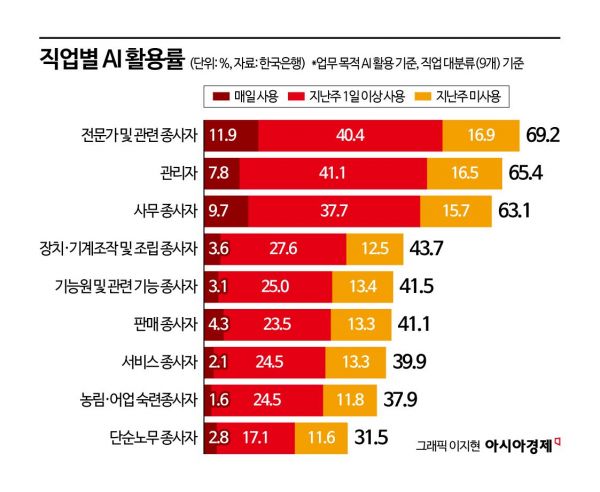
By occupation, professionals, managers, and office workers had higher AI utilization rates. This demonstrates that the nature of work by occupation significantly influences AI usage. Oh Samil noted, "What is notable is that even in occupations with relatively low usage rates, more than 30% of workers used AI," adding, "AI was being widely used across all occupations."
The intensity of use was also high. Workers using generative AI for work spent 5 to 7 hours per week on AI, which is significantly higher than in the United States (0.5 to 2.2 hours per week). The proportion of "heavy users"-those who use AI for more than an hour a day-was 78.6% in Korea, compared to 31.8% in the United States.
Economic effects... Saved 1 hour and 30 minutes of work per week, 'Productivity improvement effect of 1.0%'
Through this, workers were able to save working hours. When utilizing generative AI, working hours decreased by an average of 3.8%. Based on a 40-hour workweek, this is a reduction of 1 hour and 30 minutes. The upper limit of the potential productivity improvement effect from this is estimated at 1.0%, similar to the United States (1.1%). Oh Samil explained, "From the fourth quarter of 2022, when ChatGPT was launched, to the second quarter of this year, Korea's GDP grew by 3.9%. Theoretically, the potential contribution of generative AI adoption could be interpreted as 1.0 percentage point of this growth." However, he added, "This calculation is based on the assumption that workers used all the time saved by AI for additional productive activities. If some of the saved time was used for leisure, the productivity effect would be lower."
However, the productivity improvement effect will vary depending on how the 'time saved by generative AI,' which is expected to increase in the future, is utilized. Oh Samil said, "Generative AI, which used to handle tasks that took people 30 seconds, now handles tasks that take 30 minutes. As people increasingly delegate work to AI and focus on other tasks, the productivity effect will grow even larger," adding, "So far, the time saved by workers due to generative AI has not been enough to change company policies or work patterns. But if this time increases from 1 hour and 30 minutes to 5 or 10 hours out of a 40-hour workweek, how to utilize it will become an important issue for companies."
While Korea's AI utilization rate is relatively high, the reduction in working hours (Korea 3.8%, United States 5.4%) is somewhat lower. The effect of reduced working hours was greater for less experienced workers. Oh Samil interpreted this as "AI bringing a leveling effect by narrowing the gap in work proficiency." Even after the adoption of generative AI, the proportion of workers whose working hours did not decrease was 54.1%. If more workers use it efficiently in the future, the productivity improvement effect is expected to grow even further.

Physical AI exposure at 11%... Expected to expand to 27% in the future
The proportion of workers collaborating with autonomous robots-those exposed to physical AI-is currently 11%. This is expected to expand to 27% in the future. By occupation, device and machine operators had the highest rate of collaboration with autonomous robots. Oh Samil stated, "Currently, AI technology is mainly affecting intellectual labor through generative AI, but in the future, physical AI will bring significant changes to manual labor as well."
Among workers, 48.6% believed that AI would have a positive impact on society, far exceeding the proportion with a negative view (17.5%). Compared to similar surveys conducted in the United States, Korean workers showed a much more positive perception of AI.
A significant number are preparing for AI advancement by completing educational courses (33.4%) or planning to change jobs (31.1%). Especially among those with experience using generative AI, those collaborating with autonomous robots, and those who believe their jobs are highly likely to be automated, the probability of preparing through education or job change was higher.
Meanwhile, 32.3% of workers expressed willingness to participate in an AI technology development fund. Based on the average willingness to pay, a fund of up to 38 trillion won could be raised over the next five years. Oh Samil said, "There is also potential for designing a social investment model based on public-private cooperation."
© The Asia Business Daily(www.asiae.co.kr). All rights reserved.



















