Announcement of Joint Statement Demands on the 18th
Request for “At Least One-Year Implementation Delay”
The business community has officially requested that the implementation of the so-called "Yellow Envelope Act" (the amendment to Articles 2 and 3 of the Labor Union and Labor Relations Adjustment Act) be postponed for at least one year, even if it passes the National Assembly. This is the first time that the management side has expressed a position calling for a delay in implementation. With the ruling party set to push the bill through at the National Assembly plenary session on August 21, business leaders appear to have concluded that blocking the legislation will be difficult. Instead, they intend to accept certain provisions but delay enforcement in order to minimize the impact on corporate management. The business community stated that, while it could broadly accept provisions that reduce liability for damages related to illegal strikes in line with the legislative intent, it is firmly opposed to amendments that would expand the scope of employers to include subcontractors or that would include "managerial decisions" as a subject of strikes. <Refer to the front page of our August 12 issue>

On August 18, Sohn Kyungshik, Chairman of the Korea Employers Federation, along with vice chairmen of the Korea Chamber of Commerce and Industry, the Federation of Korean Industries, the Korea International Trade Association, the Korea Federation of SMEs, and the Korea Federation of Mid-sized Enterprises, held a joint press conference at the National Assembly Communication Office with Representative Kim Hyungdong of the People Power Party. They announced a "Joint Statement by Six Major Economic Organizations Urging Revision of the Labor Union Act Amendment." This joint statement was prepared to request that the minimum demands of the business community be met.
The business community stated, "If the law is amended, please postpone its implementation for at least one year," and added, "We need at least a year to gather sufficient input from both labor and management and to devise measures that can minimize confusion in the industrial field."
The reason the business community has proposed a delay in implementation is that companies have too little time to prepare. A representative from the Korea Employers Federation explained that, "The current amendment stipulates that the law will take effect six months after promulgation, but it is not easy for companies to prepare in that time," and added, "A minimum period is needed to reduce confusion on the ground."
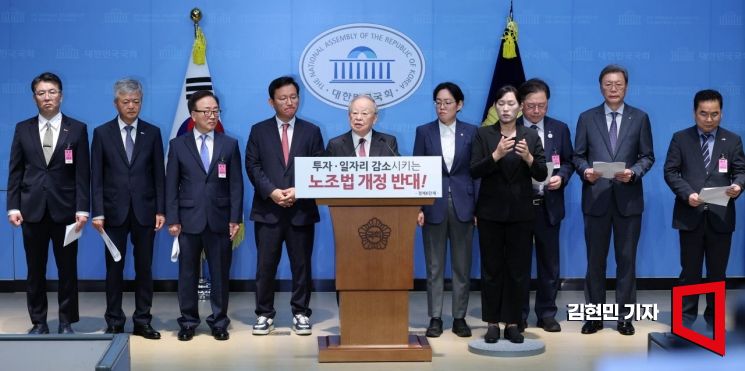 Economic organization leaders, including Sohn Kyungshik, Chairman of the Korea Employers Federation, held a press conference on the 18th at the National Assembly Communication Office urging the suspension of the revision of the Labor Union Act. Photo by Kim Hyunmin
At the press conference, participants also made their "red lines" clear. They stated unequivocally that Article 2, Paragraph 2 of the amendment, which would expand corporate responsibility to include subcontracted workers, is absolutely unacceptable. This bill would expand the definition of "employer" from "party to a labor contract" to those with "substantial and specific control." The business community argues that this standard is ambiguous and could make primary contractors potential criminals. Economic organizations stated, "Please maintain the current legal definition of 'employer,'" and expressed concern that, "If dozens or even hundreds of subcontractor unions demand negotiations, primary contractors will not be able to respond to each case, leading to extreme confusion in the industrial sector."
Additionally, regarding Article 2, Paragraph 5 of the amendment, they said, "Even if the concept of labor disputes is expanded, 'managerial decisions' must be excluded from the scope of labor disputes," and explained, "If managerial decisions that affect working conditions become the subject of labor disputes, then not only industrial restructuring but even overseas investments could become the subject of strikes, making it difficult for Korean companies to operate normally in the fiercely competitive global market." The current law only recognizes strikes as legal if they are over working conditions such as wages, working hours, benefits, or dismissals, whereas the amendment would also recognize strikes over business decisions as legitimate.
The provision that the business community has indicated a willingness to accept is Article 3 of the amendment. This provision would reduce the liability for damages by specifying the proportion of damages attributable to each worker participating in a strike. Since the Yellow Envelope Act was proposed in response to excessive claims for damages during the 2009 Ssangyong Motor layoffs strike, the business community said it respects the legislative intent. In the joint statement, participants emphasized, "In line with the purpose of the Yellow Envelope Act, which seeks to reduce the burden of damages on workers participating in illegal strikes, we have proposed to the National Assembly that the maximum amount of damages be stipulated separately in the enforcement decree, and that wages should not be subject to seizure."
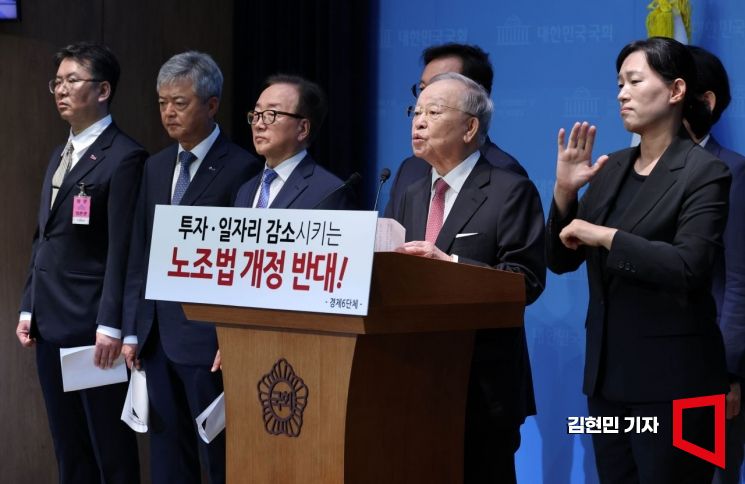 Chairman Sohn Kyungshik of the Korea Employers Federation and other economic organization leaders hold a press conference urging the halt of the amendment to the Labor Union Act at the National Assembly Communication Office on the 18th. Photo by Kim Hyunmin
They stated, "The Yellow Envelope Act represents a major change that could cause tremendous confusion in labor-management relations," and strongly urged, "Even now, we once again ask the National Assembly to seriously consider and accept the business community's alternatives so that workers' rights can be protected while ensuring that our companies remain competitive."
The Korea Employers Federation and other economic organizations have launched a "last-ditch all-out effort" to block the Yellow Envelope Act until August 21. As the enforcement decree could also become unfavorable, they are considering filing a constitutional complaint as a final measure. Lee Donggeun, Executive Vice Chairman of the Korea Employers Federation, said, "We do not know what decision the Constitutional Court will make, but a constitutional complaint is the last resort for the business community," and added, "If the enforcement decree does not reflect the position of the business community, we will proceed with a constitutional complaint."
Previously, the Korea Employers Federation delivered a letter from Chairman Sohn Kyungshik expressing the business community's concerns about the Yellow Envelope Act to all 298 members of the National Assembly.
© The Asia Business Daily(www.asiae.co.kr). All rights reserved.



















