Some Airports Integrate AI Technology
for Facility Management
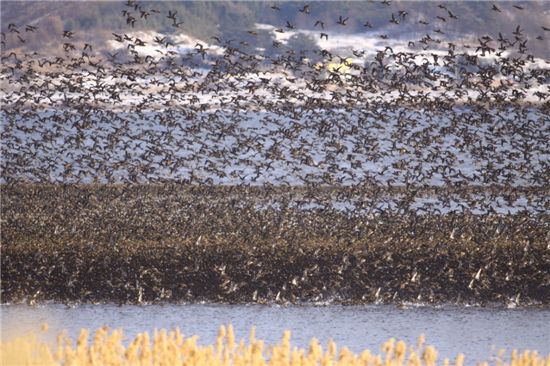
Bird strikes, identified as the primary cause of the Jeju Air passenger plane disaster at Muan International Airport in South Jeolla Province, have also emerged as a social issue in Japan. As the number of Baikal teal (pictured) has increased twentyfold over the past ten years due to global warming, and with Japan’s tourism industry recovering, the risk of such accidents has also grown.
According to the Nihon Keizai Shimbun (Nikkei) on August 18, the number of bird strikes in Japan reached 1,647 cases in 2024, the fifth highest since records began in 2011. Excluding the COVID-19 pandemic period, the annual number of incidents has remained around 1,500 over the past decade, but the number of accidents appears to have increased along with the recovery of flight operations.
Nikkei pointed out that the rise in bird strikes is linked to Baikal teal, which live in flocks. Although Baikal teal are classified as an endangered species, a nationwide survey conducted by the Ministry of the Environment every January for two weeks provisionally counted 147,313 individuals that migrated to Japan this year, more than twenty times the 7,458 counted in 2015.
The Baikal teal breed in Russia and migrate south to spend the winter in Japan. Hiroyoshi Higuchi, professor emeritus at the University of Tokyo, cited global warming as a factor, explaining, "The ice in Siberia melts earlier, making breeding easier, which may have led to an increase in their population."
For example, in January last year, a passenger plane returning to Haneda collided with more than ten Baikal teal over Izumo Airport in Shimane Prefecture, leading to flight cancellation due to aircraft damage. In fact, flocks of Baikal teal have been observed around Lake Shinji near Izumo Airport.
Nikkei also introduced a case from Korea. It reported that 179 people, including passengers and crew, died in the Jeju Air passenger plane accident at Muan International Airport in South Jeolla Province, and that bird strike appears to have been one of the causes. The accident investigation found Baikal teal blood and feathers near the engine.
As a countermeasure, the Ministry of Land, Infrastructure, Transport and Tourism revised its "Bird Strike Prevention Plan Guidance" this year, adding Baikal teal to the list of 24 "problem bird" species. In addition, bird patrols (bird dispersal teams) have been deployed to monitor runways and taxiways, repellents are being sprayed, grass is being removed from airport grounds to suppress habitats, and birds are being driven away using firecrackers, blank cartridges, and lasers.
Some airports have incorporated artificial intelligence (AI) technology. Chubu Centrair International Airport analyzes runway footage with AI to detect birds. In September last year, Chubu Centrair International Airport also introduced a new system that uses AI to analyze footage from four facility management cameras.
Professor Emeritus Higuchi stated, "There have not yet been any cases in Japan where a bird strike has led to a major accident, so sufficient countermeasures have not been established." He added, "Ecological surveys should be conducted around each airport to understand bird behavior, which varies by species, region, and weather conditions."
© The Asia Business Daily(www.asiae.co.kr). All rights reserved.

















