Osteoporosis Risk Reduced by 29% Over 20 Years
Eradication Therapy Shows Strongest Benefits for Women Over 50
A study has found that Helicobacter pylori eradication therapy is effective in preventing osteoporosis, with particularly pronounced benefits observed in women aged 50 and older.
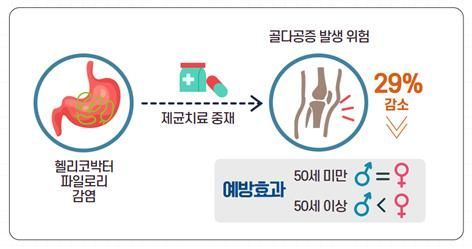 Preventive Effect of Helicobacter Pylori Eradication Therapy on Osteoporosis Incidence. Korea Disease Control and Prevention Agency
The Korea Disease Control and Prevention Agency's National Institute of Health announced on the 18th that a research paper containing these findings, authored by a team including Professor Kim Nayoung, Dr. Kim Yejin, and Professor Choi Yonghoon from the Division of Gastroenterology, as well as Professor Kong Sunghye from the Division of Endocrinology and Metabolism at Seoul National University Bundang Hospital, was recently published in the international journal 'Gut & Liver'.
Helicobacter pylori is a common bacterium that infects more than half of the global population and is known as a major cause of gastritis, gastric ulcers, and gastric cancer. As of 2017, the prevalence rate among Koreans aged 16 and older was 44%. Recent studies have also raised the possibility that this bacterium could trigger various diseases through systemic inflammatory responses.
Osteoporosis is a condition in which bone strength is weakened, making fractures more likely. It is a common disease, affecting 37.3% of Korean women aged 50 and older. In particular, fractures caused by osteoporosis increase mortality rates among the elderly and lead to higher medical costs, making it a significant social issue.
The research team conducted a follow-up study at Seoul National University Bundang Hospital, tracking 846 adults who underwent Helicobacter pylori testing from 2003 to 2023 for up to 20 years (an average of 10 years). The incidence of osteoporosis was 34.5% in the group that did not receive eradication therapy (116 people), while it was 24.5% in the group that successfully eradicated Helicobacter pylori (730 people), indicating an approximately 29% reduction in osteoporosis risk.
The preventive effect of eradication therapy was especially pronounced among female participants, with the highest effect observed in women aged 50 and older. In men, there was no statistically significant difference in osteoporosis prevention according to whether or not eradication therapy was performed.
Park Hyunyoung, Director of the National Institute of Health, stated, "This provides important evidence that managing Helicobacter pylori infection contributes not only to the prevention of gastrointestinal diseases but also to the prevention of chronic conditions such as osteoporosis." She added, "In particular, women experiencing menopause, who have decreased bone density, should check for Helicobacter pylori infection and actively consider eradication therapy."
© The Asia Business Daily(www.asiae.co.kr). All rights reserved.

















