What Falling U.S. Growth and Inflation Mean:
Long-Term U.S. Treasuries Set to Gain Favor,
While Stocks, Gold, and Bitcoin Should Be Reduced

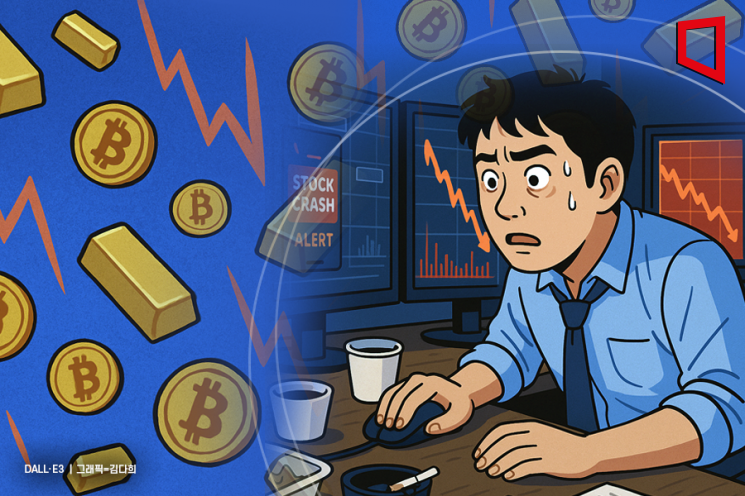
In the global financial markets, the flow of money is often closely linked to movements in the bond market. Since the fourth quarter of 2022, liquidity that could not be absorbed by the bond market has shifted to other asset markets such as stocks, gold, and Bitcoin. As a result, the prices of the NASDAQ 100, which leads the global stock market, gold as the representative safe asset, and Bitcoin as the symbol of innovative assets, have all moved in a similar pattern.
On the 18th, DB Securities released a report titled "Where Will All That Money Flow Now?" and noted that the current trends in the global financial market are similar to those around 1981. The firm recommended increasing allocations to long-term US Treasuries while reducing allocations to stocks, gold, and Bitcoin.
What Happened Around 1981 That Resembles Today?
In 1979 and 1980, the US economy was in the final stages of its battle against inflation, impacted by the second oil shock, the Soviet invasion of Afghanistan, and the outbreak of the Iran-Iraq War. Despite signs of shrinking aggregate demand, such as a decline in the US Consumer Price Index (CPI) growth rate, the US Federal Reserve (Fed) maintained a high interest rate policy. At that time, as long-term US Treasury yields rose in line with the Fed's benchmark rate, liquidity that exited the bond market fueled a rise in the stock market.
Around 1981, as the Fed lowered its benchmark rate and long-term US Treasury yields declined, the financial markets began to shift. As demand for US Treasuries increased, liquidity was absorbed into the bond market, leading to a decline in the stock market. Kang Hyunki, a strategist at DB Securities, commented, "Today's investors should take note of these historical facts," and analyzed that "the potential for change in the financial markets going forward depends on whether long-term US Treasury yields fall."
Long-Term US Treasury Yields Worth Watching
Long-term US Treasury yields are influenced by two main factors: growth rate and inflation. US growth is closely tied to the labor market, which underpins consumption. As the US leading economic index declines, the unemployment rate-a typical lagging indicator-could worsen with a time lag. Therefore, a contraction in the labor market should be considered. In terms of inflation, the tariffs imposed during Donald Trump's first administration amid the US-China trade war dampened economic activity and reduced demand, resulting in a drop in the US CPI growth rate. A similar phenomenon could occur under the tariff policies of a potential second Trump administration. If growth and inflation both decline in the future, long-term US Treasury yields could fall.
Kang Hyunki pointed out, "Across asset markets, it is important to consider that the previous situation could be reversed," and analyzed that "long-term US Treasuries could become a popular investment target." As long-term US Treasuries gain popularity, there could be an outflow of funds from other assets. Accordingly, DB Securities recommends: ▲ increasing allocations to long-term US Treasuries; ▲ reducing allocations to stocks (with a relative increase in dividend stocks in the Korean market and economic moat stocks in the US market); and ▲ reducing allocations to gold, Bitcoin, and other assets that have previously moved in tandem with stocks.
© The Asia Business Daily(www.asiae.co.kr). All rights reserved.

















