Deputy Prime Minister Convenes Ministers' Meeting
Government to Announce Measures Within This Month
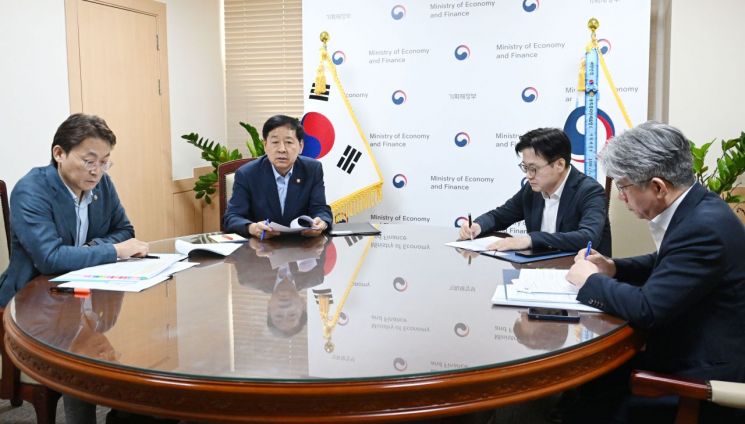 On the afternoon of the 17th, Deputy Prime Minister and Minister of Economy and Finance Koo Yoonchul held a meeting on current issues with related ministers at the Government Complex Seoul. Attendees included Minister of Trade, Industry and Energy Kim Jungkwan, Vice Chairman of the Financial Services Commission Kwon Daeyoung, and Vice Chairman of the Fair Trade Commission Nam Dongil. They received a report on the progress of the petrochemical industry restructuring and discussed future response directions. From the left in the photo are Vice Chairman Kwon Daeyoung, Deputy Prime Minister Koo Yoonchul, Minister Kim Jungkwan, and Vice Chairman Nam Dongil. Photo by Ministry of Economy and Finance
The government is accelerating discussions on restructuring the domestic petrochemical industry, which is struggling for survival. Authorities are working to create a framework that enables companies to implement self-rescue measures swiftly, while also considering various financial and policy support options to ensure the industry does not miss its critical golden window for survival.
According to the Ministry of Economy and Finance, on the afternoon of August 17, Deputy Prime Minister and Minister of Economy and Finance Koo Yoonchul presided over a meeting on current issues with related ministers at the Government Complex Seoul, where they received a report on the progress of the petrochemical industry restructuring and discussed future response directions. Attendees included Minister of Trade, Industry and Energy Kim Jungkwan, Vice Chairman of the Financial Services Commission Kwon Daeyoung, and Vice Chairman of the Fair Trade Commission Nam Dongil.
Although the government announced the 'Plan to Enhance the Competitiveness of the Petrochemical Industry' at the end of last year, discussions have stalled due to the 12·3 Martial Law Incident and the early presidential election. As the restructuring process has been delayed, concerns about the survival of the industry have grown.
Previously, on August 14, President Lee Jaemyung stated during a meeting with senior secretaries and aides that "the petrochemical industry is facing a significant crisis," and instructed relevant ministries to "swiftly develop a comprehensive plan for restructuring the petrochemical sector." The Ministry of Trade, Industry and Energy, which is the lead agency, has prepared a 'Petrochemical Industry Restructuring Plan' and has begun final coordination with related ministries and the industry. The plan is scheduled to be announced within this month at the latest.
The restructuring plan to be announced by the Ministry of Trade, Industry and Energy is reportedly focused on providing various incentives to encourage voluntary restructuring by companies, such as facility upgrades. If the responsible companies voluntarily adjust their businesses or make decisions such as mergers and acquisitions (M&A), the government will provide institutional and administrative support to ensure the restructuring process proceeds swiftly.
The upcoming announcement is expected to include specific restructuring plans for individual companies, including quantitative targets. As it is inevitable to adjust production volumes in response to the global oversupply, the plan will outline operational strategies for production facilities that maintain competitiveness, based on industry discussions. Previously, the ministry suggested directions for restructuring the petrochemical industry, such as facility closures, business divestitures, establishment of joint ventures, operational efficiency improvements, and new business M&A.
The domestic petrochemical industry has been mired in a prolonged downturn for several years, as profitability continues to deteriorate due to oversupply from China. According to a consulting report by Boston Consulting Group (BCG), considering the operating profits and financial status of domestic petrochemical companies, if the current downturn persists, half of these companies will not be able to continue operating three years from now.
In response to the crisis, companies in the industry have recently been making self-rescue efforts. For example, LG Chem has decided to suspend operations of the styrene monomer (SM) production lines at its Daesan and Yeosu plants and halt alcohol production at its Naju plant.
However, there are also calls for companies to implement even more robust self-rescue measures for industrial restructuring to succeed. As seen in previous shipbuilding and shipping industry restructuring cases, large-scale deals between companies and shared sacrifice among stakeholders must occur in parallel to lay the groundwork for successful restructuring. Minister Kim recently visited industrial sites and stated, "We recognize the seriousness of the current situation in the petrochemical industry," emphasizing that "the industry must work together and actively participate in voluntary restructuring, including facility adjustments."
© The Asia Business Daily(www.asiae.co.kr). All rights reserved.


















