Despite Declining Youth Population, Number of "Resting" Youth Rises
Estimated Monthly Income of "Resting" Youth: About 1.8 Million Won
Annual Economic Cost Reaches Approximately 11.5 Trillion Won
An analysis has found that the economic loss caused by the increase in "resting" youth has totaled 53 trillion won over the past five years.
On August 18, the Korea Economic Association announced these findings through a research report titled "Estimating the Economic Costs of the Increase in Resting Youth," which was commissioned to Professor Lee Misook of Changwon National University. Last month, the number of people in their 20s who reported neither working nor seeking employment and were simply "resting" reached 421,000, marking the highest figure ever recorded for July.
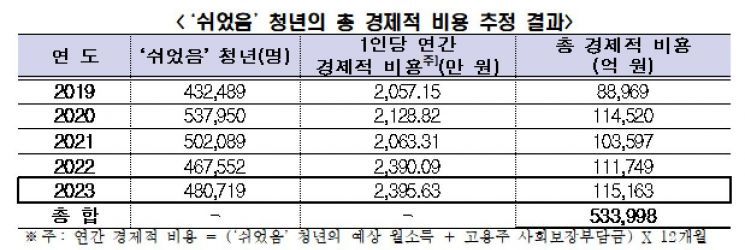
According to data from the Statistics Korea Economically Active Population Survey, the number of "resting" youth over the past five years (2019-2023) increased from approximately 432,000 in 2019 to 481,000 in 2023. The number of "resting" youth peaked at 538,000 in 2020 due to the impact of COVID-19, then declined, but began to rise again in 2023.
The report specifically pointed out that although the population of youth aged 15 to 29 has been steadily decreasing during this period, the proportion of "resting" youth relative to both the total population and the youth population increased in 2023.
The report also analyzed the number of "resting" youth by educational attainment and found that over the past five years, the proportion of highly educated "resting" youth-those with a university degree or higher-has been increasing.
The number of "resting" youth with a university degree or higher increased by approximately 38.9%, from about 159,000 in 2019 to around 184,000 in 2023. Their share of the total "resting" youth population also rose by 1.5 percentage points, from about 36.8% in 2019 to 38.3% in 2023. The report interpreted this trend as a result of highly educated youth responding flexibly to economic conditions and job market circumstances, making cautious decisions about entering the workforce.
When comparing the average annual wages of employed youth with the estimated wages of "resting" youth, the report found that over the past five years, the estimated wages of "resting" youth were about 78.5% to 85.9% of those of their employed peers. The report explained, "Although the expected income of 'resting' youth does not reach the average wage of employed youth, it is still a significant amount. The fact that youth who could earn high incomes are in a 'resting' state is generating substantial economic costs."
By adding together the annual population of "resting" youth, their estimated income, and the social security contributions that would have been paid by employers, the report calculated that the economic cost caused by "resting" youth over the past five years amounted to a total of 53.4 trillion won. The report noted that, except for a temporary spike in 2020 due to the impact of COVID-19 and a subsequent decline the following year, the economic cost generated by "resting" youth has been steadily increasing, emphasizing the need for measures to encourage their participation in economic activities.
As countermeasures, the report stressed the importance of early identification of youth in a "resting" state and a shift in social perception. It called for a systematic approach to identifying "resting" youth and connecting them with employment opportunities. The report also recommended the development of tailored programs to support their psychological recovery and promote economic activity, such as "lethargy recovery programs" and "youth recovery-type work-study scholarship systems."
Lee Sangho, head of the Economic and Industrial Division at the Korea Economic Association, stated, "As the economic downturn continues and companies reduce new hiring, the number of 'resting' youth reached a record high for July last month, illustrating the growing difficulty youth face in finding jobs." He emphasized, "In addition to customized support policies that take into account the diverse characteristics of 'resting' youth, efforts must be made to expand new employment opportunities by boosting domestic demand, easing regulations, and revitalizing corporate activity."
© The Asia Business Daily(www.asiae.co.kr). All rights reserved.


















