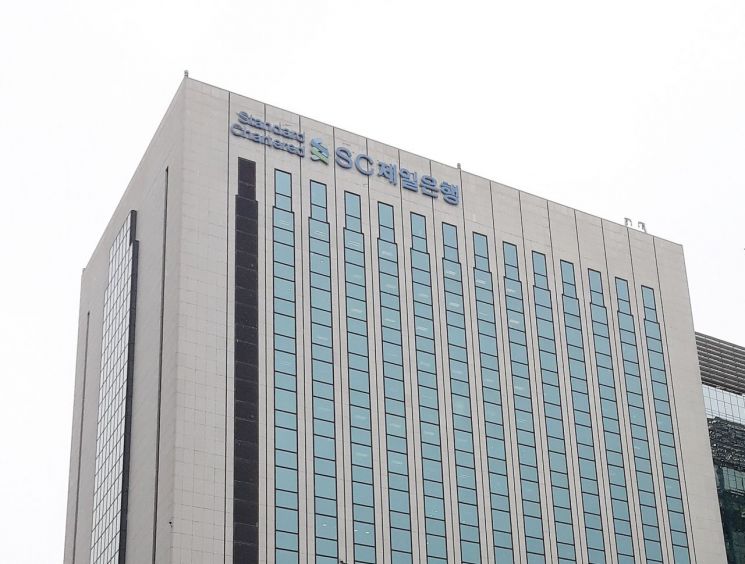
SC First Bank announced on August 15 that its net profit for the first half of this year reached 208.6 billion won, an increase of 4.6 billion won (2.3%) compared to the same period last year (204 billion won). This result reflects a base effect from the previous year, when an estimated compensation amount of 96.9 billion won for Hong Kong H-Index (Hang Seng China Enterprises Index·HSCEI) equity-linked securities (ELS) products was recognized as a one-off non-operating expense. However, this base effect was offset by a decrease in net interest income and an increase in provisions.
Despite an increase in the volume of customer loans, net interest income decreased by 25.9 billion won (4.1%) from the same period last year (635.7 billion won), due to a 0.18 percentage point drop in net interest margin (NIM) resulting from lower market interest rates. Non-interest income increased by 8.2 billion won (4.1%) from the previous year (197.7 billion won), driven by higher profits from foreign exchange and derivatives.
Operating expenses rose by 21.1 billion won (4.8%) to 457.4 billion won compared to the same period last year, mainly due to increased personnel costs, despite selective expense execution and rigorous management efforts. Provisions increased by 52 billion won (104%) to 101.9 billion won from 50 billion won in the same period last year, primarily due to additional provisions related to the TMON and Wemakeprice incidents, as well as provisions for receivables related to derivatives.
As of the end of June 2025, total assets stood at 94.4283 trillion won, an increase of 8.5874 trillion won (10%) from the end of December last year (85.8409 trillion won), mainly due to growth in mortgage loans and foreign exchange derivatives assets. The return on assets (ROA) was 0.46%, similar to the same period last year, while the return on equity (ROE) declined by 0.04 percentage points year-on-year to 7.61%. The loan loss provision ratio fell by 29.76 percentage points to 181.41% compared to the same period last year, while the ratio of substandard and below loans rose by 0.06 percentage points to 0.49%.
As of the end of June 2025, the BIS total capital adequacy ratio (CAR) and BIS common equity tier 1 (CET1) ratio stood at 21.35% and 18.12%, respectively, improving by 1.62 and 2.05 percentage points compared to the end of December last year. The bank continues to maintain sufficient loss-absorbing capacity and capital soundness, consistently exceeding supervisory requirements.
© The Asia Business Daily(www.asiae.co.kr). All rights reserved.

















