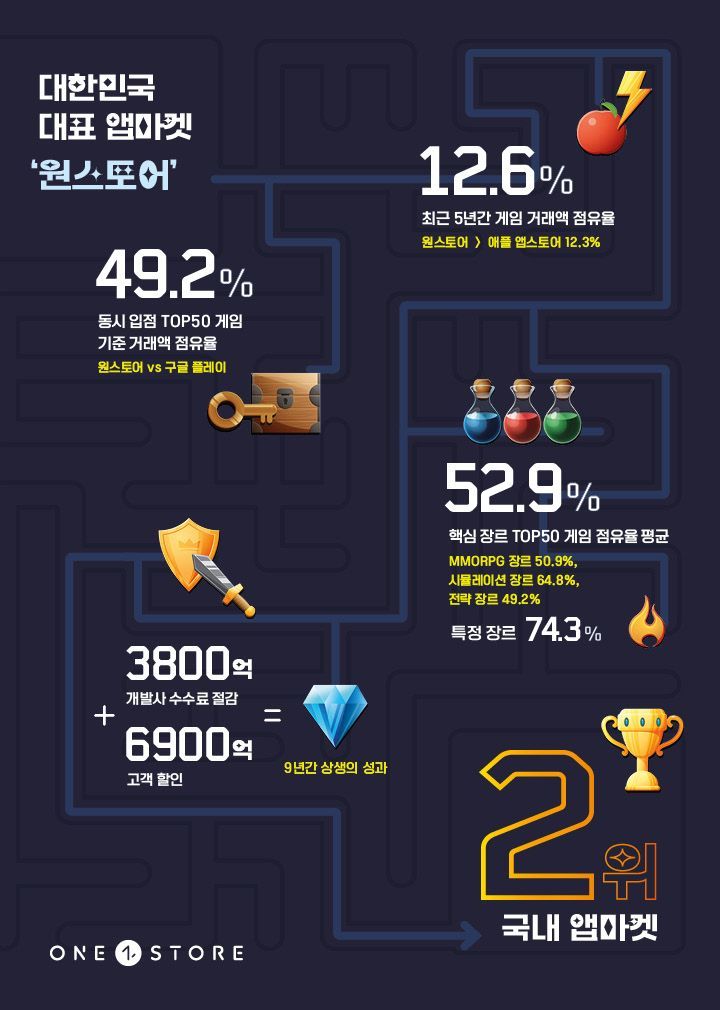
12.6% Game Transaction Market Share Over the Past Five Years
Top 50 Games Show Comparable Transaction Share to Google
Lower Commission Rates and User Discounts Drive Growth
The game transaction volume of One Store, Korea's third-party and homegrown app market, has surpassed that of the Apple App Store. This achievement was made in a market effectively monopolized by Google and Apple, which dominate the app market based on their smartphone operating system (OS) market shares. This success is attributed to One Store attracting game users through lower fees and user discounts compared to the two major app markets.
According to a survey by IGAWorks Mobile Index released on August 14, which analyzed the game transaction volume shares of the three app markets (Google Play Store, Apple App Store, and One Store) over the past five years from the second half of 2020 to the first half of 2025, One Store ranked second with a market share of about 12.6%, following Google Play. This figure exceeds the Apple App Store's 12.3%. Game transaction volume includes both the amount spent on purchasing games in the app store and the amount spent on in-game items or other digital goods.
Even in direct competition with its main rival, Google Play Store, One Store has shown parity in the gaming sector. Currently, One Store is only available on smartphones using Google’s Android OS, such as Galaxy devices. Since Play Store is the default app market for Android OS, the third-party status of One Store puts it at a disadvantage.
According to Mobile Index, based on the top 50 revenue-generating games available on both Google Play Store and One Store in the first half of this year, One Store accounted for 49.2% of the transaction volume. Although Play Store holds a virtually monopolistic influence, actual game users appear to prefer One Store. During this period, the average revenue per paying user (ARPPU) on One Store was about five times higher than that of Play Store.
One of the main reasons for One Store’s strong performance in the gaming sector appears to be its commission structure. Google and Apple currently charge an in-app purchase commission rate of around 30% for paid apps or in-app items purchased through their app markets. In contrast, One Store’s commission rate is about 20%. Furthermore, for small and medium-sized developers with monthly transaction volumes of $5,000 or less, the commission is halved. The lower commission allows game developers to use the savings to reduce the prices of game items, among other things.
Allowing payments through external payment methods is another distinguishing factor. One Store permits external payments for purchases made within downloaded apps, with a commission rate of about 5% for such transactions. In contrast, both Google and Apple prohibit external payments, citing their fee policies, and only allow in-app payments using their proprietary payment systems. According to One Store, the cumulative amount of commissions saved by developers using One Store has reached approximately 380 billion KRW to date.
One Store also operates a customer discount program. Currently, One Store offers discounts similar to those provided by telecom memberships. This is a result of One Store being formed through the integration of the app markets of the three major telecom companies and Naver. This is also why mobile game users who frequently purchase games or in-game items tend to favor One Store. The total amount of discounts received by One Store users so far is about 690 billion KRW.
However, there is a limitation in that One Store is currently only available for Android in Korea. This is because Apple does not allow third-party app markets outside of Europe. The dominance of Google and Apple over their platforms sometimes hinders the onboarding of new games or business operations. A One Store representative stated, "Creating a fair competitive environment remains a challenge for the market."
From a business performance perspective, One Store also needs to seek new avenues for growth. Last year, One Store recorded a loss of about 21.4 billion KRW, an increase from the previous year's loss of about 11.6 billion KRW. Sales outside the gaming sector have also not surpassed the strong influence of Google Play Store.
Nevertheless, One Store aims to leverage its position as a rare third-party app market in the global market to strengthen its competitiveness. Park Taeyoung, CEO of One Store, stated, "One Store continues to achieve meaningful results as the only viable alternative in an app market dominated by global big tech companies. We will continue to pursue mutual growth with developers and provide greater benefits to users, further solidifying our position as the world's most competitive third-party app market."
© The Asia Business Daily(www.asiae.co.kr). All rights reserved.

















