Relief Granted with Help from Legal Aid Corporation
Court: "Interest Exceeding Statutory Maximum Rate Constitutes Unjust Enrichment"
A debtor who had more than 33 million won of wages garnished over a 22-year-old loan of 2 million won from a private loan company has been granted relief with the help of the Korea Legal Aid Corporation (hereafter referred to as the Corporation).
According to the Corporation on August 14, Judge Kim Doohong of the Pohang Branch of the Daegu District Court ruled partially in favor of plaintiff A in a lawsuit seeking the return of unjust enrichment from private lender B, ordering B to "pay A 18,493,900 won plus interest."
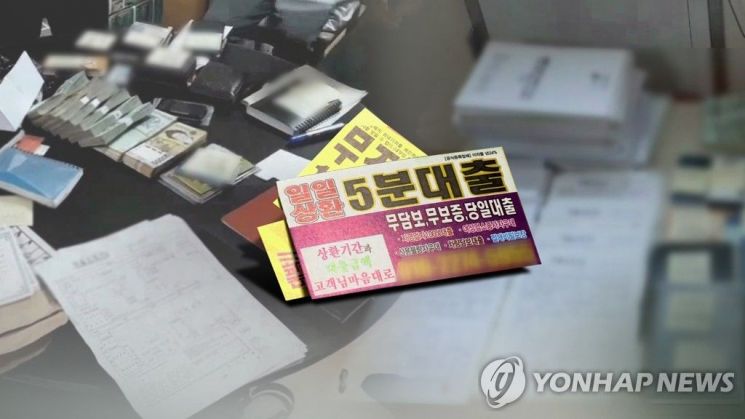
In September 2002, A borrowed 2 million won from a private lender under the terms of a one-year loan period and an annual interest rate of 69%. However, the agreement stipulated that the interest rate and overdue interest rate could be adjusted in accordance with changes in relevant laws or financial circumstances.
When A failed to repay on time, the lender filed a lawsuit with the Pohang Branch of the Daegu District Court in March 2006. The court finalized a payment order requiring A to pay 2,257,890 won plus interest.
In September of the following year, the lender's claim against A was transferred to Jeongri Financial Corporation. In July 2009, another private lender acquired the loan claim from the corporation.
The private lender that acquired the claim applied to the Suwon District Court in March 2010 for a garnishment and collection order against A's loan claim, which was granted that same month. Around that time, the lender collected 2,049,718 won from A's employer and then withdrew the garnishment and collection order.
Although the lender collected more than the principal A had borrowed, interest and principal remained outstanding. As a result, in September 2012, the lender transferred the claim against A to private lender B. According to the Civil Act, when a debtor repays only part of a debt, the payment is first applied to costs, then to interest, and finally to principal.
Private lender B, who acquired the claim against A, did not notify A of the transfer of the claim.
Meanwhile, at the end of October 2017, A applied to the Credit Counseling and Recovery Service for debt adjustment, including the debt related to this loan claim.
In December 2017, a debt adjustment agreement was drawn up. According to the committee's investigation at the time, A's remaining debt was calculated as 2,257,890 won in principal, 225,230 won in costs, and 9,301,664 won in interest, totaling 11,784,784 won.
Subsequently, the debt adjustment agreement lost effect on September 6, 2018, due to A's failure to make payments. Excluding the amounts A had partially repaid, the remaining debt was 2,194,669 won in principal, 216,220 won in costs, and 9,309,556 won in interest, totaling 11,720,455 won.
It was not until August 2021, nine years after acquiring the claim, that private lender B notified A of the claim transfer.
Then, in March of last year, B applied to the court for a garnishment and collection order against A's loan claim and obtained approval a month later.
Subsequently, by the end of October 2024, B collected 33,161,536 won from A's employer and then withdrew the garnishment and collection order.
Having had more than 15 times the amount he borrowed collected from him, A filed a lawsuit against private lender B seeking the return of the approximately 33 million won collected as unjust enrichment. During the trial, A received legal support from the Corporation through the court's legal aid system.
In court, A's side argued: ▲ that more than 10 years had passed since another lender obtained a garnishment and collection order, so the statute of limitations had expired; ▲ that the garnishment and collection order was obtained based on an inflated claim amount, since the agreed-upon variable interest rate was not applied, resulting in collection of an amount 15 times the principal; and ▲ that after the claim was transferred and left dormant for a long period, A reasonably believed all debt relations were terminated, so the sudden resumption of enforcement constituted an abuse of rights and was invalid; and ▲ that the actual principal and interest were far less than the amount collected.
The court did not accept A's arguments regarding the statute of limitations and abuse of rights.
Regarding the statute of limitations, the court explained that when the debt adjustment agreement was drawn up at the Credit Counseling and Recovery Service, any unspecified matters were to follow the relevant regulations, which included a deemed provision stating that the debtor forfeits the benefit of the statute of limitations upon signing the agreement.
Judge Kim stated, "Based solely on the circumstances and evidence presented by the plaintiff (A), it is insufficient to recognize that the defendant (private lender B) proceeding with enforcement based on the payment order is manifestly unjust or that requiring the defendant to tolerate such enforcement is clearly contrary to justice and unacceptable in social life."
However, Judge Kim accepted A's argument that the amount collected by private lender B was excessively high.
Judge Kim noted, "After September 6, 2018, the maximum legal interest rate under the Act on Registration of Credit Business, etc. and its Enforcement Decree was 24% per annum until July 6, 2021, and 20% per annum thereafter. As of October 31, 2024, when the defendant completed collection, the outstanding principal and interest on the loan claim stood at 14,667,636 won."
Judge Kim further cited Supreme Court precedent, stating, "If a payment order is finalized with content differing from the substantive rights relationship, and money is delivered based on enforcement of that order, unjust enrichment may arise. Therefore, of the 33,161,536 won collected by the defendant, the portion exceeding 14,667,636 won constitutes unjust enrichment and must be returned to the plaintiff."
Lee Sanghwa, an attorney from the Corporation who represented A, commented, "This ruling is a meaningful precedent that sounds the alarm on the predatory practices of high-interest private lending, which, being out of step with modern standards, have inflicted prolonged suffering on debtors."
He added, "With growing public consensus on the need to protect victims of high-interest loans, this ruling establishes grounds for responding to excessive debt collection practices prohibited by law, even when creditors enforce claims based on payment orders from the court. The Corporation will continue to do its utmost to ease the burden on citizens suffering from unreasonable debt collection."
© The Asia Business Daily(www.asiae.co.kr). All rights reserved.


















