The Donald Trump administration is expected to expand its policy of requiring domestic semiconductor companies, such as Nvidia and AMD, to pay the U.S. government 15% of their China export revenues in exchange for export permits to China, to other industries as well. This has sparked criticism that the U.S. administration is now seeking to intervene directly in corporate management.
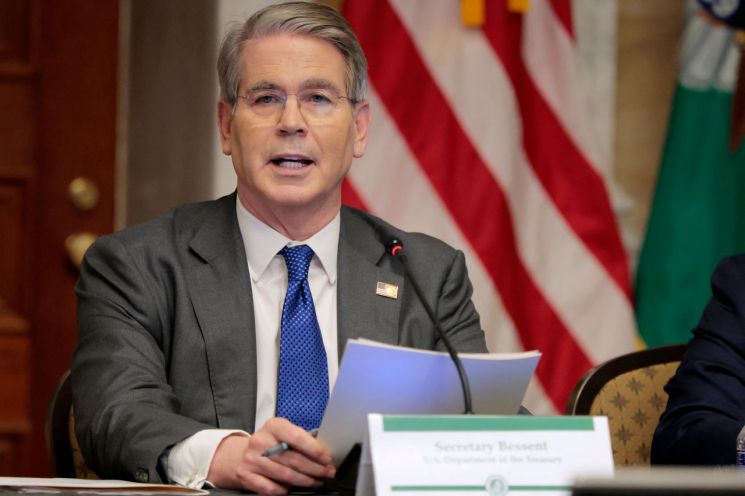
On August 13 (local time), U.S. Treasury Secretary Scott Besant appeared on Bloomberg TV and mentioned the possible expansion of the export levy, stating, "Over time, I think you’ll see this in other industries as well."
He added, "Right now, I think it’s very unique, but now that we have the model and the beta test, why not try expanding it?"
Previously, the Trump administration required Nvidia and AMD to pay 15% of their China revenues as a condition for exporting semiconductors to the Chinese market. In this context, President Trump stated that it would be possible to sell cutting-edge AI chips to China if their specifications were downgraded by 30% to 50%. Secretary Besant’s comments suggest that, beyond semiconductors, the U.S. may allow the sale of advanced technologies-previously banned from export to China to curb its technological dominance-if companies pay a tax of around 15%. Until now, the U.S. had completely banned the export of advanced technologies such as AI chips to China, but appears to have shifted to a compromise approach that secures U.S. interests and negotiating leverage through agreements.
This has raised concerns that national security is now being treated as a bargaining chip, and that the overall framework of U.S. export controls on advanced technology to China could be undermined. Raja Krishnamoorthi, the Democratic ranking member of the House Select Committee on the Chinese Communist Party (Illinois), criticized the news of the 15% export levy on Nvidia and AMD, stating, "Chip export controls are not a bargaining chip or a casino chip. We should not gamble with national security just to increase tax revenue."
In response to these security concerns, Secretary Besant said, "There are no national security concerns," adding, "We will not sell advanced chips to China. The H20 chip is four, five, or six levels below advanced chips." He also stated, "We do not want Huawei to have a digital Belt and Road, and we do not want Chinese standards to become established, either globally or even within China."
However, experts continue to raise issues, noting that this policy departs from the Republican Party’s traditional economic stance of non-interference in corporate management, and constitutes unjustified intervention. Ann E. Harrison, former dean of the Haas School of Business at the University of California, Berkeley, said, "This is not a rational industrial policy," adding, "It is interfering with who runs the company and threatening to impose penalties if companies do not follow President Trump’s directives." The New York Times pointed out that President Trump has turned corporate management-traditionally led by engineers-into a political arena.
© The Asia Business Daily(www.asiae.co.kr). All rights reserved.

















