From July 14 to July 25, 2025, Gyeonggi Province investigated illegal acts of unauthorized occupation along the coastline and uncovered seven violations, including unauthorized occupation and use of public waters, failure to comply with restoration orders, and unregistered restaurant operations near the seaside.
The Gyeonggi Provincial Special Judicial Police Unit conducted a focused investigation targeting public waters and fishing port areas along the coastlines of five cities in Gyeonggi Province (Hwaseong, Ansan, Pyeongtaek, Siheung, and Gimpo). This initiative aimed to eradicate unauthorized occupation around the province's popular beaches during the summer vacation season and to ensure a safe and pleasant marine environment for residents.
Major violations included an individual, identified as Mr. A, who was caught installing a container without authorization on public waters adjacent to his home and using it as a warehouse.
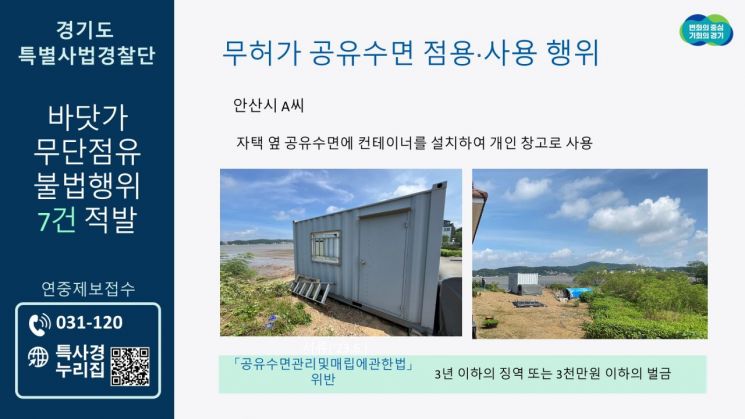 Unauthorized Reclamation and Occupation of Public Waters Detected by Gyeonggi Provincial Special Judicial Police Unit
Pension B illegally installed a deck and stairs on public waters in front of its business for guests to use. Although the relevant authorities ordered restoration to the original state, the order was not followed. In addition, Company C was found operating a sashimi restaurant by occupying public waters without reporting to the relevant authorities.
Under the current 'Act on the Management and Reclamation of Public Waters,' unauthorized occupation or use of public waters is punishable by up to three years in prison or a fine of up to 30 million won. Failure to comply with a restoration order from the relevant management authority is punishable by up to one year in prison or a fine of up to 10 million won. Furthermore, operating a food service business without reporting to the relevant authorities is subject to up to three years in prison or a fine of up to 30 million won under the 'Food Sanitation Act.'
Kee Ido, head of the Gyeonggi Provincial Special Judicial Police Unit, stated, "Public waters are, as the name suggests, a public resource that belongs to everyone. We will never tolerate individuals seeking private gain from them. We will continue our monitoring efforts to ensure a safe and healthy environment and to maintain pleasant beaches for our residents."
© The Asia Business Daily(www.asiae.co.kr). All rights reserved.

















