Most of South Korea's ethylene exports serve as a "gap filler" for China's coastal petrochemical companies
Regional imbalances persist, but rapid capacity expansion and improved logistics are closing the gap
Annual supply is expected to increase by several million tons, intensifying competitive pressure
Most of South Korea's ethylene exports to China are directed toward petrochemical companies located along China's eastern coast. While China's overall ethylene supply and demand are balanced at the national level, there are regional disparities. Petrochemical companies in eastern China face a shortage of ethylene supply. As a result, ethylene exported from South Korea serves as a "gap filler" for these companies. However, China is planning a massive expansion, aiming to add 25 million tons of annual ethylene production capacity by 2030. If logistics networks are further improved, this supply gap is expected to close rapidly.
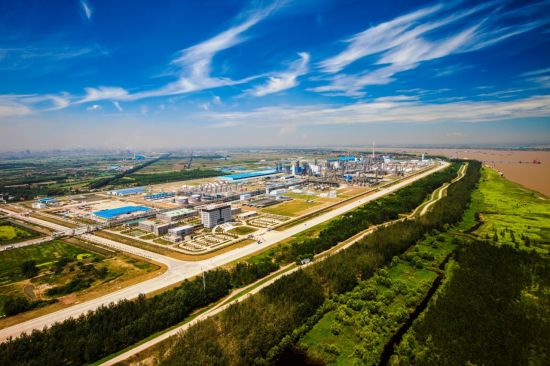 Exterior view of Junghan Petrochemical plant. Photo is not directly related to the article. Junghan Petrochemical
According to the China Petroleum and Chemical Industry Federation and global market research firm ICIS on August 14, China's ethylene demand is expected to reach up to 61 million tons this year. Current ethylene production capacity stands at approximately 51 million tons. Given that the operating rate of ethylene production facilities, including naphtha cracking centers (NCC), is around 86%, actual production is limited to 43.86 million tons, which falls short of demand. The regions with the largest gap between production and demand are the coastal areas of East and South China. These regions, which have a high concentration of major downstream demand for products such as polyethylene (PE), ethylene oxide (EO), and polyvinyl chloride (PVC), often rely on imports in the short term due to logistical constraints of new inland facilities. Ethylene from South Korea plays a supplementary role in filling this gap.
South Korea is the world's fourth-largest ethylene producer, and it can transport ethylene from major petrochemical complexes in Yeosu, Daesan, and Ulsan to port cities along China's coast such as Shanghai, Ningbo, and Guangzhou within two to five days. The high proportion of high-purity, high-quality products makes Korean ethylene particularly suitable for producing high-value derivatives. Transactions are conducted through a mix of regular contracts and spot deals. However, this competitive edge is highly sensitive to fluctuations in the prices of raw materials such as naphtha, making it difficult to view the current situation as a stable, long-term export base.
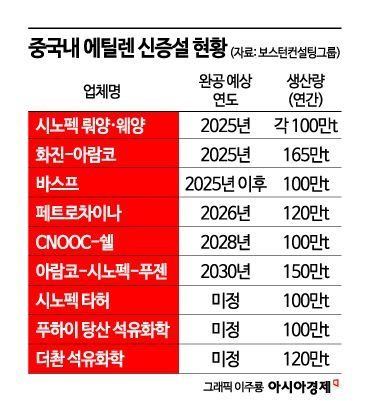
In the medium to long term, China continues to expand its supply. State-owned and global major companies such as Sinopec, China National Petroleum Corporation (CNPC), and SABIC are adding several million tons of new production capacity each year through 19 large-scale projects scheduled for completion by 2030. This trend has accelerated since China set a national goal of achieving 100% self-sufficiency in 2021, with more than 20 new production sites breaking ground in the past five years.
Boston Consulting Group (BCG) stated in materials for the National Assembly Future Industry Forum that "due to the new capacity additions from China, it will be difficult to expect a natural upturn after a down cycle as in the past."
© The Asia Business Daily(www.asiae.co.kr). All rights reserved.

















