WSJ Reports: "DeepSeek and Qwen Shock the U.S."
"Global Race for Standards with Open-Source AI Models"
"Need to Build Open Models Based on American Values"
Reports have emerged that Chinese artificial intelligence (AI) companies are establishing open-source AI models as global standards, leaving U.S. companies and the government in shock. According to Yonhap News, citing The Wall Street Journal (WSJ) on August 12 (local time), "History shows that the most technologically advanced companies have not always won the race to set global standards," adding, "Accessibility and flexibility play crucial roles, and in this regard, the development of open-source AI in China is causing concern in the United States."
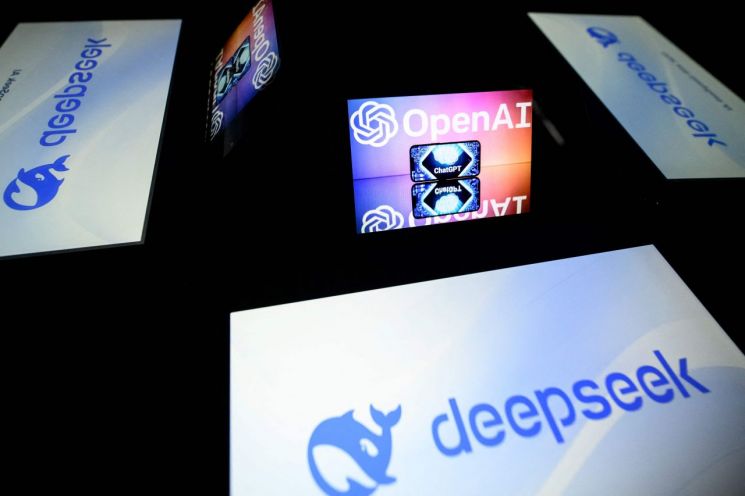 The open-source AI model DeepSeek from China and the representative generative AI tool ChatGPT from the United States. Photo by AFP
Recently, Chinese companies have been racing to release open-source or open-weight AI models. Open-weight refers to models that are not fully open-source but disclose the parameters learned and adjusted during the AI training process, allowing developers to customize them. Notable examples include DeepSeek's 'R1' AI model, released in January, and Alibaba's 'Qwen,' launched in July.
The Chinese authorities have long encouraged open-source research and development not only in AI but also in areas such as operating systems, semiconductor architecture, and engineering software. Lian Jiesu, an analyst at AI research firm Omdia, analyzed, "China, concerned about being cut off from U.S. technology, is fostering open-source projects as strategic alternatives and emergency resources."
Currently, Chinese open-source AI models are reportedly competing to attract corporate adoption. Many clients prefer open-source AI because they can freely adopt and apply it to their own computer systems, and manage sensitive information internally.
Oversea-Chinese Banking Corporation (OCBC), one of Southeast Asia's largest banks headquartered in Singapore, has developed about 30 internal tools using Google's open-source model 'Gemma' for document summarization, Qwen for computer code generation, and DeepSeek for market trend analysis. An OCBC representative told the WSJ, "This is to avoid being locked into a specific model," adding, "We review new open-source models as they emerge and switch if we find one we like. We prefer models that are familiar to many developers."
According to research firm Artificial Analysis, the overall performance of China's top open-weight models surpassed that of the leading U.S. open-source models as of November last year. The company, which evaluates model capabilities in mathematics, coding, and other areas, stated that Alibaba's Qwen3 outperformed OpenAI's GPT-oss.
In its AI action plan announced last month, the U.S. government stated, "Open-source models could become the global standard in certain business and academic research sectors," and emphasized, "We must build leading open models based on American values." As U.S. companies that have maintained closed models feel the pressure, there is an assessment that OpenAI's release of its first open-weight AI models, 'GPT-oss-120b' and 'GPT-oss-20b,' earlier this month was influenced by DeepSeek.
The WSJ analyzed, "Currently, the rewards for winners in the open-source AI field are minimal, but companies that secure users can sell other services based on free offerings." This is similar to how Google bundles revenue-generating products such as search and YouTube with its Linux-based Android operating system. Charlie Chai of Chinese tech analysis firm 86Research said, "Chinese companies often prioritize customer loyalty over immediate revenue."
© The Asia Business Daily(www.asiae.co.kr). All rights reserved.


















