There is a high likelihood that intense heatwaves and tropical nights will continue through August and September, and there are also concerns that a late-autumn typhoon could approach the Korean Peninsula in October.
Lee Myungin, head of the Heatwave Research Center at Ulsan National Institute of Science and Technology (UNIST), stated, "Typhoons that have been blocked by high-pressure systems this summer may begin to have an impact from mid-August onward, and there have been cases of typhoons in October as well." He added, "While the performance of current climate prediction systems has improved thanks to advances in supercomputers and AI, the accuracy of long-term forecasts beyond one month remains low." He emphasized that "disaster predictions for heatwaves, typhoons, and torrential downpours need to reach a practical level."
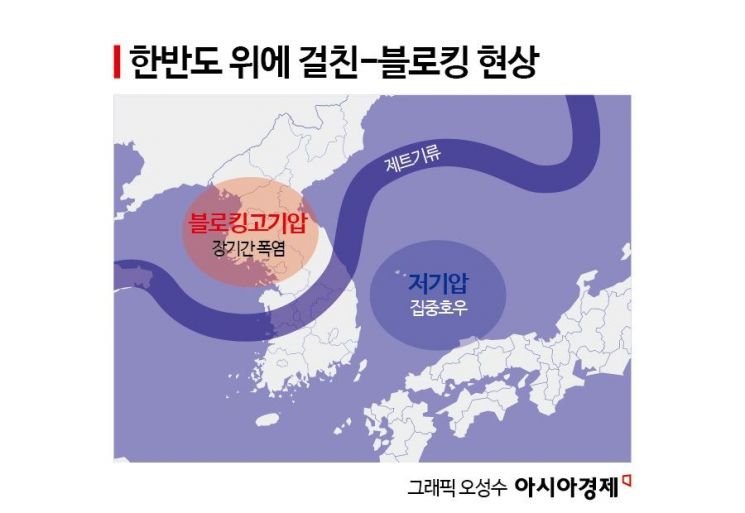
Recently, the background of heatwaves and torrential downpours on the Korean Peninsula has been attributed to 'Arctic Amplification' and the weakening of the jet stream. As Arctic temperatures rise more than twice as fast as those in other regions, the temperature difference narrows, causing the jet stream-which drives large-scale air currents-to weaken. The destabilized jet stream becomes wavier, leading to a 'blocking' phenomenon that disrupts atmospheric flow. As a result, high-pressure and low-pressure systems linger over one area for extended periods, triggering heatwaves and extreme rainfall.
Currently, the development of a trough in northern Korea is causing an upper-level high-pressure system to move southward, resulting in heatwaves mainly in the southern regions. Lee explained, "This is a temporary phenomenon, and even after the passage of the upper-level low-pressure system, there is a high possibility of lingering heat in August and September." He further projected, "Since global sea surface temperatures remain high, the heatwave could persist for an extended period."
Typhoons are also a variable. Although more typhoons formed in July this year compared to average years, they did not affect the Korean Peninsula due to strong high-pressure systems. However, if the high-pressure weakens after mid-August, the path for typhoons to approach the Korean Peninsula is likely to open up. Lee added, "We cannot rule out the possibility of a typhoon in October, as was the case in 2014."
© The Asia Business Daily(www.asiae.co.kr). All rights reserved.

















