Employment Growth Remains in the 100,000 Range for Two Consecutive Months
Manufacturing and Construction Sectors Continue to Decline
Youth Employment Rate Falls for 15th Straight Month
In July, the number of employed people increased by nearly 170,000, marking the second consecutive month with an increase in the 100,000 range. The decline in employment in the manufacturing and construction sectors has also continued for over a year. The employment rate among young people has shown a negative trend for 15 consecutive months.
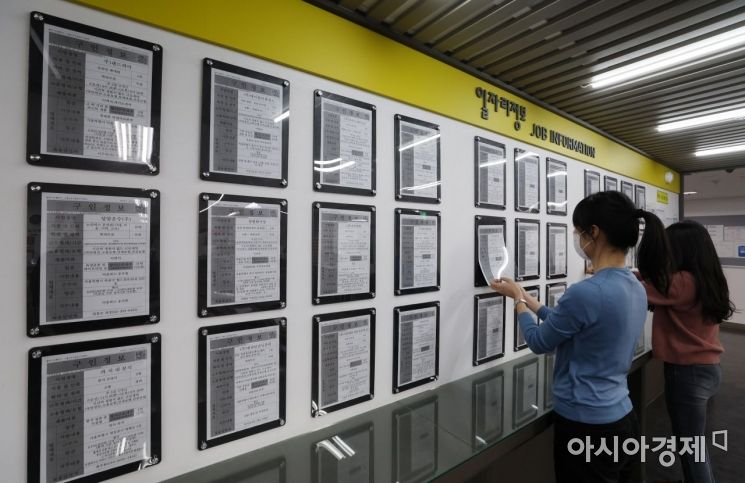 The number of employed people increased by more than 1.13 million compared to the previous year in January. This increase is the largest in 22 years. However, it is largely attributed to the fact that the number of employed people had decreased by nearly 1 million due to the COVID-19 pandemic a year ago. Especially when looking at different age groups, the number of employed people in their 30s, which had decreased by more than 270,000 a year ago, only increased by about 20,000 in January. The photo shows employees at the Seoul Western Employment Support Center replacing job information on the job information bulletin board that day. Photo by Kim Hyunmin kimhyun81@
According to the "July Employment Trends" released by Statistics Korea on August 14, the number of employed people aged 15 and over last month was 19,029,000, an increase of 171,000 compared to the same month last year. The increase in employment remained in the 100,000 range for the second month in a row, following the previous month's 183,000. This is the lowest increase since February (136,000).
By industry, the number of people employed in manufacturing decreased by 78,000. Although the decline was smaller than in June (-83,000), it has continued for 13 consecutive months since July last year (-11,000). The construction sector also saw a decrease for the 15th consecutive month since May last year (-47,000), as the construction market downturn persisted. The decrease was 92,000, a slight improvement from the previous month's 97,000 decline.
The agriculture, forestry, and fisheries sector (-127,000) recorded a decrease for the sixth consecutive month. The number of people employed in the accommodation and food service sector, which is related to domestic demand, also fell by 71,000, marking a decline for the third consecutive month, and the decrease was larger than the previous month (-38,000). This is the largest drop in the accommodation and food service sector since November 2021 (-86,000). The number of people employed in wholesale and retail increased by 130,000, marking a third consecutive month of growth.
On the other hand, the healthcare and social welfare services sector saw an increase of 263,000, while professional, scientific, and technical services (91,000) and finance and insurance (38,000) also experienced growth in employment. The finance and insurance sector has now seen employment increase for 16 consecutive months.
By age group, the number of employed people aged 60 and over (342,000) and those in their 30s (93,000) increased, while the number of people in their 20s (-135,000) continued to decline. Employment also decreased among those in their 40s (-56,000) and 50s (-49,000). The number of employed young people (aged 15-29) fell by 158,000.
The employment rate (ages 15-64) stood at 70.2%, up 0.4 percentage points from the same month last year. However, the employment rate among young people (ages 15-29) was 45.8%, down 0.7 percentage points from a year earlier. The youth employment rate has now declined for 15 consecutive months.
The number of unemployed people was 726,000, a decrease of 11,000 from last year. The unemployment rate was 2.4%, down 0.1 percentage points from the previous year. The youth (ages 15-29) unemployment rate remained unchanged at 5.5% compared to last year.
The economically active population, which includes both employed and unemployed people, was 29,754,000, an increase of 160,000 from a year earlier. The economically inactive population was 16,004,000, up by 8,000. Among them, the number of people who were "resting," meaning not seeking work, increased by 69,000 from a year ago. The number of discouraged job seekers was 396,000, up 15,000 from the previous year.
© The Asia Business Daily(www.asiae.co.kr). All rights reserved.

















