The scale of wildfire damage in Canada this year has been identified as the second largest on record. Experts have warned that, due to climate change, we have entered a 'new reality' from which there is no return to the past.
The British daily The Guardian reported on the 11th (local time) that, according to the Canadian Interagency Forest Fire Centre (CIFFC), wildfires this year have affected an area of 7,318,421 hectares (about 73,000 square kilometers). This is the second largest area of damage after 2023 (18.5 million hectares), with the third largest on record being 17,203,625 hectares.
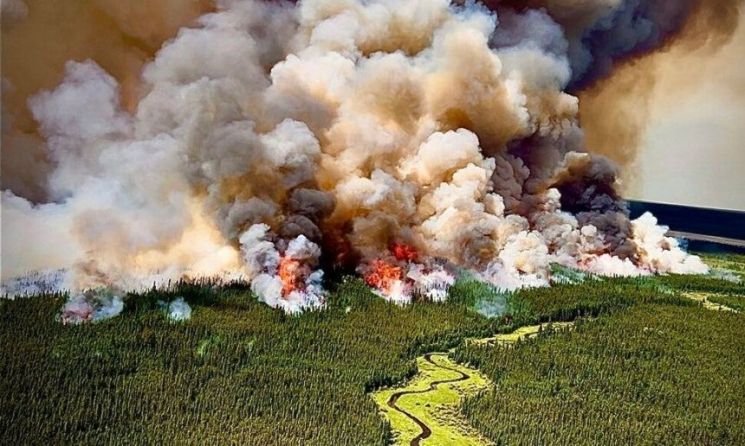 Aerial photo taken by the Public Safety Agency of Saskatchewan of the wildfire that occurred in northern Saskatchewan in July and August. Photo by AFP Yonhap News
The Canadian wildfire management agency has classified more than 470 fires nationwide as 'out of control.' Particularly severe fires have been concentrated in Saskatchewan and Manitoba, the prairie regions of Canada. These two provinces account for about 60% of the total area burned by wildfires in Canada this year.
Nationwide, tens of thousands of residents have been confirmed to have evacuated. In Saskatchewan, more than 6,700 households and over 17,000 residents evacuated with the help of the Canadian Red Cross. In Newfoundland and Labrador, on the eastern coast, evacuation orders were issued for several cities due to intense wildfires.
Experts have cited 'climate change' as the cause of this wildfire spread. Mike Flannigan, Chair of Predictive Services, Emergency Management, and Fire Science at Thompson Rivers University, stated, "This is our new reality," and predicted, "As the weather gets warmer, fires will occur more frequently." He added that hotter climates dry out fuels, dead vegetation, and the forest floor by absorbing moisture, creating conditions that make fires more likely.
The 2025 analytical report published by the United Nations University in Japan also included the assessment that this year's Canadian wildfires are "a stark sign of climate change." The report noted, "Warm and dry spring weather raised temperatures by 2.5 degrees above the average."
John Abatzoglou, a professor at the University of California, Merced, pointed out that Canadian wildfires are also affecting neighboring countries such as the United States, and emphasized, "The wildfire issue must be addressed as an international problem."
Recently, France also experienced its worst wildfire in 75 years. The wildfire, which was extinguished on the 7th, burned about 17,000 hectares (about 170 square kilometers), turning more than 1.5 times the area of Paris (10,540 hectares) to ashes. The blaze swept through 15 villages in the Corbi?res mountain region, destroying 36 houses.
© The Asia Business Daily(www.asiae.co.kr). All rights reserved.

















