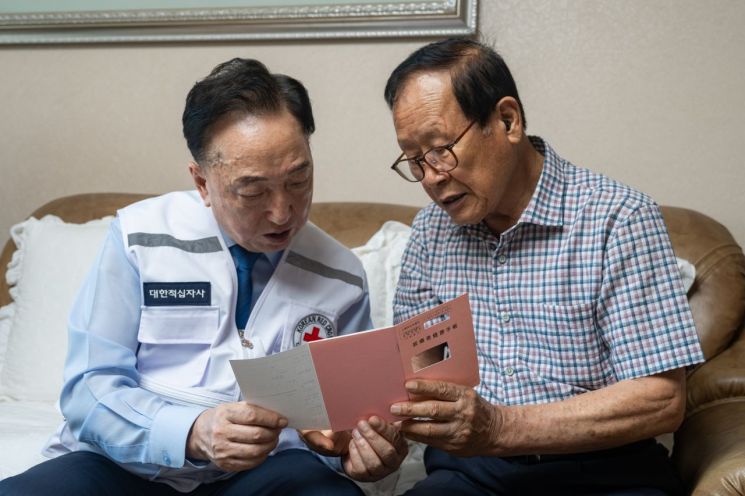
 Atomic bomb survivor Jung Jeongwoong is explaining the atomic bomb victim identification booklet to Kim Cheolsu, president of the Korean Red Cross. Korean Red Cross
Kim Cheolsu, Chairman of the Korean Red Cross, visited the home of atomic bomb survivor Jung Jungwoong (85), who resides in Jeongneung-dong, Seoul, on August 12, ahead of the 80th anniversary of Liberation.
This visit was part of the "Heart Bodomi Project," in which the Korean Red Cross, to mark the 80th anniversary of Liberation, is visiting all 1,589 surviving atomic bomb victims across the country throughout the month of August to deliver comfort packages and check on their well-being.
The recipient of this visit, Jung Jungwoong, was exposed to the atomic bomb in Hiroshima, Japan, while staying there with his parents, who had been forcibly mobilized to work in a munitions factory. Although 80 years have passed, Jung, who was five years old at the time, still vividly remembers the scene of radioactive fallout. His entire family survived because they were inside their house, but two cousins and neighbors who were outside died instantly. After returning to Korea, Jung endured years of poverty and hunger, including during the Korean War.
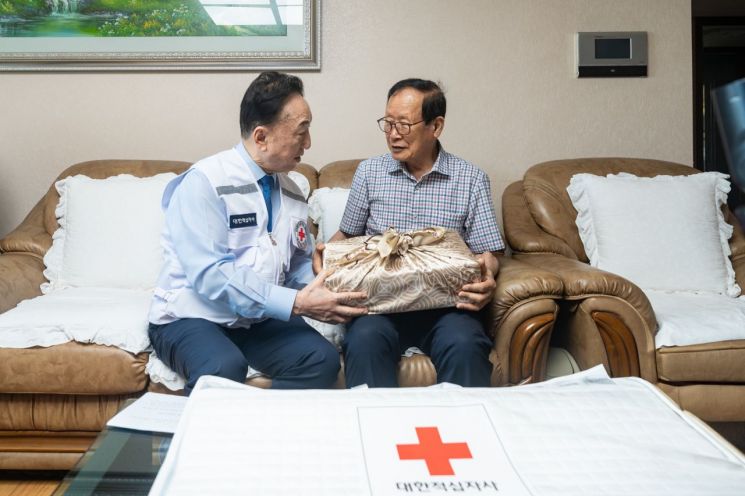 Kim Cheolsu, Chairman of the Korean Red Cross, is visiting atomic bomb victim Jeong Jungwoong to offer consolation and deliver gifts. Korean Red Cross
Since 1996, Jung Jungwoong has received medical expenses and medical assistance subsidies from the Korean government through the Korean Red Cross, and since 2003, he has also received monthly support payments and medical expenses from the Japanese government. However, when his mother died of cancer over 30 years ago, he was unaware of these programs and was unable to receive timely support.
Kim Cheolsu, Chairman of the Korean Red Cross, stated, "Since 1986, the Korean Red Cross has worked to improve the welfare of atomic bomb victims. We will continue to support victims and, at the same time, collaborate with members of the International Red Cross Movement to ensure that such tragedies are never repeated."
Since 1991, the Korean Red Cross has been solely responsible for welfare programs for atomic bomb victims, delegated by both the Korean and Japanese governments. Key initiatives include customized support throughout the life cycle (medical expenses, comprehensive health checkups, support payments, funeral costs, etc.), mobile health consultations, and the operation of welfare centers for atomic bomb victims.
© The Asia Business Daily(www.asiae.co.kr). All rights reserved.
![Clutching a Stolen Dior Bag, Saying "I Hate Being Poor but Real"... The Grotesque Con of a "Human Knockoff" [Slate]](https://cwcontent.asiae.co.kr/asiaresize/183/2026021902243444107_1771435474.jpg)

















