Small Businesses Say "Too Difficult to Bear" Amid Stricter Industrial Accident Penalties
Calls for Easing Working Hour Regulations and Flexible Labor System Improvements
As the government announced plans to strengthen penalties for employers in the event of industrial accidents, small and micro-sized businesses voiced concerns, stating that such measures are "unrealistic to bear" and called for improvements to the system and expanded support. They expressed worries that, given the lack of both manpower and financial resources, the expanded application of the Serious Accidents Punishment Act could make it difficult for them to continue operating.
Kim Yoonjung, Chairman of the Seoul Printing Information Industry Cooperative, met with reporters after a labor and workforce issue meeting held at the Korea Federation of Small and Medium Business in Yeouido, Seoul, on the 12th. He said, "Instead of placing all responsibility on the employer for accidents that occur around the workplace, I hope that the possibility of employee negligence will also be considered. No matter how much care an employer takes and how much training is provided to staff, there is no way to prevent accidents that happen in an instant. This is an issue that requires further consideration."
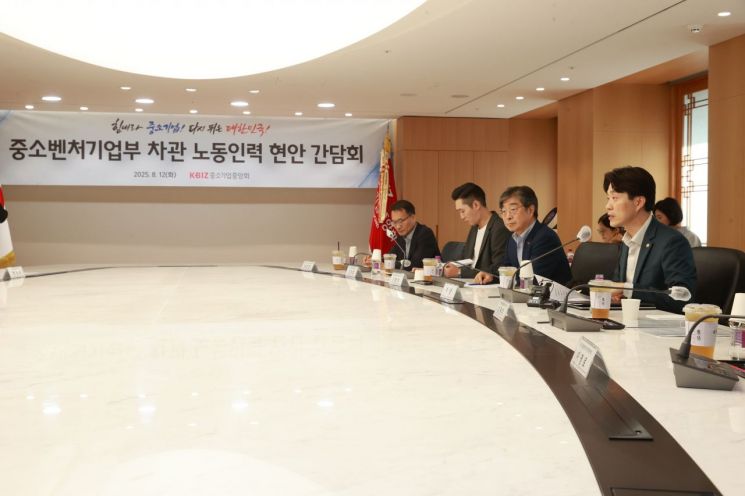 On the 12th, a labor and workforce issue meeting was held at the Korea Federation of Small and Medium Business in Yeouido, Seoul, chaired by Noh Yongseok, Vice Minister of the Ministry of SMEs and Startups. Ministry of SMEs and Startups
He emphasized that before strengthening penalties for employers in the event of industrial accidents, environmental improvements and support for safety management must come first. Kim noted, "There are about 5,000 printing companies in Chungbuk alone, and because the environment itself is poor, the risk of accidents lurks everywhere. The risk of occupational diseases is high due to dust, noise, and foul odors, so the environment itself must be improved," he said.
At the meeting, key labor issues for small and medium-sized businesses were broadly discussed, including the Yellow Envelope Act, the Serious Accidents Punishment Act, and working hour regulations such as the 52-hour workweek. Kim stated, "Small businesses are facing a severe labor shortage, and if working hours are further reduced from the current 52-hour workweek to a four-and-a-half-day workweek, we will have no choice but to close our doors. I hope that conditions can be created so that we can work more during peak seasons and reduce work during off-seasons to balance overall working hours," he said.
Noh Yongseok, Vice Minister of the Ministry of SMEs and Startups, said, "Emphasizing industrial safety, improving working conditions for foreign workers, revising the Trade Union Act, and extending the retirement age are all major labor issues that will have an even greater impact on small and medium-sized businesses with limited personnel and resources. We will work closely with relevant ministries to ensure that the voices of the SME sector are not overlooked regarding these issues," he said.
© The Asia Business Daily(www.asiae.co.kr). All rights reserved.

















