Goal to Pass Judicial Reform Bill Before Chuseok
Jung Cheongrae: "Minority Control Contradicts Democracy"
Proposal to Expand Supreme Court Justices to 30 Discussed at Meeting
On August 12, Democratic Party leader Jung Cheongrae called for the Special Committee on Judicial Reform to swiftly prepare reform proposals, stating, "We must fulfill judicial reform in accordance with the will of the people, but the most important thing is to seize the golden time for reform."
Speaking at the launch ceremony and first meeting of the Democratic Party's Special Committee on Judicial Reform held at the National Assembly that afternoon, Jung added, "With a sense of historic mission to complete judicial reform before Chuseok, as we have set as our goal, I ask all our committee members to fully commit to this task."
Jung also pointed to the concentration of power among a small group as one of the causes of declining public trust in the judiciary, along with issues such as trial delays and concerns over hasty trials. He said, "Article 27, Clause 3 of the Constitution states that 'all citizens have the right to a prompt trial' and 'criminal defendants have the right to be tried without delay unless there is a substantial reason.' However, this constitutional mandate is not being realized in our judicial system, and as a result, citizens' rights continue to be infringed upon."
He continued, "The very notion that a small group monopolizes or covertly controls certain matters runs counter to the principles of democracy. Therefore, I urge our committee members to break through bottlenecks and clear stagnation in accordance with democratic principles, so that judicial reform can restore public trust in the judiciary."
Baek Hyeryeon, chair of the special committee, also stressed the need for reform, saying, "Public trust in the judiciary is currently at rock bottom. According to a public opinion poll released in April, 61.8% of respondents said they do not trust the judiciary, showing that more than 6 out of 10 citizens lack confidence in our highest judicial institution."
She explained that the committee's goals include "increasing the number of Supreme Court justices, which has long been discussed as a key reform task, and enhancing the objectivity and independence of judicial evaluations to improve transparency and strengthen democratic oversight of the judicial system, thereby restoring public trust. We also aim to improve ordinary citizens' access to judicial services and protect their rights by expanding citizen participation trials and increasing the disclosure of court rulings."
Ruling Party: "Some Lawmakers Agree to Expand Supreme Court Justices to 30... No Plans to Appoint Non-Lawyer Justices"
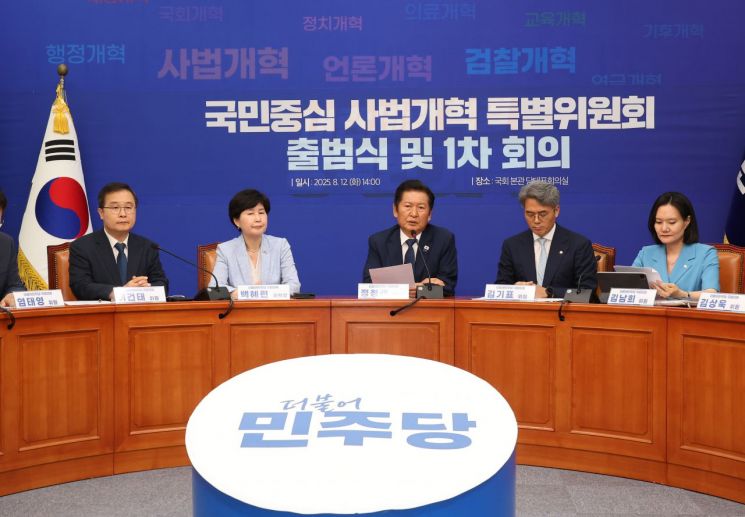
At the meeting, the committee selected five major agenda items: increasing the number of Supreme Court justices, improving the nomination process for Supreme Court justices, reforming the judicial evaluation system, expanding the disclosure of lower court rulings, and introducing a pre-approval system for search and seizure warrants.
Lee Geontae, the committee's secretary, told reporters after the meeting, "We will hold an expert public hearing on the 19th and a public listening session on the 27th of this month. We plan to submit the bill as quickly as possible after these hearings and reviews, aiming for completion before Chuseok."
When asked whether there had been specific discussions on the scale of the Supreme Court justice expansion, Lee replied, "We need to develop a proposal through the public hearing, but some lawmakers generally agreed to expand the number to 30, which would mean an increase of 16 justices."
Asked about communication with the presidential office, given reports that President Lee Jaemyung had urged caution on the pace of expanding the Supreme Court, Lee said, "We will need to consult with the government and the presidential office during the committee's work and the process of drafting proposals. However, no specific dates for such consultations have been set yet."
Regarding the nomination process for Supreme Court justices, Lee commented, "Currently, the nomination process is supposed to ensure formality, procedure, transparency, and diversity, but in reality, the Chief Justice ultimately recommends those he prefers. The candidate pool is not one that guarantees democratic legitimacy, so we will work to assemble a pool that can ensure the diversity the public demands."
Asked whether the Democratic Party would revive its previously withdrawn proposal to appoint non-lawyer Supreme Court justices, which was introduced in May during the presidential election period but later retracted due to controversy, Lee stated firmly, "Supreme Court justices handle highly complex legal matters and therefore must be legal experts. I believe the court should be composed of individuals with ample experience."
Regarding suggestions that the push to expand the Supreme Court is related to President Lee Jaemyung's own trial outcomes or previous investigations and search and seizure warrants, Lee responded, "That is not the case. Judicial reform and the expansion of the Supreme Court have been longstanding issues. The Supreme Court has been facing a backlog of cases, and even during the Park Geunhye administration, there were efforts to resolve this issue, such as the proposal to establish an appellate court."
© The Asia Business Daily(www.asiae.co.kr). All rights reserved.


















