After Meeting With Intel CEO Amid "China Allegations,"
Trump Shifts His Stance
U.S. President Donald Trump is exerting significant influence over the global strategies and leadership of major semiconductor companies. After previously allowing exports to China on the condition that 15% of chip sales revenue be paid, President Trump has now announced that he is considering permitting the export of Nvidia's Blackwell chips to China.
During a press briefing on August 11 (local time), President Trump stated, "We may allow transactions involving Blackwell processors with somewhat reduced performance," adding, "Specifically, their performance would be lowered by about 30 to 50 percent."
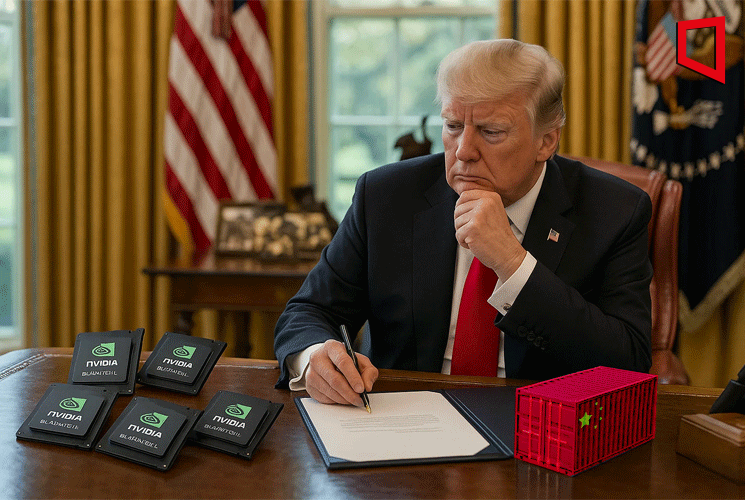
President Trump did not specify when he would discuss the Blackwell chips with Nvidia CEO Jensen Huang, but suggested the possibility of a meeting by saying, "It seems he will come back to see me about that issue." He also clarified that, if such a deal occurs, it would involve a lower-performance version rather than the top-tier model.
Additionally, President Trump confirmed media reports from the previous day that an agreement had been reached with Nvidia to pay 15% of sales revenue to the U.S. government in exchange for permission to sell H20 chips to China. The South China Morning Post (SCMP) in Hong Kong reported that President Trump himself was the party to this deal.
Currently, the export of Nvidia's latest chips, including the Blackwell series, to China is prohibited. In response to the Biden administration's restrictions on the export of advanced chips used for artificial intelligence (AI) development, Nvidia released a lower-performance H20 chip specifically for the Chinese market. President Trump banned the export of the H20 chip in April this year, but abruptly reversed his position and authorized exports after meeting with CEO Huang.
After the semiconductor export restrictions to China were tightened in April, Nvidia announced that it would develop new China-exclusive chips to obtain approval, but also stated that the Hopper architecture, which underpins the China-specific H20 chip, could not be further downgraded in performance.
Such agreements are characteristic of the Trump administration's typical negotiation pattern: securing U.S. investments and job growth in exchange for concessions in trade. However, U.S. national security experts have expressed concerns that President Trump's sudden reversal of the policy to curb China's technological capabilities could undermine national security justifications.
On the same day, President Trump also met with Intel CEO Lip-Bu Tan, who had faced calls for resignation over alleged ties to China. On his social media platform, Truth Social, President Trump wrote, "Today, I met with Intel's Lip-Bu Tan, along with Commerce Secretary Howard Lutnick and Treasury Secretary Scott Besant. It was a very interesting meeting." He continued, "His success and rise are remarkable stories," adding, "Mr. Tan and my cabinet members will spend more time together, and he will bring proposals to me next week."
Tan, a Chinese-American born in Malaysia, was appointed as Intel's new CEO in March. However, controversy arose when Senator Tom Cotton (Republican, Arkansas), chairman of the Senate Intelligence Committee, sent a letter to Intel's board demanding clarification regarding Tan's alleged connections to China. Tan previously served as CEO of Cadence Design Systems, a semiconductor design software company that paid substantial fines to the U.S. government for selling its software to Chinese universities. Additionally, suspicions intensified as Tan had invested in hundreds of Chinese companies through his venture fund.
Given that President Trump, who had called for Tan's resignation on Truth Social on August 7, has since changed his stance, it appears that Tan has successfully addressed the concerns. In particular, since Trump mentioned that Tan would bring proposals, it is expected that Intel will pursue large-scale investments and cooperation with the U.S. government in the future.
Foreign media outlets have noted that it is unusual for President Trump to publicly demand a CEO's resignation. Along with the requirement for Nvidia and AMD to pay 15% of their China export revenues, concerns have been raised about the extent of government control over corporate management.
Meanwhile, following news of the meeting between President Trump and CEO Tan, Intel's stock price closed up 3.51% in regular trading.
© The Asia Business Daily(www.asiae.co.kr). All rights reserved.

















