14 out of 100 Seoul Residents
Spend Over Two Hours Commuting or Traveling to School
Long Commutes Harm Health
Forced to Endure Due to Rising Housing Costs
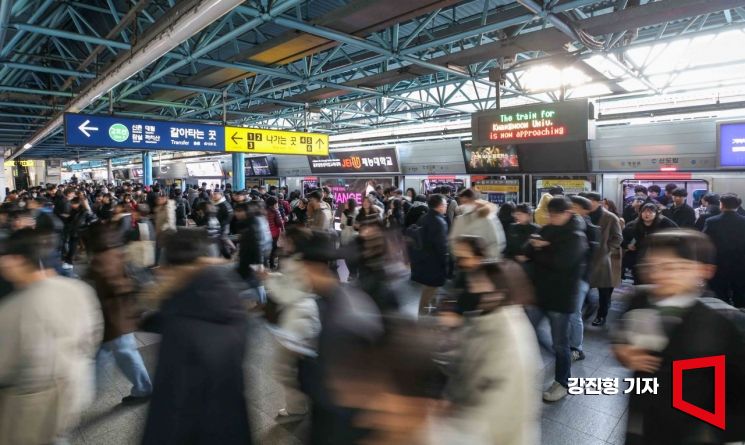
It has been found that about 14 out of every 100 Seoul residents spend more than two hours a day commuting to work or school.
According to the Seoul Institute on August 11, the average one-way commute or school travel time in Seoul in 2023 was approximately 34.5 minutes, meaning the round trip takes more than an hour. Big data analysis of metropolitan area mobility in 2024 also showed that the average commute time within Seoul during the morning rush hour (7?9 a.m.) was about 35.3 minutes.
14 out of 100 say "Commute or school travel takes more than two hours"
The 2023 survey by the Seoul Metropolitan Government found that 13.5% of all citizens spend more than one hour on a one-way commute or school trip. In other words, about 14 out of every 100 people spend at least two hours a day on round-trip commuting or school travel.
Most Seoul residents who spend more than an hour on a one-way commute live in outer districts with inconvenient transportation, such as Yangcheon-gu, Gangdong-gu, Gangbuk-gu, and Dobong-gu.
Longer commuting times also affect satisfaction with family life and social life. According to a 2022 paper titled "The Impact of Commuting Time on Quality of Life: The Case of China," published in the Archives operated by the U.S. National Institutes of Health (NIH), longer commutes are associated with lower job and life satisfaction. In addition, long commutes negatively affect physical health and lead to reduced physical activity, causing health problems.
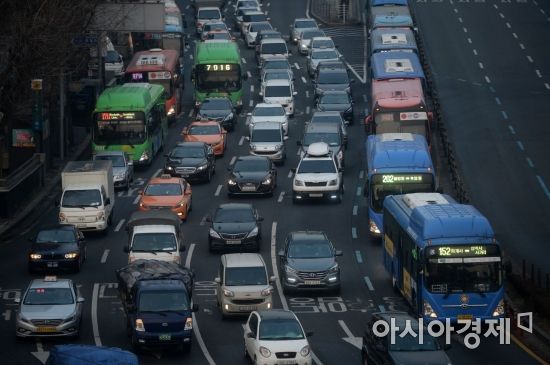 The downtown viewed from Seoul-ro 7017 shows congestion with vehicles during the evening rush hour. Photo by Asia Economy DB
Long commutes harm health... Forced to endure due to housing costs
A 2019 paper titled "Commuting Time and Behavior-Related Health: A Fixed-Effects Analysis" also found that people who work more than 40 hours a week and commute more than five hours per week are more likely to experience physical inactivity and sleep problems than those who commute one to five hours per week.
Long commuting times also result in economic losses. According to a 2013 report by the Korea Transport Institute, the economic value of one hour spent commuting is estimated at about 940,000 won per month. Calculated as a two-hour round trip, this amounts to an economic loss of about 1,880,000 won per month. However, as housing prices rise, people are forced to endure long commutes.
The Seoul Institute pointed out that since 2010, urban growth and increasing complexity, as well as rising housing prices in the Seoul metropolitan area, have led many people to secure housing in the outskirts of Seoul and Gyeonggi Province regardless of their workplace location. As a result, this has caused long-distance (and long-duration) commutes.
© The Asia Business Daily(www.asiae.co.kr). All rights reserved.

















