A next-generation ophthalmic diagnostic technology has been developed in South Korea that can detect retinal diseases and functional deterioration using contact lenses equipped with ultrathin organic light-emitting diodes (OLEDs).
This technology is expected to replace conventional retinal diagnostic methods that rely on stationary equipment, and could be applied in the future to areas such as myopia treatment, ocular biosignal analysis, augmented reality (AR) visual delivery, and light-based neural stimulation.
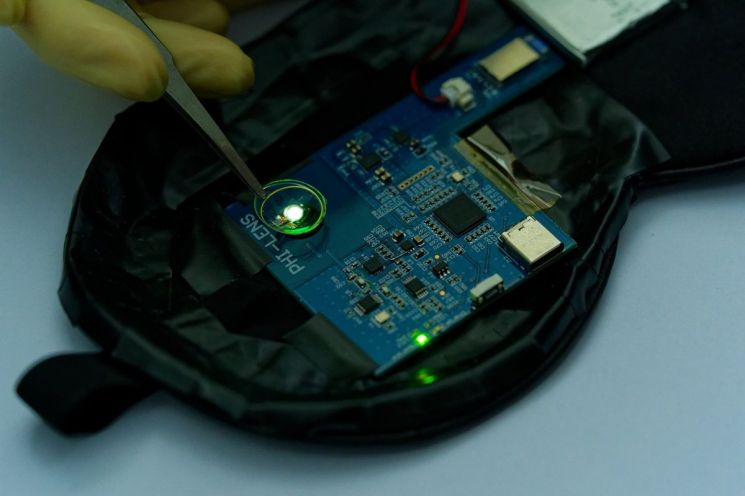 The research team is demonstrating wireless operation using an ultrathin OLED contact lens sample. Provided by KAIST
KAIST announced on August 12 that a research team led by Professor Yoo Seunghyup of the School of Electrical Engineering, in collaboration with Professor Woo Sejoon of Seoul National University Bundang Hospital, Professor Han Saekwang of POSTECH, PHI Biomed, and the Electronics and Telecommunications Research Institute (ETRI), has developed the world's first wireless contact lens-based "wearable retinal diagnostic platform" using OLED technology.
This technology allows retinal potential measurement simply by wearing the lens, offering the advantage of dramatically simplifying the traditionally complex ophthalmic diagnostic environment.
Until now, electroretinography (ERG) tests have been conducted in dark rooms using large, stationary ERG machines installed in ophthalmology clinics, requiring patients to keep their eyes open and remain still. This environment imposes spatial constraints and demands the patient's full cooperation.
To overcome these inconveniences, the joint research team integrated an ultrathin, flexible OLED (12.5μm thick), which is 6 to 8 times thinner than a human hair (70?100μm), into the ERG contact lens electrode, and also incorporated a wireless power-receiving antenna and control chip, creating a system capable of independent operation.
In particular, the team adopted wireless power transmission using a 433MHz resonant frequency and implemented it as a sleep mask-type wireless controller that can be linked to a smartphone, thereby increasing the feasibility of real-world use.
Most existing smart contact lens-type light sources developed to shine light into the eye use inorganic LEDs. However, inorganic LEDs are rigid and, due to their "point light source" characteristic that emits strong light from a single spot, are prone to heat accumulation issues. This structural limitation restricts the amount of light that can be safely used in actual clinical settings.
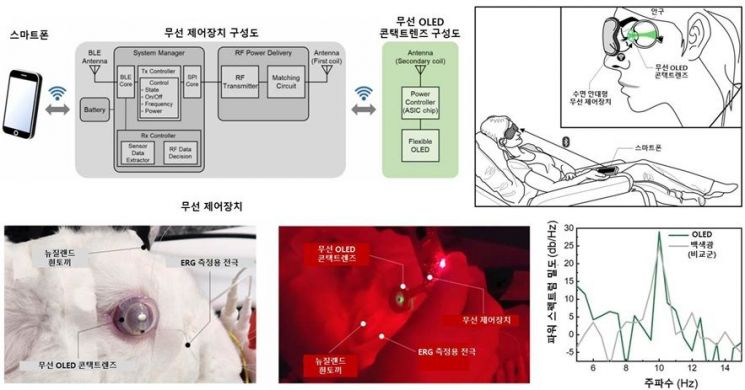 Schematic diagram of a retinal potential measurement system using wireless OLED contact lenses. Provided by KAIST
In contrast, OLEDs are surface light sources that allow for wide and uniform illumination and can induce sufficient retinal responses even under low-luminance conditions.
In fact, the joint research team was able to induce stable ERG signals at a relatively low brightness of 126 nits (a measure of surface or screen brightness), securing diagnostic signals equivalent to those of existing commercial light sources.
Based on these results, animal experiments showed that the surface temperature of rabbits' eyes wearing the OLED contact lenses remained below 27 degrees Celsius, preventing thermal damage to the cornea, and that the light-emitting performance was maintained even in hot and humid environments. This demonstrates that the device can serve as an effective and reliable ERG diagnostic tool in actual clinical settings.
Professor Yoo Seunghyup said, "This is the world's first attempt to integrate the flexibility and diffused light characteristics of ultrathin OLEDs into contact lenses," and added, "We hope that these research results will contribute to the expansion of digital healthcare technology."
© The Asia Business Daily(www.asiae.co.kr). All rights reserved.


















