Agreement on Emergency Capital Injection Averts Default Crisis
Prolonged 'Raw Material Price War' Looms Amid Petrochemical Slump
Diverging Views on Ethylene Price Floor and Long-Term Contracts
The conflict between Hanwha Solutions and DL Chemical, the joint major shareholders of Yeocheon NCC, is intensifying. Although both sides participated in a capital increase, allowing Yeocheon NCC to narrowly avoid a default crisis, the dispute has escalated over structural issues such as responsibility for the situation and the terms of raw material supply contracts.
On August 12, Hanwha Group released a statement, claiming that DL Group had caused significant losses to Yeocheon NCC through low-priced transactions in the past and called for DL to join efforts to overcome the default crisis. According to Hanwha, Yeocheon NCC was subject to an additional tax assessment totaling KRW 100.6 billion following a National Tax Service audit earlier this year, after selling ethylene and C4R1 (a synthetic rubber feedstock) at prices below market value. Of this amount, transactions with DL Group accounted for KRW 96.2 billion (96%), while transactions with Hanwha accounted for KRW 4.4 billion (4%). The breakdown of the DL transactions is KRW 48.9 billion for ethylene, KRW 36.1 billion for C4R1, KRW 9.7 billion for isobutane, and KRW 1.5 billion for other items.
Hanwha stated, "The National Tax Service determined that DL Group obtained unfair profits," and added, "It is inevitable that contract terms must be revised to reflect market prices." Hanwha also criticized, "DL Chemical is demanding a 20-year long-term contract at prices below market value, which essentially means they intend to secure enormous profits from Yeocheon NCC over the next 20 years." Hanwha warned that, "If unfair contract terms continue, there could be another tax assessment resulting in significant losses," and expressed willingness to undergo verification by external experts. Hanwha further emphasized, "As a shareholder, it is our responsibility to participate in financial support to alleviate the concerns of employees, the local community, and the industry."
This conflict is closely linked to the renegotiation of the ethylene supply contract between Yeocheon NCC and its two major shareholders. Following the National Tax Service audit, the supply contracts that both companies had with Yeocheon NCC expired earlier this year. In the renewed contract negotiations, their positions have diverged. DL Chemical is demanding a 'price floor' and a long-term contract to prevent sales below cost, while Hanwha insists on not setting a price floor and instead wants to procure raw materials at lower prices if market conditions decline.
The dispute surrounding Yeocheon NCC is widely seen as a reflection of the ongoing slump in the domestic petrochemical industry. During boom periods, the price of raw material supply was not an issue at all. However, when product prices fall, companies must lower raw material costs to maintain margins.
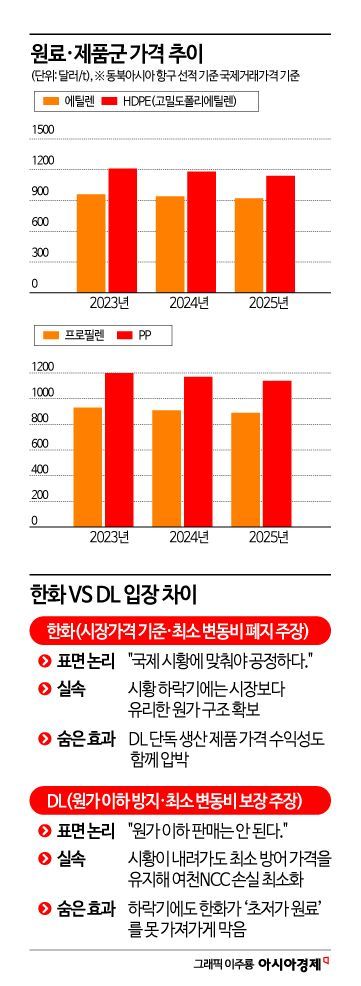
Northeast Asia's ethylene price fell by 4% from $960 per ton in 2023 to $920 per ton last month, while propylene dropped from $930 to $890. The high-density polyethylene (HDPE) spread declined from $250 to $220 over the same period, low-density polyethylene (LDPE) from $350 to $300, and PVC from $330 to $290.
Yeocheon NCC accounts for about 14% of domestic ethylene production. Hanwha Solutions, a Hanwha affiliate, uses this to produce 450,000 tons of LDPE and 810,000 tons of PVC annually, while DL Chemical produces 180,000 tons of HDPE and C4R1. Due to deteriorating profitability by product, both parties are finding it difficult to make concessions in negotiations.
DL Group convened an emergency board meeting the previous day and decided to inject KRW 200 billion into Yeocheon NCC through a capital increase. This came just three days after Hanwha Solutions announced its intention to participate in the capital increase. However, DL Chemical attached the condition that "management efficiency and structural improvements must be prerequisites."
Yeocheon NCC was established in 1999, with Hanwha Petrochemical (now Hanwha Solutions) and Daelim Industrial (now DL Chemical) each contributing a 50% stake. During downturns, this 50-50 structure has led to delays in decision-making and conflicts over management control. Since 2022, accumulated losses have forced the shutdown of Yeosu Plant 3 this year.
© The Asia Business Daily(www.asiae.co.kr). All rights reserved.
![Clutching a Stolen Dior Bag, Saying "I Hate Being Poor but Real"... The Grotesque Con of a "Human Knockoff" [Slate]](https://cwcontent.asiae.co.kr/asiaresize/183/2026021902243444107_1771435474.jpg)

















