Proportion of Fatal Falls at 56.9%... "Developing Country-Type" Disasters on the Rise
Majority of Deaths Attributed to Individual Negligence, Higher Than Last Year
Aging Workforce, Communication Barriers with Foreign Workers, and Illegal Subcont
From the beginning of this year through last month, 102 people lost their lives at construction sites across the country. Despite a slump in the construction sector, more than 14 "funerals" are still taking place every month. Structural problems such as an aging workforce at sites, communication barriers with foreign workers, and illegal subcontracting remain unresolved. At the same time, the proportion of so-called "developing country-type disasters"-such as fatal falls-and accidents caused by individual negligence has risen sharply. Experts are calling for immediate measures that can directly reduce fatalities.
Rising Share of Fatal Falls and Individual Negligence... 'Developing Country-Type' Disasters Persist
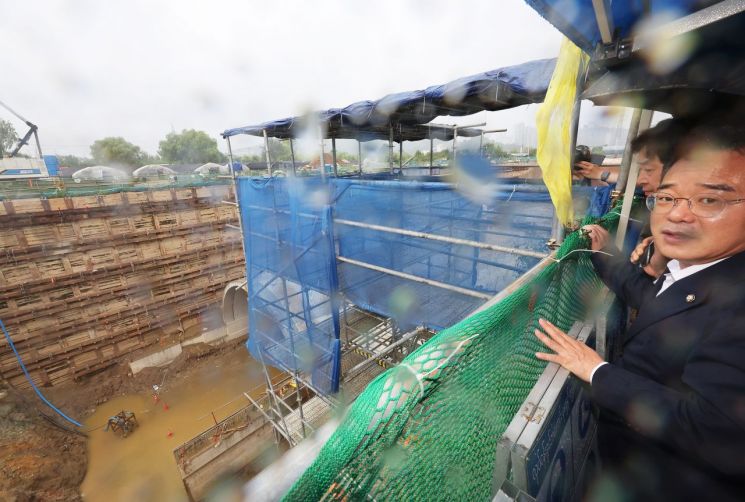 Democratic Party lawmakers inspecting the accident site on the Gwangmyeong-Seoul Expressway where a foreign worker suffered an electric shock fatality. Photo by Yonhap News.
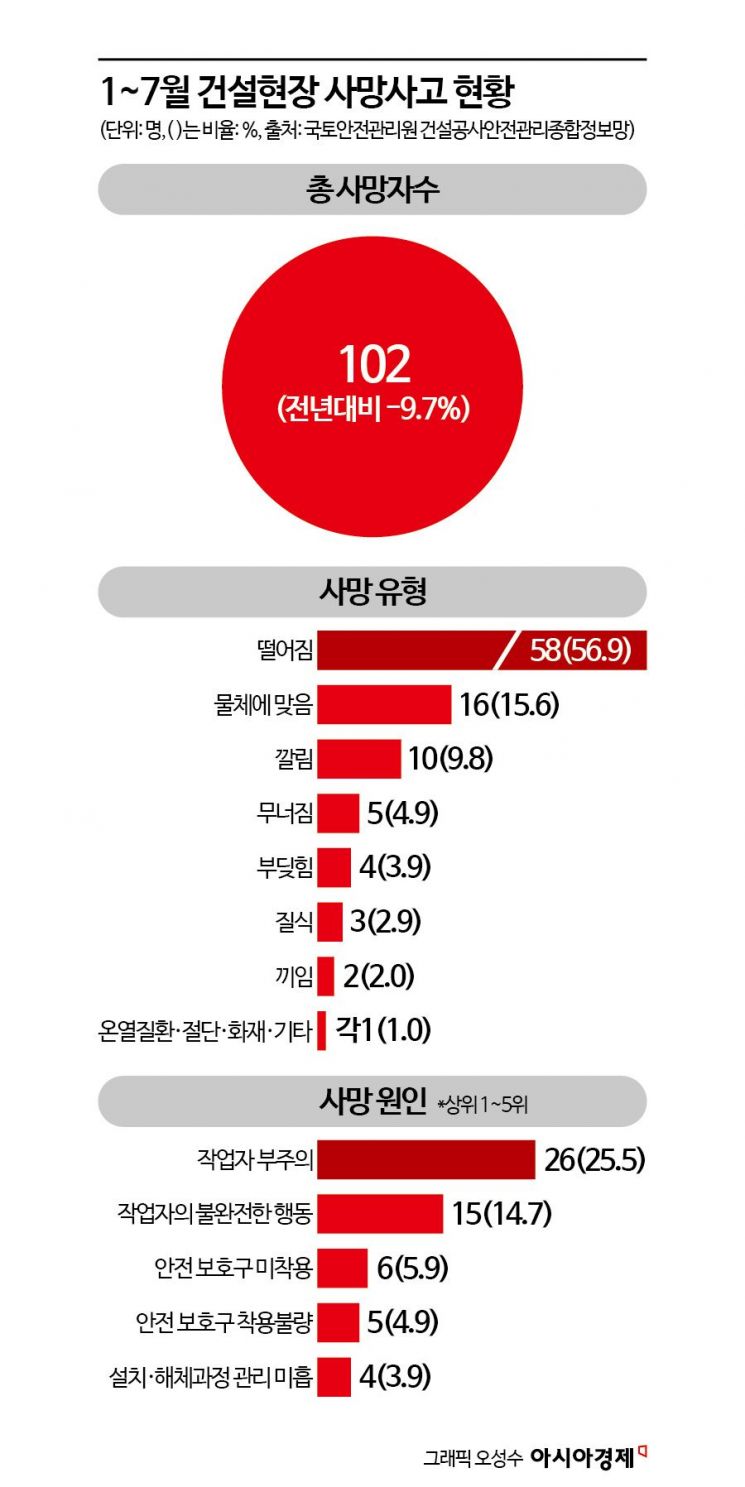
According to an analysis of accident data compiled by the Construction Safety Integrated Information System (CSI) of the Korea Infrastructure Safety and Technology Corporation as of August 13, there were 102 deaths (excluding disease) at construction sites from January to July this year. This is about a 10% decrease compared to the same period last year, when 113 people died. Construction site accidents are counted based on cases involving death or injuries requiring at least three days of absence from work, as well as property damage of at least 10 million won.
By type of accident, 56.9% (58 people) of this year's deaths were caused by "falls," commonly referred to as fatal falls. This is 3.8 percentage points higher than the 53.1% (60 people) recorded during the same period last year. Fatal falls are widely considered "developing country-type disasters" because they can often be prevented simply by following basic safety rules and wearing protective equipment. As recently as August 8, a fatal fall occurred at a DL Construction apartment project site. Police investigations so far indicate that the worker was not wearing a safety harness. Other leading causes of death after falls include being "struck by objects" (16 people), being "crushed" (10 people), "collapse" (5 people), "collision" (4 people), "suffocation" (3 people), "caught in/between" (2 people), and heat illness, amputation, fire, and other causes (1 person each).
By cause, deaths due to worker carelessness were the most common, accounting for 26 fatalities. This was followed by unsafe worker actions (15 people), failure to wear protective equipment (6 people), improper use of protective equipment (5 people), and inadequate management during installation or dismantling processes (4 people). Except for inadequate management during installation or dismantling, all of these are classified as accidents caused by individual negligence. In total, 52 people died in such incidents, highlighting the persistent "safety insensitivity" at construction sites.
"Structural Issues Are a Long-Term Task... Preventing Individual Negligence Must Come First"
This year, 16 people have died at sites operated by the top 10 construction companies by construction capability. Six died at Hyundai Engineering, followed by four at POSCO E&C, three at Hyundai Construction, two at HDC Hyundai Development Company, and one at Samsung C&T Construction Division. The remaining 86 deaths occurred at sites managed by companies outside the top 10, where there are relatively fewer personnel for management and supervision and smaller safety budgets.
The number of foreign worker fatalities this year stands at 13, the same as last year (13 people). Foreign workers, who face language barriers and often miss out on safety training, are frequently assigned to high-risk tasks such as rebar and concrete work, often replacing domestic workers, whose workforce is rapidly aging. As of the end of January, 60.3% of domestic construction workers were in their 50s or older, and 26.6% were in their 60s or older. Additionally, the weakening of control by prime contractors due to illegal subcontracting practices is also cited as a fundamental cause of accidents at construction sites.
The number of people who lost their lives in construction accidents reached 238 in 2022, 244 in 2023, and 207 last year. Considering that the number of sites has decreased this year due to the downturn in the construction sector, the number of fatal accidents in the first seven months of this year is practically on par with last year. According to the Korea Institute of Construction Industry, the construction sector's fatality rate per 10,000 workers in the first quarter of this year was 0.43 (per 10,000), which is four times higher than the overall industry average of 0.10. Although this rate fell from 0.56 in 2021 to 0.40 in 2023, it rebounded to 0.43 last year and has remained at that level this year.
Experts point out that while structural problems are a long-term challenge, measures to prevent "developing country-type disasters" and accidents caused by individual negligence must be implemented immediately.
Choi Myungki, Vice President of the Korean Society of Construction Safety, said, "Structural issues such as an aging workforce, lack of communication with foreign workers, and illegal subcontracting require long-term solutions. However, accidents with clear causes, such as fatal falls, can be significantly reduced," adding, "It is urgent to prevent individual negligence by strengthening safety education and supervision, and by enhancing the installation of safety equipment." He went on to emphasize, "Rather than complex structural reforms, the starting point for reducing fatal accidents is establishing a culture in which basic safety rules are strictly followed at worksites."
© The Asia Business Daily(www.asiae.co.kr). All rights reserved.


















