Aerosol-Assisted Deposition Enables High-Resolution Quantum Dot Photodiode Arrays
Eliminates Photolithography Complexity and Enhances Device Stability
Paves the Way for Commercialization of Next-Generation Infrared Image Sensors
The research team led by Professor Sunghoon Kim of Dong-Eui University and Professor Seungjoo Oh of Korea University has developed a quantum dot photodiode array technology capable of implementing infrared image sensors.
 From the left, student Younggyun Choi (PhD program, Korea University), student Youngho Lee (Master's program, Dong-Eui University), Professor Sunghoon Kim (Dong-Eui University), Professor Seungjoo Oh (Korea University). Provided by Dong-Eui University
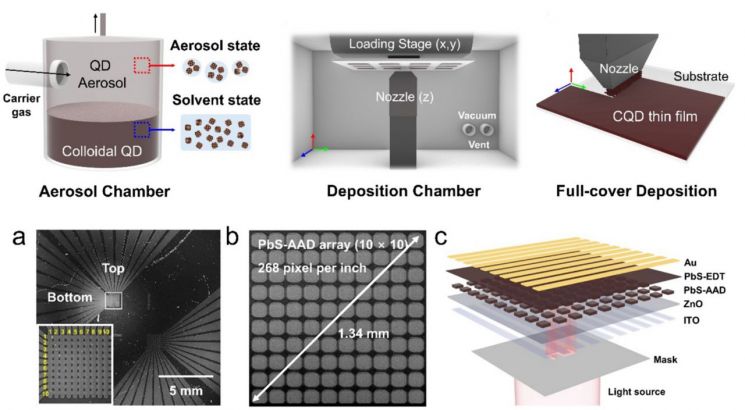
This technology utilizes Aerosol-Assisted Deposition, which enables precise patterning of quantum dot thin films without the need for complex photolithography processes. By doing so, it presents a new direction that could accelerate the commercialization of next-generation quantum dot-based infrared image sensors.
This research was published online in July 2025 in the internationally renowned journal "Chemical Engineering Journal" under the title "High-resolution infrared quantum dot photodiode Array via aerosol-assisted deposition." The study was co-first-authored by Younggyun Choi, a PhD student at Korea University, and Youngho Lee, a master's student at Dong-Eui University. Professors Sunghoon Kim (Dong-Eui University) and Seungjoo Oh (Korea University) served as co-corresponding authors.
This technology features the direct deposition of aerosolized colloidal quantum dots onto substrates, enabling the realization of high-resolution photodiode arrays at a level of 268 ppi while maintaining high photoresponsivity.
In conventional photolithography processes, degradation of the quantum dot surface frequently occurred. However, this new approach fundamentally eliminates such issues and establishes a technological foundation that ensures both the stability and performance of the device.
This result demonstrates the feasibility of a single deposition process technology that enables pixelated patterning without the need for complex photolithography processes.
This research was supported by the National Research Foundation of Korea, funded by the Ministry of Science and ICT.
Professors Seungjoo Oh and Sunghoon Kim stated, "Through this research, we have achieved a significant technological advancement that can be widely applied to next-generation SWIR sensors, gas sensors, displays, as well as in the fields of optoelectronic and energy devices."
© The Asia Business Daily(www.asiae.co.kr). All rights reserved.


















