Unprecedented Move...
"Trump's Negotiation Pattern"
As the Donald Trump administration has once again allowed U.S. semiconductor companies to export to China, Nvidia and AMD have agreed to provide 15% of their revenue from semiconductor sales in China to the U.S. government in exchange for export permits, the Financial Times (FT) reported on August 10 (local time).
According to U.S. government officials and other sources, the two companies reached this agreement last week in order to obtain export licenses for China. Nvidia is required to pay 15% of its revenue from H20 chip sales in China, while AMD must pay 15% of its revenue from MI308 chip sales.
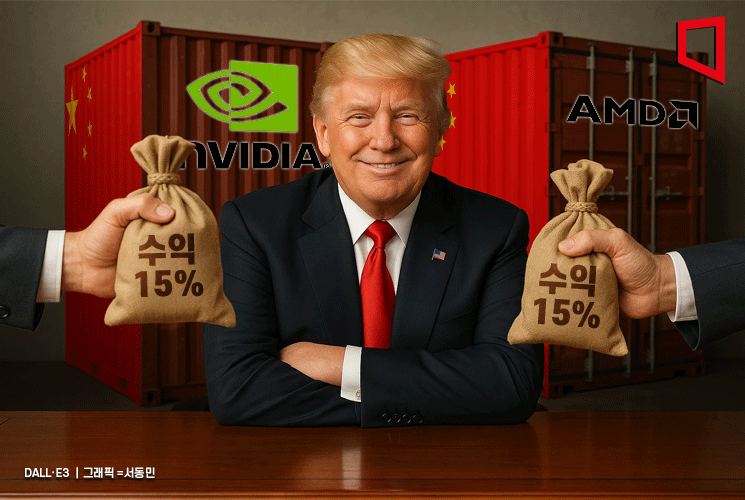
According to export experts, it is unprecedented for a U.S. company to agree to share a portion of its revenue with the government in order to secure an export license. However, the FT pointed out that this deal is typical of the Trump administration's negotiation style. President Trump has often demanded that companies invest in the U.S. in order to avoid tariffs, aiming to increase jobs and promote economic growth through such measures.
AMD did not respond to the FT's request for comment on the matter. Nvidia did not deny the report, stating, "We comply with the rules set by the U.S. government in order to participate in global markets."
The Trump administration has not yet determined how it will use the funds received in exchange for semiconductor sales. Research firm Bernstein estimated that, based on the situation before the regulations were implemented earlier this year, Nvidia could sell about 1.5 million H20 chips in China in 2025, generating $23 billion (approximately 32 trillion won) in revenue. At this rate, Nvidia would have to pay $3.45 billion.
Nvidia introduced the lower-performance H20 chip for the Chinese market after the previous Joe Biden administration restricted exports of advanced chips used for artificial intelligence (AI) development to China. In April 2025, President Trump also banned exports of the H20 chip, but abruptly reversed his position after meeting with Nvidia CEO Jensen Huang. However, even after this, the Bureau of Industry and Security (BIS) under the U.S. Department of Commerce, which oversees export controls, did not issue export licenses. On August 6, CEO Huang raised the issue with President Trump again. Shortly after their meeting, on August 8, the BIS began issuing export permits.
U.S. national security experts are criticizing the Trump administration's decision to resume H20 chip exports. Controlling the export of advanced technology to China in order to limit China's technological capabilities has been a consistent policy across previous administrations. However, with the Trump administration once again allowing exports, concerns have been raised that the H20 chip will strengthen the Chinese military and weaken U.S. competitiveness in AI. Matt Pottinger, who served as Deputy National Security Advisor during the first Trump administration, and 19 other security experts recently sent a letter to U.S. Secretary of Commerce Howard Lutnick urging him not to grant export licenses for the H20 chip.
© The Asia Business Daily(www.asiae.co.kr). All rights reserved.

















