1,009 Public Facilities and 13,315 Private Facilities Confirmed Damaged
Full-Scale Restoration to Begin in September
On August 11, Hapcheon County in South Gyeongsang Province announced that, following record-breaking heavy rainfall that lasted from July 16 to 20 and caused significant damage across the county?including to roads, homes, and farmland?it is making every effort to carry out rapid emergency restoration and support for affected residents.
The county completed the input of all damaged facilities by August 5 in order to finalize the damage assessment. The investigation confirmed a total of 14,324 cases of damage, including 1,009 cases involving public facilities and 13,315 cases involving private facilities. As of now, the emergency restoration progress rate has reached approximately 70%.
Damage to public facilities amounted to 1,009 cases, with total damages estimated at 87.5 billion won. The planned restoration budget is 156.3 billion won. In addition, 11 separate improvement and restoration projects are scheduled to have their final budgets determined in September. These projects go beyond simple restoration and focus on fundamental facility improvements to prevent similar damage in the future.
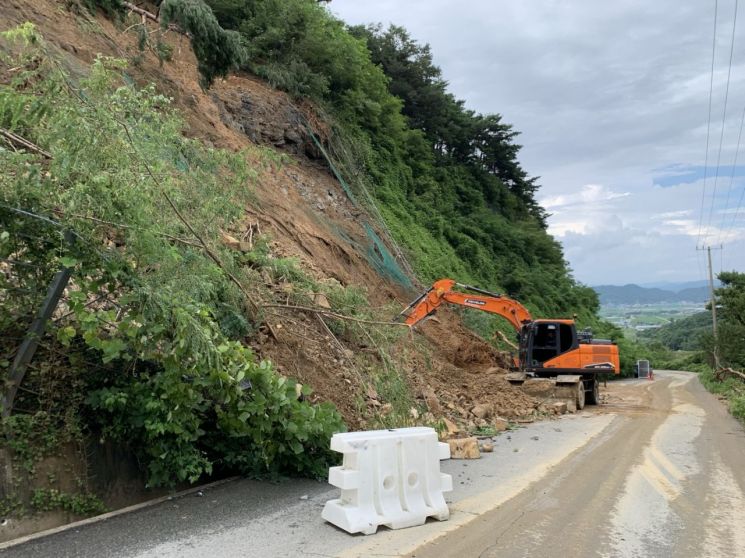 Emergency restoration of landslide on rural road No. 101 at Sinchon Reservoir, Chogye-myeon, Heupcheon County.
Damage to private facilities totaled 13,315 cases and 31.5 billion won. This includes 11,970 cases (17.3 billion won) involving farmland, crops, and agricultural and forestry facilities; 93 cases (400 million won) involving livestock facilities and livestock; 517 cases (3.9 billion won) involving homes; 409 cases (9.1 billion won) involving small business owners and SMEs; and 326 cases (800 million won) involving forest crops and other categories. Disaster relief funds will be distributed according to a separate calculation method based on the disaster index.
To support restoration, the county urgently allocated 3 billion won for emergency restoration by mobilizing special grants, special adjustment grants, and reserve funds. However, the available restoration budget falls short compared to the scale of the damage.
As a result, the county is considering additional allocations from the disaster management fund and reserve funds. It is avoiding projects that require self-restoration and is focusing emergency restoration efforts on improvement and restoration sites, such as rivers, that require long-term work, in order to prevent secondary damage. For small-scale facilities that can be repaired in September, the county plans to minimize overlapping use of county funds.
In addition, the county plans to utilize 800 million won in priority disaster response grants to commission detailed design services in August. In September, some designs will be completed, and full-scale work will begin on self-restoration and small-scale restoration projects.
County Governor Kim Yooncheol stated, "Many residents suffered significant damage from this heavy rainfall. The county will do its utmost to ensure that damage restoration and disaster relief payments are carried out swiftly, and we will focus our administrative resources on supporting the stabilization of residents' lives."
© The Asia Business Daily(www.asiae.co.kr). All rights reserved.

















