A platform has been developed that generates signaling molecules inside and outside of cells through electrical stimulation, enabling cell responses to be switched on and off like an electric switch.
On August 11, KAIST announced that a research team led by Professor Jimin Park from the Department of Biological Chemical Engineering, in collaboration with Professor Jihan Kim’s team from the same department, has developed a 'bioelectrosynthesis platform' that can generate signaling molecules such as nitric oxide and ammonia at desired moments using electrical signals. This platform allows precise control over the timing, range, and duration of cellular responses.
 (From left) Professor Jimin Park, PhD candidate Myeongeun Lee, PhD candidate Jaewoong Lee, Professor Jihan Kim. Provided by KAIST
Human cells exchange various signaling molecules to regulate neural, immune, and vascular functions. However, nitric oxide and ammonia are unstable or exist in a gaseous state, making it extremely difficult to generate or control them externally.
In contrast, the platform developed by the joint research team enables the generation and control of nitric oxide and ammonia. This is expected to serve as a core foundation for next-generation medical technologies such as electronic medicines, electro-genetics, and personalized cell therapies.
Before developing the platform, the joint research team was inspired by the action of nitrite (NO2-) reductase enzymes in the body. They succeeded in implementing an electricity-based technology that can selectively generate the biological signaling molecules nitric oxide and ammonia from a single substance (nitrite, NO2-).
Additionally, noting that the type of signaling molecule produced varies depending on the catalyst, the team used nitrite as a single precursor and selectively synthesized ammonia and nitric oxide signaling molecules using a copper-molybdenum-sulfur-based catalyst (Cu2MoS4) and an iron-containing catalyst (FeCuMoS4), respectively.
Based on this, the joint research team conducted electrochemical experiments and computer simulations, revealing that using a catalyst containing iron produces more nitric oxide, while using a catalyst without iron produces more ammonia. This demonstrated that the production ratio can be controlled depending on the catalyst used.
By switching catalysts, the team proved that nitric oxide or ammonia signaling molecules can be freely generated through electrical signals.
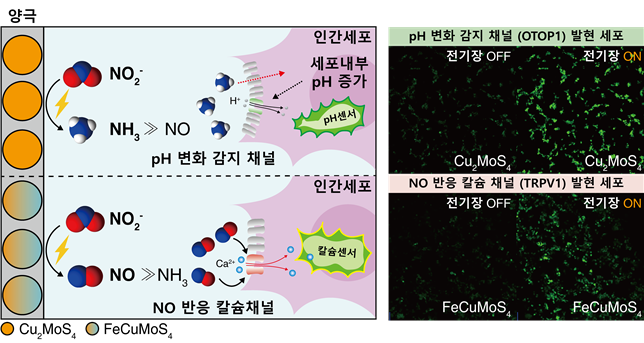 Schematic diagram of the bioelectrosynthesis platform synthesizing signaling molecules through electrical signals and results of precise control. Provided by KAIST
The joint research team also experimentally demonstrated that by adjusting the intensity and duration of the applied voltage using this platform, they could freely control the initiation, range, and termination of cellular responses. This makes it possible to regulate cell signaling just like turning an electric switch on and off.
Professor Jimin Park stated, "This research is significant in that it enables the selective production of various signaling molecules using electricity, allowing for precise control of cells," and added, "This platform also has great potential to be expanded into electronic medicine technologies targeting the nervous system or metabolic diseases in the future."
This research was supported by the National Research Foundation of Korea. PhD candidates Myeongeun Lee and Jaewoong Lee from the KAIST Department of Biological Chemical Engineering participated as first authors, and Professor Jihan Kim participated as a co-author. The research results (paper) were published on July 8 in 'Angewandte Chemie International Edition,' one of the most prestigious journals in the fields of chemistry and chemical engineering.
© The Asia Business Daily(www.asiae.co.kr). All rights reserved.


















