22 Million Tons of Annual Greenhouse Gas Emissions Reduced in One Year
1 Trillion Won in Local Consumption Generated... 240,000 Won Saved in Annual Transportation Costs
'The Gyeonggi Pass,' which allows Gyeonggi-do residents to receive partial refunds on transportation costs when using public transportation anywhere in the country, has proven effective in various areas, including reducing transportation expenses, protecting the environment, and revitalizing the local economy.
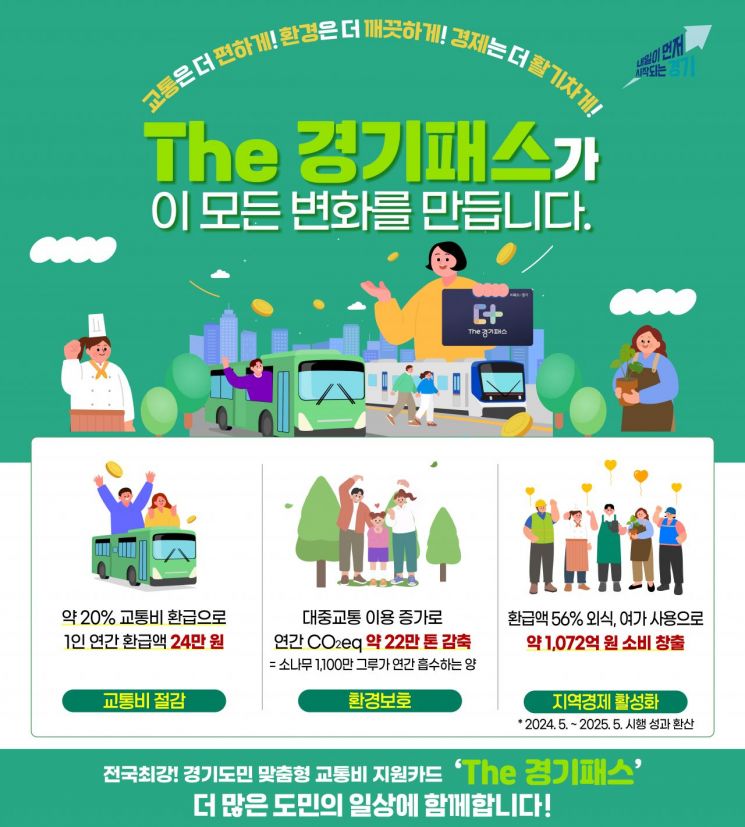
According to the report 'Socio-Economic Effects of the Implementation of The Gyeonggi Pass' published by the Gyeonggi Research Institute, since its launch in May 2024, Gyeonggi-do residents have received an average monthly refund of about 20,000 won (30%) out of their average monthly transportation expenses of 67,000 won per person through 'The Gyeonggi Pass.' This translates to an annual refund of 240,000 won.
An analysis of actual usage by refund recipients showed that the average number of monthly public transportation trips increased from 29 in May 2024 to 39 in November 2024. Based on this, the Gyeonggi Research Institute estimated that annual greenhouse gas emissions were reduced by approximately 220,000 tons of CO2 equivalent. This is equivalent to the amount absorbed in a year by 11 million 30-year-old pine trees.
In a user survey, 56% of the money saved was reported to be spent on consumption such as dining out and leisure. Based on the total refund amount of 190.8 billion won over the past year, it is estimated that approximately 107.2 billion won in consumption was generated.
'The Gyeonggi Pass' is a customized transportation cost support program that provides additional benefits to Gyeonggi-do residents based on the Ministry of Land, Infrastructure and Transport's K-Pass. The eligible age for youth has been expanded from 19-34 to 19-39, and the K-Pass limit of 60 uses per month and 2 uses per day has been lifted to unlimited. It can be used on buses, subways, metropolitan buses, GTX, and the Shinbundang Line nationwide, and supports refunds of 20% to 53% of monthly public transportation costs.
Since July 2025, Gyeonggi-do has been the first in the country to introduce an integrated transportation cost support policy that combines the advantages of both the refund-type and commuter pass systems. An additional full refund benefit is provided for usage exceeding 61 times per month under The Gyeonggi Pass. The province explained that, for usage beyond 61 times, there is virtually no additional cost, resulting in the effect of a commuter pass.
Residents who wish to use The Gyeonggi Pass can apply for a dedicated K-Pass card (credit/debit card, etc.) through the K-Pass website or individual card company websites, and then register as a member on the K-Pass website. During registration, address verification is conducted, and once Gyeonggi-do residency is confirmed, The Gyeonggi Pass benefits are automatically applied.
Yoon Taewan, Director of the Gyeonggi-do Metropolitan Transportation Policy Division, stated, "The Gyeonggi Pass is a flagship livelihood policy that goes beyond transportation welfare to address climate crisis response and local economic revitalization," adding, "We will continue to strengthen our efforts to implement transportation policies that residents can truly feel."
© The Asia Business Daily(www.asiae.co.kr). All rights reserved.