Beyond Simple Trade Expansion:
A Turning Point for Establishing a Mid- to Long-Term Industrial Security Partnership through a "Package Cooperation Plan"
The visit of To Lam, General Secretary of the Communist Party of Vietnam, to Korea is expanding the business activities of domestic companies such as Samsung Electronics, Hyundai Motor, and Hanwha, in addition to the export of K-9 self-propelled howitzers. Industry insiders are reviewing various measures, including production expansion, localization of parts, and the establishment of research and development (R&D) centers. This is interpreted as part of a strategy to simultaneously pursue supply chain stability and market diversification.
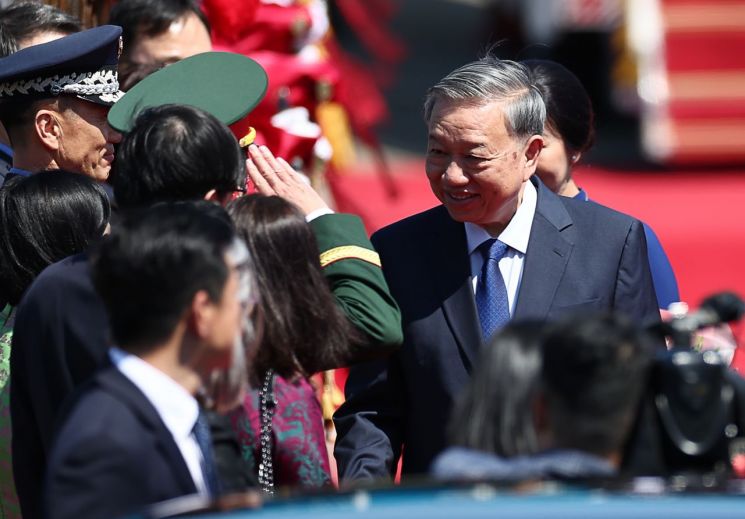 Also, Lum Vietnam Party Secretary General and his wife arrived at Seoul Airport on the 10th and are currently moving. Invited by President Lee Jae Myung, Secretary General Lum is visiting Korea on a four-day state visit until the 13th, during which he will attend a summit and state banquet on the 11th, participate in the Korea-Vietnam Business Forum on the 12th, and visit Busan on the 13th. Yonhap News
During the state banquet hosted by President Lee Jae Myung on the 11th, as well as at the business forum and individual meetings with group chairmen, various cooperation measures are expected to be discussed. The business community predicts that this summit and forum will serve as a turning point for establishing a mid- to long-term industrial security partnership through a national project "package cooperation plan," going beyond simple trade expansion.
The area where cooperation is most prominent is nuclear power. Last month, Korea Electric Power Corporation (KEPCO) invited an economic and social research delegation led by a former senior vice minister of Vietnam's Ministry of Planning and Investment to Seoul and held a nuclear power cooperation workshop. As Vietnam is considering the introduction of new nuclear power plants, Korea presented its nuclear power plant construction and operation technology, as well as its safety management know-how. The so-called "Team Korea" includes related companies such as Hyundai Engineering & Construction, Susa Industry, Doosan Enerbility, KEPCO Engineering & Construction, BHI, KEPCO Plant Service & Engineering, Hyosung Heavy Industries, Iljin Power, Taihan Electric Wire, Hyundai Construction Equipment, and HD Hyundai Infracore.
Cooperation in power infrastructure and strategic mineral development is also accelerating. LS Cable & System subsidiary LS Eco Energy is the only company in Vietnam with facilities to produce ultra-high voltage cables and is considered a key partner in building the local power grid. In May, the company discussed establishing a joint venture with the Vietnamese government and requested regulatory adjustments for business permits. The Vietnamese government has expressed a positive stance on a model that combines Korean technology with domestic resources. In addition, projects for the development and processing of rare earth elements are being concretized.
An LS Cable & System official said, "Since 2023, we have been collaborating with a Vietnamese state-owned company to build a submarine cable factory. If investment discussions take place, we are likely to discuss expanding the submarine cable factory, new power grid projects, or rare earth elements."
Amid escalating tensions between the United States and China, Vietnam is being evaluated as an alternative production base that can ease the trade structure heavily dependent on the US and China and serve as an export hub to third countries. Vietnam's importance is growing as it is considered a partner capable of cooperation across strategic industries such as rare earth elements, energy, and defense.
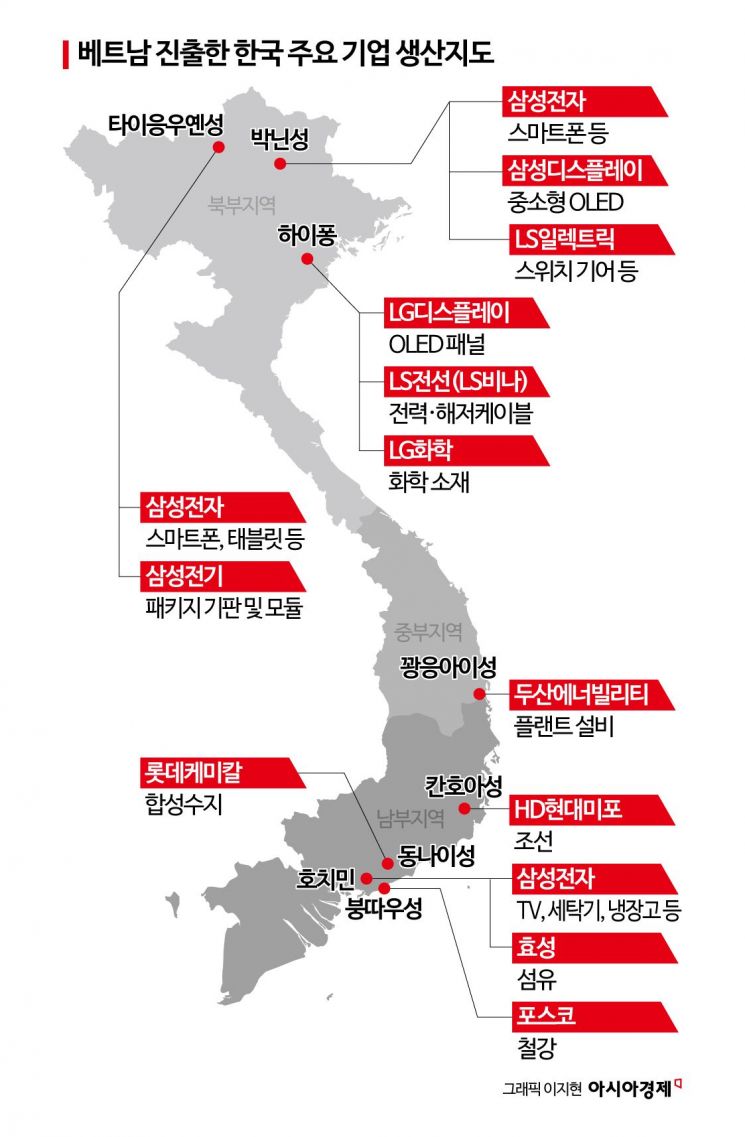
The business community is looking forward to discussing investment expansion, supply chain restructuring, and cooperation in advanced manufacturing, energy, and strategic minerals through individual meetings such as business forums and corporate roundtables.
Experts assess that Vietnam has emerged as a key region for resource security and supply chain diversification. Kim Taehwang, professor of international trade at Myongji University, said, "Vietnam may be concerned that countries such as Korea, China, and Japan could reduce their investment in Vietnam, and for us, trade could decrease in markets where we have high trade dependency." He added, "In the context of supply chain restructuring, securing key resources has become the biggest economic security issue. In the long term, it is necessary to seek ways to strengthen economic cooperation with ASEAN (Association of Southeast Asian Nations) countries, including Vietnam."
Han Areum, senior researcher at the Korea International Trade Association, diagnosed, "China continues to include rare earth elements on its export control list and uses this as leverage to exert pressure in the tariff arena, which is a ticking time bomb for companies." She added, "Cooperation with Vietnam on rare earth elements is meaningful as it is an attempt by companies to diversify supply chains and reduce uncertainty."
© The Asia Business Daily(www.asiae.co.kr). All rights reserved.


















