Analysts have pointed to the historically and economically close relationship between India and Russia as the reason why India continues to maintain friendly ties with Russia, despite the threat of a "tariff bomb" from the United States.
The Wall Street Journal (WSJ) reported on August 9 (local time) that "it will be difficult for President Donald Trump to persuade Indian Prime Minister Narendra Modi to reset relations with Russia," highlighting this dynamic.
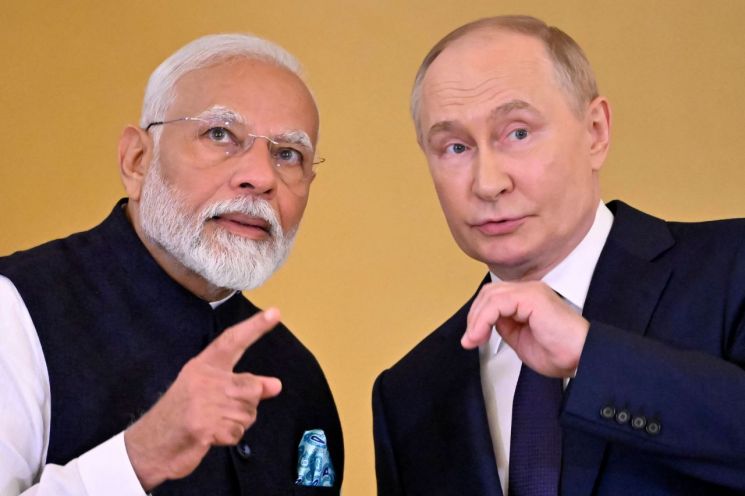
According to the report, India and Russia have maintained close ties since the Cold War era, even before the dissolution of the former Soviet Union. In particular, after the Sino-Soviet split intensified in the 1960s, the Soviet Union rapidly drew closer to India. The relationship between the two countries became even tighter as the United States supported Pakistan and imposed various sanctions on India following its nuclear tests.
Harsh Pant, director of the think tank Observer Research Foundation (ORF), stated, "Indians still see Russia as a reliable partner for historical reasons," adding, "In contrast, they have always believed that the United States leaned toward Pakistan."
As a result, India did not join the international community's sanctions against Russia after the Russia-Ukraine war. Instead, India benefited by purchasing Russian crude oil. According to ORF, last year, India purchased more than one-third of all crude oil exported by Russia, and by selling petroleum products overseas, India secured high profits.
Of course, Russia exports more crude oil to China than to India. However, due to concerns within Russia about deepening dependence on China, Russia places even greater importance on its relationship with India. Over the past three years, trade between Russia and India has surged to $69 billion (approximately 96 trillion won).
Defense is another area where India depends heavily on Russia. Soviet and Russian-made weapons account for more than half of India's military assets. Last month, India commissioned a new stealth frigate from Russia, and two more frigates are being built domestically in India with Russian technical support.
Ashley Tellis, a security expert at the Carnegie Endowment for International Peace, predicted, "Even if India could replace its Russian equipment, it would actually take several decades to achieve a complete transition."
Previously, President Trump expressed dissatisfaction with India's excessive purchases of Russian crude oil and weapons, and subsequently signed an executive order imposing an additional 25% tariff on Indian exports. As a result, the tariff rate on Indian products exported to the United States has risen to 50%.
© The Asia Business Daily(www.asiae.co.kr). All rights reserved.

















