AI Duty Manager and Public Late-night Children's Hospital Set National Standards
Health and Welfare Minister Jung Eunkyung Visits Gwangju-daum Integrated Care Site
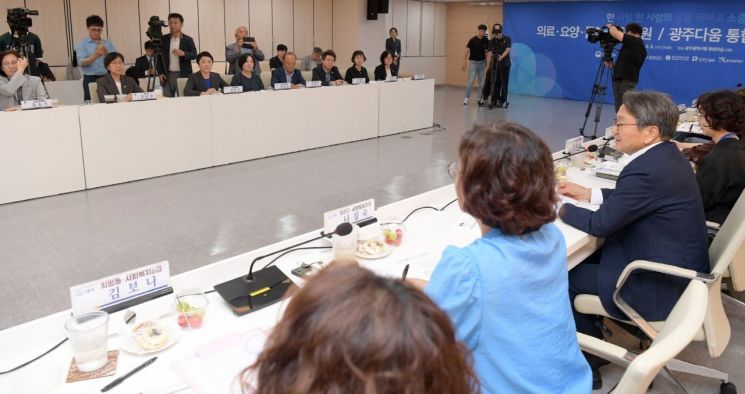 Gwangju Mayor Kang Gijeong attended the 'Care Integrated Support Implementation Field Meeting' held at the Ochi Complex Community Center in Buk-gu on the afternoon of the 6th with Health and Welfare Minister Jung Eunkyung, exchanging opinions with care officials from the city, five autonomous districts, and the National Health Insurance Corporation. Photo by Gwangju City
Gwangju City's pioneering and innovative policies are attracting nationwide attention and establishing themselves as a new administrative model for South Korea. A wide range of policies?including Gwangju-daum Integrated Care, the 10 a.m. work start support for parents of elementary school students, AI administrative services, and public late-night children's hospitals?are dramatically improving the quality of life for citizens and becoming benchmarks for other regions across the country.
According to the city on August 10, a series of 'nation's first' innovative policies spanning education, welfare, healthcare, labor, and safety?initiated proactively since the launch of the 8th popularly elected administration?are being recognized as practical alternatives for citizens' lives.
The introduction of 'AI Duty Manager' has significantly contributed to improving the inefficient night duty system in public institutions and reducing staff fatigue. The artificial intelligence (AI) system, which is capable of handling civil complaints 24 hours a day, is being evaluated as a model case that enhances the quality of administrative services while maximizing operational efficiency of personnel.
This policy is receiving even more attention after President Lee Jaemyung instructed at a senior aides meeting on July 24 to "completely overhaul the inefficient duty system to enhance vitality in the public sector." It is being recognized as a model for the President's directive.
The '10 a.m. work start for parents of elementary school students' policy was implemented for the first time in the nation to ease the difficulties of parents who struggle with sending their children to school and to create an environment where work and family can coexist. As a new form of flexible work, it is being rapidly adopted by other local governments such as Suwon City, North Gyeongsang Province, and North Jeolla Province. This policy was also introduced as an exemplary policy at the 2024 Central-Local Cooperation Meeting.
'Gwangju-daum Integrated Care,' designed to eliminate welfare blind spots, is the nation's first universal care policy that allows anyone to receive care services regardless of age, income, or health condition. It is being evaluated as a response model for a super-aged society. Now in its third year of implementation, it has evolved into the 'third-generation Gwangju-daum Integrated Care,' which combines medical services to connect 'daily life support' and 'treatment and recovery' into a single system, providing customized integrated care?such as medical, nursing, housing, meal, and mobility support?to improve citizens' quality of life.
In particular, with the 'Medical, Nursing, and Local Care Integrated Support Act' set to take effect in March next year, Health and Welfare Minister Jung Eunkyung visited Gwangju on August 6 to observe the 'Gwangju-daum Integrated Care' system in action.
The 'Public Late-night Children's Hospital,' established to address medical service gaps, is emerging as a new model for essential healthcare services by safeguarding children's right to health and alleviating parental anxiety. This policy is being recognized as an essential medical system that should be expanded nationwide.
The 'Half-price Breakfast Service for Workers,' which provides affordable and healthy meals to workers who are likely to skip breakfast, is not only promoting health but also revitalizing daily life. It is also contributing to the revitalization of the local small business economy, creating a virtuous cycle.
In addition, policies such as the 'Grandchild Caregiver Support Project' for gap care, the installation of 'banner stands' for pedestrian safety, the 'New Start Encouragement Fund' to support the independence of sexual violence survivors, and the debt adjustment cost support project for financially vulnerable groups are providing substantial support for socially disadvantaged citizens and enhancing their sense of well-being.
Mayor Kang Gijeong stated, "Gwangju City has focused on practically solving problems directly related to citizens' lives," and added, "Going forward, we will continue to create a happy Gwangju for all citizens based on the value of 'citizen-centered administration' and through sustainable innovative policies."
© The Asia Business Daily(www.asiae.co.kr). All rights reserved.

















