Oral Testimonies and Mobilization Routes of 13 Victims Revealed
To Be Announced at the "Memorial Day" Event at Jeonil Building on the 13th
City and Districts Prepare Citizen-Participatory Programs... "Remembering and Passing Down the Legacy"
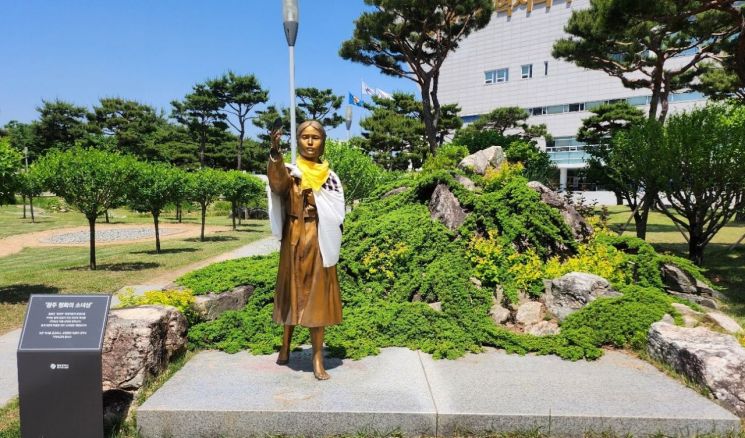
#1. Grandmother Choi Bokae was working at a textile factory in Gwangju when she boarded a train at Namgwangju Station, traveled via Yeosu, and then took a connecting ferry. After passing through Japan, she finally arrived at Palau, a remote island in the South Pacific.
#2. Grandmother Kim Taeseon (pseudonym), who was mobilized from Gangjin, spent a night at an inn in Gwangju in 1944. The next day, she boarded a freight car on the Honam Line at Gwangju Station. She endured harsh years in Myanmar (formerly Burma) in Southeast Asia.
The city of Gwangju has newly uncovered and disclosed cases of victims through its search for traces of Japanese military "comfort women" victims in the Gwangju area. Based on these findings, the city will hold a citizen-participatory memorial event, "Japanese Military Comfort Women Memorial Day," at 5 p.m. on August 13 at the multipurpose auditorium of Jeonil Building 245.
The city decided to improve the previously formalized "Memorial Day" event by infusing it with local characteristics and historical context. Last year, it commissioned the Chonnam National University Industry-Academic Cooperation Foundation (Public History Research Institute) to collect materials related to local Japanese military comfort women victims. As a result, the city confirmed oral testimonies and mobilization routes for 13 victims associated with Gwangju.
There are three other cases, in addition to Grandmother Choi, of women who were forced to work as Japanese military comfort women after being collectively mobilized to China from thread or textile factories in Gwangju. In this way, Gwangju served as an intermediate gathering point, where women who had migrated from nearby rural areas were mobilized through factories or assembled before being sent elsewhere.
Additionally, seven cases of criminal punishment related to "forced requisition" rumors from 1938 to 1944 have been discovered. The relevant court rulings show that the Japanese authorities even prosecuted people for allegedly spreading rumors to counteract the belief that "the Japanese regime is sending young girls and widows to the battlefield." These records are regarded as evidence of the fear and oppressive atmosphere experienced by women at the time.
Through this investigation, the city has revealed 12 additional cases of victims from the Gwangju area, whereas previously only Grandmother Kwak Yeenam was known among the 240 recognized Japanese military comfort women victims. Through oral testimonies, it was also confirmed that Gwangju was an intermediate gathering point for forced mobilization.
This year, the city is promoting a variety of citizen-participatory Memorial Day events. To this end, since April, it has formed a Memorial Day Event Promotion Committee (TF) with local civil society organizations and has discussed all aspects of the event.
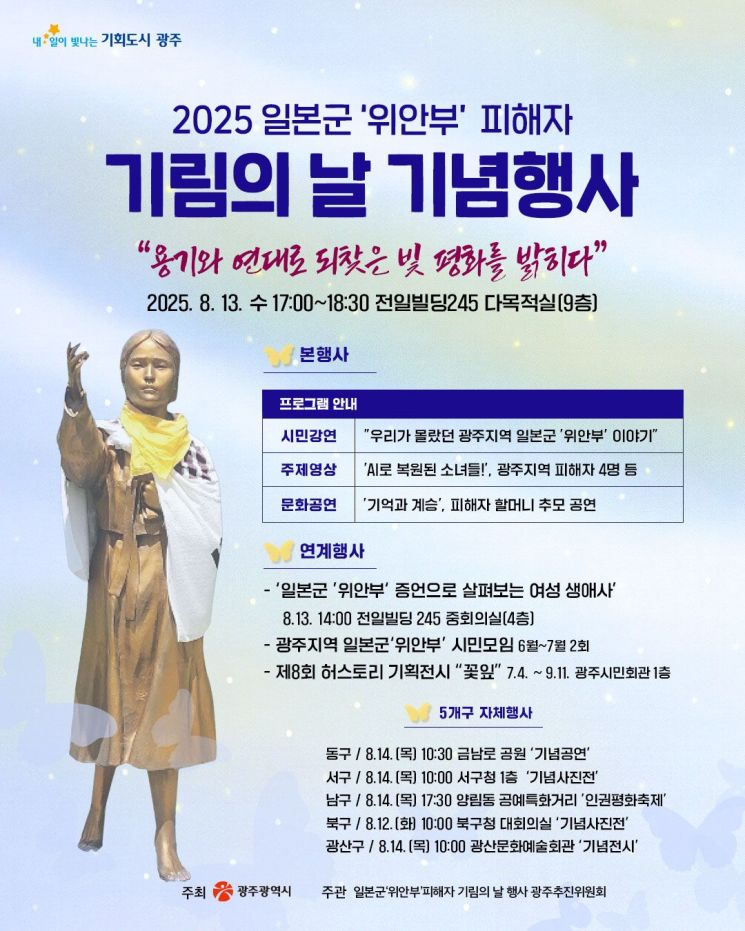
First, the "2025 Japanese Military Comfort Women Memorial Day" commemorative event will be held at 5 p.m. on August 13 at the multipurpose auditorium on the 9th floor of Jeonil Building 245, with around 300 citizens expected to attend.
The event, held under the theme "Light Regained Through Courage and Solidarity, Illuminating Peace," will feature a variety of programs, including a citizen lecture, a themed video, and cultural performances.
Lee Jeongseon, a professor in the Department of History and Culture at Chonnam National University, will deliver a citizen lecture titled "The Untold Stories of Gwangju's Japanese Military Comfort Women." This will be followed by a themed video titled "Girls Restored by AI," which will include visual materials based on photographs of four Gwangju victims taken during their lifetimes.
The cultural performance will be a memorial performance by the traditional performance group Nori-Pae Shinmyeong, and there will also be a "Calling the Names of 13 Victims" performance, along with a participatory memorial program involving the audience.
Notably, this year, the chairpersons of the Gwangju City Children's and Youth Council and the Gwangju Metropolitan Office of Education Student Council will participate, making it a meaningful occasion where both current and future generations remember and carry on this legacy together.
As a pre-event, a lecture hosted by the Japanese Military Comfort Women Research Association (theme: Women's Life History Through Testimonies of Japanese Military Comfort Women) will be held at 2 p.m. in the medium conference room of Jeonil Building 245.
The five districts will also each hold separate events to commemorate Memorial Day, starting with Buk-gu on August 12, followed by Dong-gu, Seo-gu, Nam-gu, and Gwangsan-gu on August 14, including exhibitions, performances, and human rights and peace festivals.
"Memorial Day" was designated a national memorial day in 2018 to commemorate August 14, 1991, when the late Grandmother Kim Haksoon publicly testified about her experience as a victim. Of the 240 government-registered Japanese military comfort women victims, only six are still alive, and Grandmother Kwak Yeenam, who was registered in Gwangju, passed away in March 2019.
Lee Youngdong, Director of the Department of Women and Family, stated, "Through this event, we hope to remember the courage and voices of the Japanese military comfort women victims and to reaffirm the importance of correct historical awareness and the value of human rights." He added, "In particular, with the active participation of young people, this will be a meaningful Memorial Day for remembrance and succession."
© The Asia Business Daily(www.asiae.co.kr). All rights reserved.
![Clutching a Stolen Dior Bag, Saying "I Hate Being Poor but Real"... The Grotesque Con of a "Human Knockoff" [Slate]](https://cwcontent.asiae.co.kr/asiaresize/183/2026021902243444107_1771435474.jpg)

















