Government Temporarily Allows Visa-Free Entry for Chinese Group Tourists
Aims to Boost Tourist Arrivals and Consumption; Tourism Industry Anticipates Positive Impact
The government’s decision to temporarily allow visa-free entry for Chinese group tourists from August 29 this year until June 30 next year has raised expectations in the tourism industry.
Previously, on August 6, the Ministry of Culture, Sports and Tourism and the Ministry of Justice finalized this plan after consultations with related ministries. The aim is to simplify entry procedures for Chinese tourists, who make up the largest share of inbound travelers to Korea, in order to boost tourist arrivals and stimulate consumption.
Of the 16.37 million foreign tourists who visited Korea last year, 4.6 million (28%) were Chinese, making them the largest group. The government has set a target of attracting 5.36 million Chinese tourists this year, a figure close to the pre-COVID-19 level of 6.02 million in 2019. The Bank of Korea has estimated that an increase of 1 million Chinese group tourists would raise GDP by 0.08 percentage points.
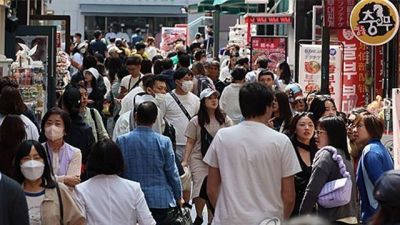
The policy is expected to significantly increase the number of group tourists, especially as it will be implemented just ahead of China’s largest holiday, National Day (October 1?7). According to data from Trip.com, bookings for group tours to Korea by Chinese travelers last year rose by 357% compared to the previous year.
The duty-free industry is also anticipating a recovery in sales with the return of “Yuke” (Chinese group tourists), who are known for their high spending. Group tourists tend to spend more per person than individual travelers, and travel agencies are likely to expand shopping itineraries to increase revenue.
On Qunar, searches for flights to Seoul surged by 120% within 30 minutes of the visa-free announcement, while on Tongcheng Travel, searches for group tour packages to Korea during National Day rose by more than 60%, reflecting a positive local response. The Ctrip Travel Research Institute expects the new measure to help attract middle-aged and family tourists and to expand demand for travel to regional cities.
Some point out that, due to China’s economic slowdown and a growing preference for individual travel since the end of the pandemic, spending power may not reach previous levels. Nevertheless, the industry is optimistic about the long-term effects, noting that group tours can serve as a first visit and may lead to subsequent individual trips.
© The Asia Business Daily(www.asiae.co.kr). All rights reserved.

















