Number of Advance Directives Surpasses 3 Million
Bill Proposed to Expand Eligibility from "Dying Process" to "Terminally Ill"
The number of people who have pledged to choose a dignified death instead of life-sustaining treatment at the end of life has surpassed 3 million. Among elderly women, one in four has expressed their intention to discontinue life-sustaining treatment.

On August 10, Yonhap News reported, citing the National Agency for Management of Life-Sustaining Treatment, that as of 9 a.m. that day, the number of people who had registered advance directives for life-sustaining treatment stood at 3,003,237. This accounts for 6.8% of the entire adult population in South Korea. It has been 7 years and 6 months since the so-called “Death with Dignity Act,” officially known as the Life-Sustaining Treatment Decision Act, was introduced in February 2018.
An advance directive for life-sustaining treatment is a document in which an individual preemptively states their decision not to initiate or to discontinue life-sustaining treatment. Anyone aged 19 or older can prepare an advance directive in anticipation of becoming a patient in the dying process.
Number of Female Registrants for Advance Directives is Twice That of Males
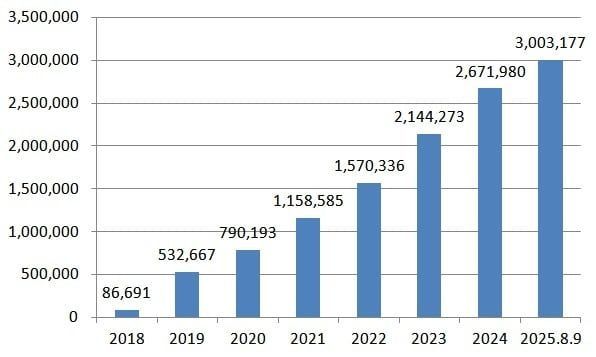 Trends in the Number of Registered Advance Directives in South Korea. National Agency for Management of Life-Sustaining Treatment
In 2018, the first year of implementation, only about 80,000 people participated. However, as participation gradually increased, the number surpassed 1 million in August 2021, after 3 years and 6 months. It then exceeded 2 million in October 2023, 2 years and 2 months later. The increase from 2 million to 3 million took less than 2 years.
As of the end of last month, the number of female registrants for advance directives stood at 1.99 million, which is twice the number of male registrants. The older the age group, the higher the registration rate. Among those aged 65 and older, one in five (21.0%) has signed an advance directive. In particular, among women aged 65 and older, about one in four (24.9%) has expressed the intention to discontinue life-sustaining treatment. The number of cases in which life-sustaining treatment was actually discontinued has reached a total of 443,874.
The number of people who have not yet registered an advance directive but intend to refuse life-sustaining treatment is also on the rise. According to a survey conducted last year by the Korea Institute for Health and Social Affairs on 1,021 adults, 91.9% responded that they would be willing to discontinue life-sustaining treatment if they became terminally ill. The proportion in favor of legalizing assisted death with dignity reached 82.0%.
There is also a growing call to expand the timing of life-sustaining treatment discontinuation, which is currently allowed only for patients in the “dying process,” to include those who are “terminally ill.” The reasons cited are that it is difficult to distinguish between terminal illness and the dying process, and that expanding the scope in line with the original intent of the law would help improve the quality of life for terminally ill patients and their families.
In a study conducted last year by the Yonsei University-Industry Collaboration Foundation at the request of the Ministry of Health and Welfare, 22 out of 27 relevant medical societies (81.5%) supported moving up the timing for discontinuing life-sustaining treatment. A bill to amend the law, led by Nam Insoon of the Democratic Party of Korea, was also submitted to the National Assembly last year.
© The Asia Business Daily(www.asiae.co.kr). All rights reserved.
![Clutching a Stolen Dior Bag, Saying "I Hate Being Poor but Real"... The Grotesque Con of a "Human Knockoff" [Slate]](https://cwcontent.asiae.co.kr/asiaresize/183/2026021902243444107_1771435474.jpg)












