Xavier Brunson Holds Press Conference
"Modernization of the ROK-US Alliance, Responding to the Changed Security Environment"
On Possible South Korean Involvement in Taiwan Strait: "Each Country Acts in Its Own Interest"
"Rushing OPCON Trans
Xavier Brunson, Commander of United States Forces Korea, recently addressed growing discussions about a potential reduction of US forces in Korea, stating, "At the operational and tactical level, numbers may be discussed, but at the strategic level, we must focus on the capabilities needed to respond to the evolving threats posed by adversaries."
During a press conference with the Ministry of National Defense press corps held on August 8 at Camp Humphreys in Pyeongtaek, Gyeonggi Province, Commander Brunson was asked about the 'modernization of the ROK-US alliance' and the subsequent adjustment of USFK's role. He responded, "As the commander, I believe that changes are necessary for USFK," elaborating on his perspective.
"Threats from North Korea, China, and Russia are growing in Northeast Asia...We must consider how to respond to the changing operational environment"
Regarding the modernization of the ROK-US alliance, Commander Brunson said, "We need to look at the context behind the term 'modernization of the ROK-US alliance.' Contextually, the Northeast Asian region has changed dramatically compared to the past." He continued, "To our north, there is a hostile force armed with nuclear weapons, Russian regional involvement is increasing, and China is also threatening a free and open Indo-Pacific region."
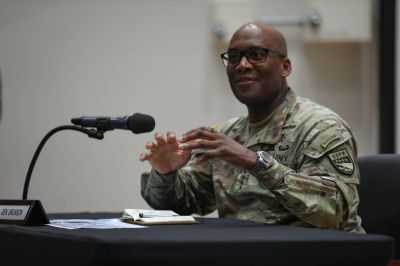 Xavier Brunson, Commander of the United States Forces Korea, is answering reporters' questions at a press conference held on the 8th at Camp Humphreys in Pyeongtaek, Gyeonggi Province. Photo by United States Forces Korea.
Commander Brunson further stated, "Modernizing the alliance means that the two militarily strong nations, the US and South Korea, must rationally assess how to navigate an operational environment that is more different than ever before in history." He added, "Since 2015-2016, there has been no discussion about the alliance and its future direction, but such discussions are essential to ensure that our alliance maintains readiness, remains valid, and jointly sustains the capabilities needed to best respond to evolving security challenges."
On the topic of adjusting USFK's role as part of alliance modernization, he said, "The region connecting South Korea, Japan, and the Philippines forms a triangle through which 52% of global trade passes. It is dangerous to believe that developments in this region will only affect the region itself." He also pointed out, "Notably, none of the agreements or treaties between the US and South Korea, such as the ROK-US Mutual Defense Treaty, specifically name any particular adversary."
He continued, "Geographically, North Korea is the closest adversary, but recently, Russia has emerged as a threat as well, given its exchanges of weapons and technology with North Korea, and the increasing closeness between China and Russia." He emphasized, "Therefore, our focus is not on responding to a specific threat, but on developing interoperability at the level of tactics, techniques, and procedures (TTP), and maintaining readiness for any situation through continued training."
Addressing concerns that South Korean forces might be drawn into a Taiwan Strait contingency, he said, "As always, each country will make decisions based on its own interests, and there is no need to conclude that South Korea must participate simply because the US would support Taiwan." He stressed, "What has been requested of South Korea is to play a greater role in dealing with North Korea, and as we modernize the alliance, to demonstrate flexibility so that USFK can also undertake other tasks if needed."
Regarding strategic flexibility, Commander Brunson said, "It is not practical for military forces to be fixed in one location. The ability to reposition strategy according to time, space, and necessity is what strategic flexibility means, and we always aim to maintain this capability." He added, "When actions involving such strategic flexibility occur, it is our command's responsibility to inform our ally, South Korea, about what we are doing."
"For USFK, the focus should be on capabilities, not numbers"
Regarding the accompanying discussion of reducing USFK numbers, he stated, "I do not focus on numbers, but on capabilities." He explained, "For example, I am considering the deployment of a Multi-Domain Effects Battalion (MDEB) under the US Army's Multi-Domain Task Force (MDTF) to help monitor, detect, and understand the operational environment, as well as the deployment of fifth-generation fighter jets to the Korean Peninsula. This is because I am always considering how to shape the operational environment by introducing new capabilities."
When asked whether this issue might be discussed at the upcoming ROK-US summit later this month, he replied, "There may be decisions regarding reduction or adjustment, but these will not be purely about numbers. Rather, the discussion will focus on the capabilities available to fulfill our mission." He added, "The Korean Peninsula is located within what is known as the First Island Chain and is adjacent to all hostile and friendly forces in Northeast Asia, which must be taken into account."
Commander Brunson also commented on the recent rotation of USFK's Patriot missile batteries from the Korean Peninsula to the Middle East, saying, "As the Commander of the United Nations Command and the Combined Forces Command, I was not pleased, but as USFK Commander, I followed the orders of the US Secretary of Defense." He continued, "Over the past six months, fifth-generation fighter jets (stealth fighters F-35) have been deployed to the Korean Peninsula to fill the gap. While it is difficult to say when the Patriot batteries will return, when they do, they will be equipped with the latest upgraded equipment."
Regarding the retirement of certain surveillance and reconnaissance assets, he said, "Some assets are being retired, but they will be replaced with new ones, and currently, we maintain at least the same level of surveillance capability as before." He added, "At present, we are considering how to maximize the advantages of space in intelligence gathering and ISR (Intelligence, Surveillance, and Reconnaissance) in cooperation with the South Korean military."
"OPCON transfer should not be rushed"
Commander Brunson expressed concern that rushing the transfer of wartime operational control (OPCON) could increase security risks. He said, "There is an OPCON transfer plan based on mutually agreed conditions, and as long as we proceed according to the agreed direction, things will go well." However, he cautioned, "If we take an easy shortcut, it could jeopardize the readiness of forces on the Korean Peninsula."
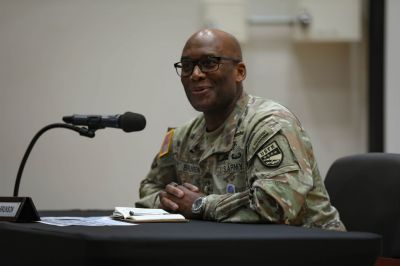
He further stated, "Rushing simply to declare the completion of OPCON transfer is not beneficial for either the US or South Korea. Until a new plan is negotiated, we must implement the current transfer conditions, and even when a new plan is discussed, it must also reflect conditions that guarantee the ability to maintain peace on the Korean Peninsula."
Regarding the current level of the South Korean military, he said, "It is an honor to command a military (the South Korean military) with such a high level of professionalism among those that a US general could lead." He added, "Even when looking at NATO or other regions, no one has a partner as competent as the South Korean military, my partner."
On the postponement of some field training exercises (FTX) for this year's Ulchi Freedom Shield (UFS) combined exercise to September, he said, "Minister of National Defense Shin Wonsik and Chairman of the Joint Chiefs of Staff Kim Myungsoo asked whether it would be acceptable to adjust some training due to extreme heat and flooding." He continued, "Although some exercises have been adjusted, training for readiness will be conducted fully. I see no problem with these decisions."
© The Asia Business Daily(www.asiae.co.kr). All rights reserved.


















